
Military VR Training: How Simulation Builds Tactical Skills
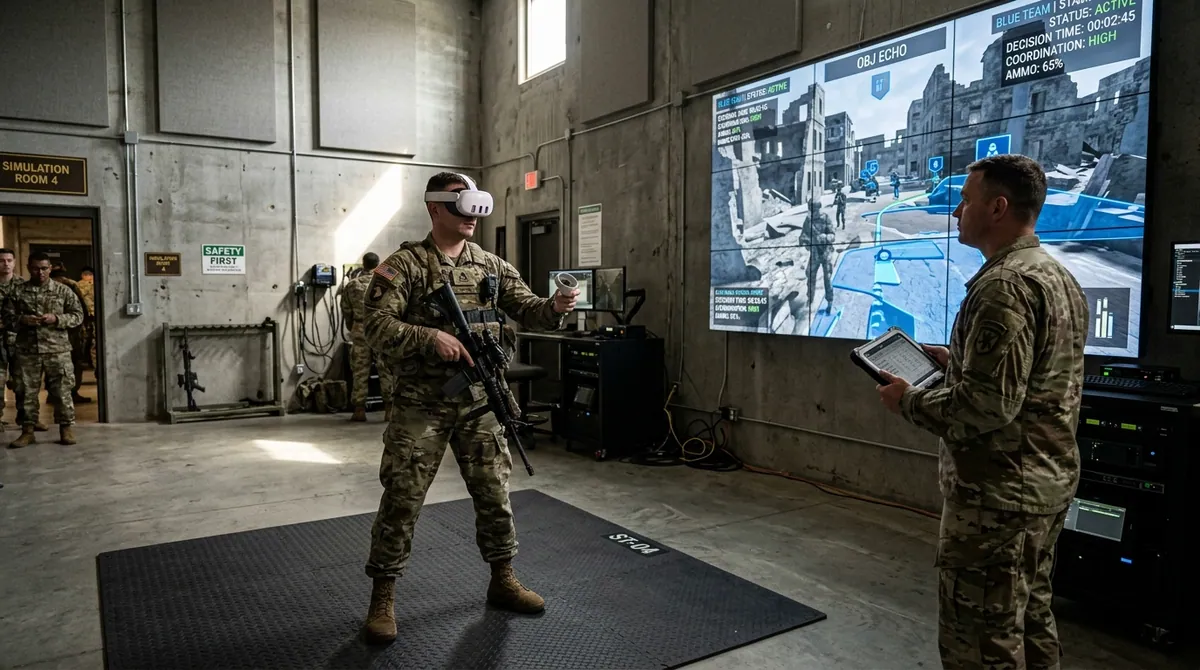
Military VR training extends effective training days by providing decision repetitions that live-range budgets cannot fund. Squads that rehearse mission scenarios in simulation before live exercises demonstrate better decision timing, reduced cognitive load, and more consistent team coordination.

Hugo Ramirez
Quick Answer
Military VR training is most effective for decision-intensive scenarios where live training is cost-prohibitive or logistically constrained: squad tactics, TCCC, vehicle egress, IED recognition, and cultural awareness. VR extends training days and builds cognitive familiarity with mission scenarios before live execution. It supplements, not replaces, live and collective training. xAPI records provide per-learner decision data for after-action review.
Why Training Days Are Not Enough
Live military training is expensive. Range time, ammunition, vehicle fuel, and safety requirements constrain how many repetitions a unit can run in a training cycle. A squad might run a given mission type two or three times before deployment. VR allows the same squad to run the same scenario decision sequence twenty times in a week, building the cognitive familiarity that converts training into reflexive performance.
The research on decision-making under stress is consistent: performance degrades under stress for tasks not well-practiced before stress exposure. VR repetitions reduce the cognitive load of a scenario, which preserves decision quality when the operational environment adds real pressure.
25%
Faster skill acquisition in VR training programs versus traditional methods (Boeing internal research on technical training)
4x
More training scenario repetitions achievable per training day in VR versus constrained live training environments (PwC, 2020)
Military VR Training by Scenario Type
| Scenario | Training Objective | VR Advantage vs Live |
|---|---|---|
| Squad tactical movement | Decision timing, formation, sector of fire | High: unlimited scenario variants, no range |
| TCCC (Tactical Combat Casualty Care) | Hemorrhage control sequence, MARCH protocol | High: decision tree, limited for procedural hands |
| Vehicle rollover and egress | Spatial orientation, egress sequence | High: no vehicle needed, scenario repeatable |
| IED recognition and route clearance | Pattern recognition, reporting protocols | High: varied environments, no inert devices needed |
| Live fire and weapons handling | Trigger control, sight picture, malfunctions | Moderate: marksmanship requires live rounds |
| Cultural awareness and language | Interaction protocols, pattern recognition | High: no foreign-language actors needed |
What We See in Defense VR Training Programs
- Units that use VR for pre-exercise mission rehearsal consistently report shorter execution times and fewer communication errors on the live exercise, because the decision sequence is familiar before real variables are added
- After-action reviews using per-individual xAPI decision data are more useful than AAR from live training because the data shows what each soldier chose at each branch point, not just the aggregate outcome
- TCCC VR programs work best when paired with hands-on manikin practice: VR builds the decision sequence and protocol, the manikin builds the physical skill of tourniquet application and pressure dressing
- Programs built for unclassified scenarios on commercial hardware are the fastest to deploy and maintain: no ATO process, no cleared personnel requirement, and headsets are replaceable at consumer pricing
Defense VR Training: Procurement and Implementation Considerations
Defense VR training procurement differs from commercial enterprise procurement in several ways that buyers should understand before issuing an RFP or sole-source justification.
- Clarify classification level upfront: Unclassified training scenarios can run on commercial off-the-shelf (COTS) hardware and software with no special clearance requirements. Classified scenarios require STIG-compliant hardware, network isolation, and potentially ATO (Authority to Operate) approval, which can add 6 to 18 months to a program timeline. Separate unclassified and classified training needs at the requirements stage, not after award.
- Define xAPI data handling requirements: xAPI records from VR training that includes mission-specific procedures or operational TTPs may require data handling controls even at the unclassified level. Work with your information security officer to define what data fields can be stored in a commercial LMS and what fields require on-premise storage before finalizing the technical architecture.
- Account for TCCC and medical scenario limitations: Tactical Combat Casualty Care (TCCC) and other medical simulation scenarios require review from your unit's medical officer or training surgeon. VR can build the decision sequence and protocol sequence, but dosing, pressure, and manual skills still require hands-on manikin time. Do not replace manikin hours with VR hours for medical certification programs.
- Plan for hardware in austere environments: If headsets will be used in field environments, specify IP rating, operating temperature range, and drop resistance requirements in your RFP. Commercial VR headsets are not rated for field use without protective cases. Add ruggedized case and transport requirements to your hardware specification.
- Pilot with one unit before installation-wide deployment: Defense programs that skip pilots and deploy directly to installation scale consistently report higher rework costs. A 6 to 8 week pilot with a single company or platoon generates the scenario feedback, usability data, and instructor training requirements that prevent costly revisions after full deployment.
When Military VR Training Is Not the Right Tool
VR simulation improves decision speed and protocol adherence in documented scenarios. It is not a substitute for all live training in any military context.
- Live fire qualification: No VR simulation satisfies live fire qualification requirements under Army, Marine Corps, Air Force, or Navy regulations. VR can reduce range time for fundamentals development, but actual qualification requires real rounds downrange on a certified range.
- Physical conditioning and endurance training: VR does not develop the physical conditioning, load-bearing endurance, or terrain navigation skill required for combat readiness. It augments decision training; it does not replace physical training.
- Classified operational planning: VR scenarios built around actual operational plans, classified TTPs, or real named area of operations require classified network environments and cleared development personnel that most commercial VR vendors cannot support.
- Leader development for senior NCOs and officers: Strategic decision-making, moral leadership, and complex command decisions are best developed through command-post exercises, simulation-assisted exercises (SAE), and war-gaming, not individual VR headset training. VR is most effective for individual and small-unit tactical skills.
Frequently Asked Questions
What military training scenarios use VR most effectively? +
VR is most effective for scenario-based decision training where the cost or risk of live training is high. High-value applications include squad movement and tactical decision exercises, medical triage under fire (TCCC), vehicle rollover and egress procedures, IED recognition and route clearance, cultural awareness and language training, and leadership and command post exercises. Live-fire ranges and physical combatives require physical training; VR supplements these with repetitions that live training budgets cannot cover.
How does military VR training compare to live training? +
VR and live training are complementary, not competitive. Live training builds the physical and environmental fidelity that VR cannot replicate. VR builds repetition volume, decision practice, and scenario variety at a fraction of the cost and without range safety constraints. A squad that rehearses a mission in VR before a live exercise performs better on that exercise because the cognitive load of the scenario is familiar. The best programs use VR to extend effective training days, not replace them.
What headsets are used for military VR training? +
Defense VR programs use both commercial platforms (Meta Quest 3, HTC Vive Focus) and military-grade systems (Varjo XR-4, Applied Research Associates systems). Commercial platforms are used for knowledge and decision training where cost and scalability matter. Military-grade systems are used for high-fidelity flight, vehicle, and weapons simulation where visual precision and tracking accuracy meet DoD specifications. The right platform depends on the training objective and classification requirements.
How does classified training content affect VR deployment? +
Classified training content requires deployment on systems certified for the applicable classification level. This typically means on-premises hardware with controlled network isolation, encrypted storage, and audit logging. Several defense VR platforms are designed specifically for classified environments and are IL5/IL6 compliant or in process for DoD Authorization to Operate (ATO). Unclassified scenario training on commercial platforms is common for foundational skills that do not expose sensitive operational details.
Can civilian VR training companies build military training programs? +
Yes. Many enterprise VR training companies build DoD and defense-adjacent programs, particularly for unclassified training content: tactical decision exercises, TCCC, cultural awareness, leadership, and equipment familiarization. Companies with ITAR compliance programs and defense industry experience are preferred. Classified content development typically requires cleared personnel and facilities, which narrows the vendor pool.
Building a defense or government VR training program?
Schedule a discovery call to discuss scenario requirements, classification constraints, and hardware platform options.