
VR Training ROI: Build the Business Case Before You Buy
A defensible VR training ROI calculation requires four inputs: current training cost, outcome cost you are preventing, expected improvement, and program cost. This framework walks through each step with real benchmarks from Boeing, Walmart, and PwC.

Hugo Ramirez
Quick Answer
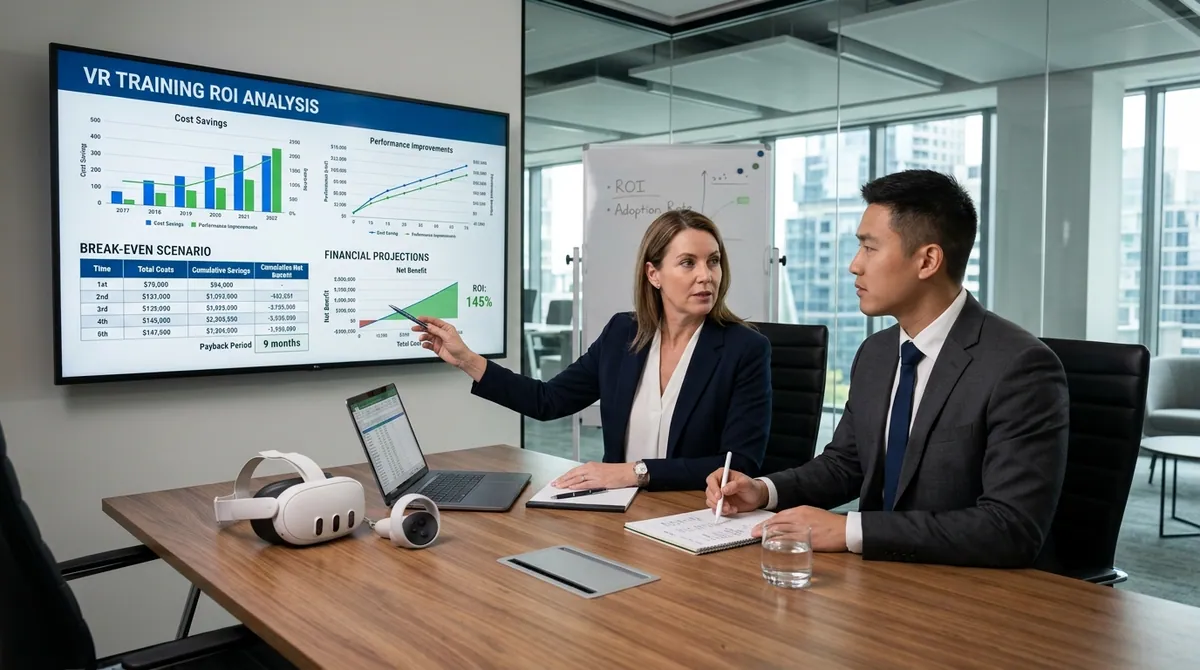
VR training ROI is calculated by comparing current fully-loaded training cost plus outcome cost (incidents, errors, ramp time) against total program cost including development, hardware, and maintenance. Most enterprise programs targeting high-stakes content reach positive ROI in 18 to 36 months. The strongest ROI cases are built on costs that already appear in your accounting, not on engagement metrics.
Why Most VR ROI Presentations Fail Finance Review
The most common mistake in a VR training business case is leading with engagement data: employees love it, retention is higher, satisfaction scores improve. These are real outcomes, but a CFO reviewing a capital expenditure proposal needs numbers that connect to the P&L.
A defensible ROI presentation quantifies costs that already exist in the business, shows how VR training reduces them, and ties the reduction to a specific dollar figure. The engagement benefits are supporting evidence, not the lead argument.
The Four-Input ROI Framework
$58K
Average cost per OSHA recordable workplace injury (National Safety Council)
25%
Improvement in production quality for VR-trained Boeing technicians
Input 1: Current training cost per employee per year
Include: facilitator salary and benefits (prorated to training time), travel and venue costs, materials and consumables, and employee lost productivity during training time. For a two-day safety training program with 200 employees at $35/hour average wage, lost productivity alone exceeds $112,000 annually before facilitator or venue costs.
Input 2: Cost of the outcomes you are preventing
For safety training: OSHA recordable incident cost averages $58,000 per incident (NSC), plus workers compensation premium impact. For sales training: revenue lost per extended ramp day. For compliance: cost of regulatory findings or audit failures. These numbers exist in your accounting. Pull them.
Input 3: Expected improvement percentage
Use conservative benchmarks: 20 to 30% incident reduction for safety programs (supported by NSC and OSHA case data), 15 to 25% ramp time reduction for procedural training (Boeing, internal case data), 10 to 20% improvement in assessment scores (PwC). Build your model on the bottom of the range.
Input 4: Total program cost
Custom VR program development typically ranges from $75,000 to $500,000 depending on scope. Add hardware (Meta Quest 3 at approximately $500 per unit, amortized over 3 years) and annual maintenance (typically 15 to 20% of development cost). For a $150,000 development with 20 headsets and 3-year amortization: approximately $63,000 per year total program cost.
| Scenario | Annual Current Cost | Annual Program Cost | Break-even |
|---|---|---|---|
| 500-employee safety program, 3 recordable incidents/yr | $174K (incidents) + $80K (training) | $63K | 14 months |
| 200-employee onboarding, 45-day average ramp | $120K (lost productivity) | $48K | 22 months |
| 100-employee compliance program, regulated industry | $60K (facilitation + travel) | $35K | 30 months |
What Makes a Business Case Survive Finance Review
- The strongest approvals come from cases that quantify a cost the CFO already knows about, such as a specific OSHA fine, a high workers comp claim, or a documented cost-per-hire problem
- Programs with a single well-defined success metric get approved faster than programs with five metrics, because one metric means one person owns the outcome
- Phased rollouts that start with a pilot cohort of 20 to 50 employees and measure outcomes before full deployment reduce perceived risk and accelerate final approval
- The most credible presentations include a sensitivity analysis: what happens to ROI if incident reduction is only 10% instead of 25%, and is the program still justified
VR Training ROI Calculator
Every figure below is yours to change. Nothing is sent anywhere, nothing is stored, and no email is required. The output is an estimate built from the numbers you enter, not a projection of savings we are promising.
- Current annual training cost
- -
- Estimated VR annualized cost
- -
- Estimated cost per learner, current
- -
- Estimated cost per learner, VR
- -
- Estimated break-even
- -
- Three-year comparison
- -
This calculator is a planning tool, not a guaranteed savings projection. Nothing you type is sent anywhere unless you choose one of the buttons above. If you request a review, the figures you entered travel with the request so the call starts from your model instead of a blank page. Your name and email are only ever collected on the contact form itself.
What this model assumes. That VR replaces the instructor-led hours you enter, that the employee still gets paid for the VR hours, and that the program and hardware are amortized straight-line across the useful life you set. It counts only hard training delivery costs.
What it deliberately leaves out. Incident and injury reduction, turnover, ramp-to-productivity, insurance and litigation exposure, and productivity lost to a worker who cannot yet perform the task. Those are usually the largest numbers in the real business case and none of them can be estimated honestly from a form. This is a floor, not a forecast, and your own data is what turns it into a business case.
How to Calculate VR Training ROI: A Step-by-Step Framework
Before engaging a VR vendor, build your ROI model independently using data you already have. This protects you from vendor-supplied projections and gives you a credible internal business case. Use the following four-input framework.
- Input 1: Training cost reduction. Calculate your current fully-loaded cost per learner for ILT (instructor salary + prep time + travel + venue + materials). Estimate post-VR cost per learner (headset amortization + content licensing + facilitation time reduction). The delta times your annual learner volume is your cost savings input.
- Input 2: Productivity improvement from faster ramp. Use this formula: (days saved in ramp) x (daily fully-loaded cost per new hire) x (annual new hire count). PwC data showing 4x faster completion suggests 10 to 15 days of saved ramp for a 6-week onboarding program. At $250/day fully loaded, 200 annual hires = $500,000 to $750,000 in productivity value.
- Input 3: Incident and error cost reduction. Pull your last 3 years of safety incident data, compliance fines, or quality error costs. A 15 to 20% reduction in incident rate is a conservative target based on published safety VR research. Apply that percentage to your current annual incident cost to get a dollar value.
- Input 4: Attrition reduction value. First-year attrition costs 50 to 200% of annual salary to replace (SHRM benchmark). If VR-supported onboarding reduces first-year attrition by 10 percentage points for a 200-person annual cohort at $50,000 average salary, the retention value is $1,000,000 to $2,000,000 annually. Use the conservative end of this range for your initial business case.
Add the four inputs, subtract total program cost (development + hardware + maintenance), and divide by program cost to get ROI percentage. A well-scoped program for a 200-person annual cohort typically shows 150 to 300% first-year ROI when all four inputs are measured correctly.
Common Mistakes in VR Training ROI Calculations
ROI models for VR training fail for three consistent reasons. Recognizing these before you build your model prevents the credibility problems that kill internal approval processes.
- Using vendor-supplied ROI projections as primary evidence: Every VR vendor has a case study that shows 300% ROI. These are marketing documents, not audited financial analyses. Use them as directional evidence only. Build your own model using your own baseline data.
- Measuring only training cost reduction: Training cost reduction is the smallest of the four ROI inputs for most organizations. L&D leaders who only model cost savings underestimate total value and produce weak business cases. Productivity and attrition are where the real numbers are.
- Projecting ROI without baseline data: If you do not have current incident rates, ramp time data, or attrition costs documented before the program launches, you cannot prove ROI after deployment. Capture baseline metrics before go-live, not after.
- Ignoring ongoing costs: Content refresh, hardware replacement (headsets depreciate over 3 to 4 years), LMS integration maintenance, and facilitator training are recurring costs. ROI models that only use upfront development cost systematically overstate returns in years 2 and 3.
Frequently Asked Questions
What is a realistic ROI timeline for a VR training program? +
Most organizations with 200 or more employees training on high-stakes content reach positive ROI in 18 to 36 months. Programs targeting safety training with measurable incident costs often break even faster, sometimes in 12 to 18 months. Programs focused on soft skills or compliance take longer because the cost baseline is less concrete.
What data do I need to calculate VR training ROI? +
You need four inputs: (1) current fully-loaded training cost per employee per year, including facilitator time, materials, travel, and lost productivity; (2) the cost of the outcomes you are trying to prevent, such as incidents, errors, or extended ramp time; (3) expected improvement percentages from vendor case studies or industry benchmarks; and (4) total program cost including development, hardware, and ongoing maintenance.
How do I account for hardware costs in the ROI calculation? +
Amortize hardware costs over the expected device lifecycle, which is typically 3 to 4 years for enterprise VR headsets. A Meta Quest 3 at $500 per unit amortized over 3 years costs approximately $167 per unit per year. For a 20-headset deployment, that is $3,340 per year in hardware cost, which is often lower than annual consumable costs for equivalent hands-on training.
What are the most defensible ROI claims for VR training? +
The most defensible claims are tied to costs that already appear in your accounting: OSHA recordable incident costs (average $58,000 per incident per NSC), workers compensation premiums, facilitator salaries and travel, and new hire ramp time expressed in revenue per day. Softer claims like engagement or confidence improvement are real but harder to defend in a capital expenditure review.
How do competitors justify VR training investment? +
Boeing reported 25% improvement in production quality for technicians trained in VR. Walmart deployed VR to 1 million employees and reported improved assessment scores and faster completion. STRIVR clients report up to 96% retention rates versus 10% for video-based training. These benchmarks provide external validation when your own pre-implementation data is limited.
Building your VR training business case?
Schedule a discovery call to scope your program, get accurate cost estimates, and build a defensible ROI model.