
WHMIS VR Training for Canadian Warehouses and Plants: Labels, SDS and Safe Handling
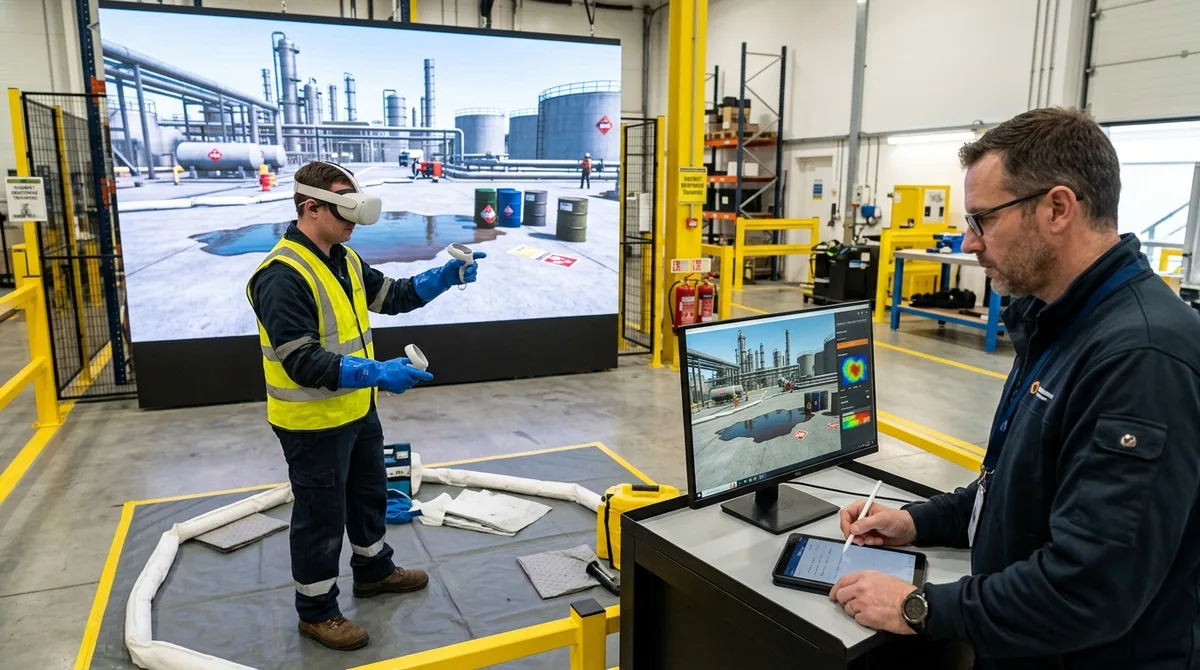
VR WHMIS scenario for Canadian warehouses: reading supplier and workplace labels, finding the SDS, decanting safely and acting on a leaking container.
QUICK ANSWER
WHMIS is Canada's hazard communication system for hazardous products at work. It relies on supplier labels, workplace labels, safety data sheets and worker education. A VR warehouse lets workers practise reading labels and using an SDS under time pressure instead of only in a classroom.
What the Rule Requires
WHMIS (Workplace Hazardous Materials Information System), CCOHS guidance: WHMIS aligns with the Globally Harmonized System and has three main elements: hazard classification and labels on hazardous products, safety data sheets, and worker education and training. Federal, provincial and territorial occupational health and safety laws require employers to apply it in the workplace.
The scenario is a third-party logistics warehouse in Calgary that stores cleaning chemicals and coatings. A pallet arrives with a damaged drum, a worker has decanted a product into an unlabelled spray bottle and the SDS binder at the dock is out of date.
Hazards in This Scenario
- Unlabelled secondary containers
- Incompatible products stored together
- Leaks from damaged containers
- Missing or outdated safety data sheets
The Procedure the Scenario Rehearses
- Read the supplier label pictograms and signal word
- Find the current SDS before handling
- Apply a workplace label when decanting
- Separate incompatible products
- Isolate and report a leaking container
- Use the PPE the SDS specifies
Mistakes the Scenario Is Built to Catch
- Using an unlabelled bottle
- Relying on memory instead of the SDS
- Stacking oxidizers near flammables
- Cleaning a spill without checking the product
Competence Assessment Matrix
| Decision point | What the assessor sees | Pass standard |
|---|---|---|
| Labels | Pictograms and signal word | Read correctly |
| SDS | Current sheet found | Before handling |
| Decanting | Workplace label applied | Every container |
| Leaks | Response | Isolated and reported |
What VR Covers
- Labels and pictograms read in context
- An SDS lookup under pressure
- A leak response with no real exposure
- Records per worker of each decision
What VR Does Not Replace
- Site-specific WHMIS education
- Spill kits and drills
- Up-to-date SDS management
Scope of a One-Scenario Pilot
A pilot builds this scenario as a single module, in Unity or Unreal Engine depending on the visual fidelity the task needs and the headsets on site. It runs on standalone headsets, logs every learner decision, and exports a per-person record for your training file. It is measured against your current method with a test cohort before anything is scaled.
Frequently Asked Questions
What are the elements of WHMIS?
Labels, safety data sheets and worker education and training, applied under federal, provincial and territorial law.
Does VR meet WHMIS education requirements?
It supports them. Employers still provide site-specific education on their own products.
Why practise with real-looking labels?
Workers learn to read pictograms and signal words fast when a container is damaged or unlabelled.
Want this scenario built around your site?
We review your current procedure and tell you which parts can be rehearsed in VR and which still need hands-on practice.
Map Your Highest-Risk Scenario