
Forklift and Materials Handling VR Training for Federally Regulated Canadian Sites (COHSR, Part XIV)
VR forklift scenario for federal ports, rail yards and airports: pre-use checks, pedestrians, load stability and operator instruction under COHSR Part XIV.
QUICK ANSWER
Part XIV of the Canada Occupational Health and Safety Regulations covers materials handling equipment in federally regulated workplaces, including inspection of equipment and instruction and training for the people who operate it. A VR yard lets operators practise pedestrian awareness and load handling where a mistake costs nothing.
What the Rule Requires
Canada Occupational Health and Safety Regulations (SOR/86-304), Part XIV Materials Handling: Part XIV applies to materials handling equipment in federally regulated workplaces. It requires the equipment to be inspected and maintained, operators to be instructed and trained in its safe operation, and the work to be arranged so that people on foot are protected from moving equipment and loads.
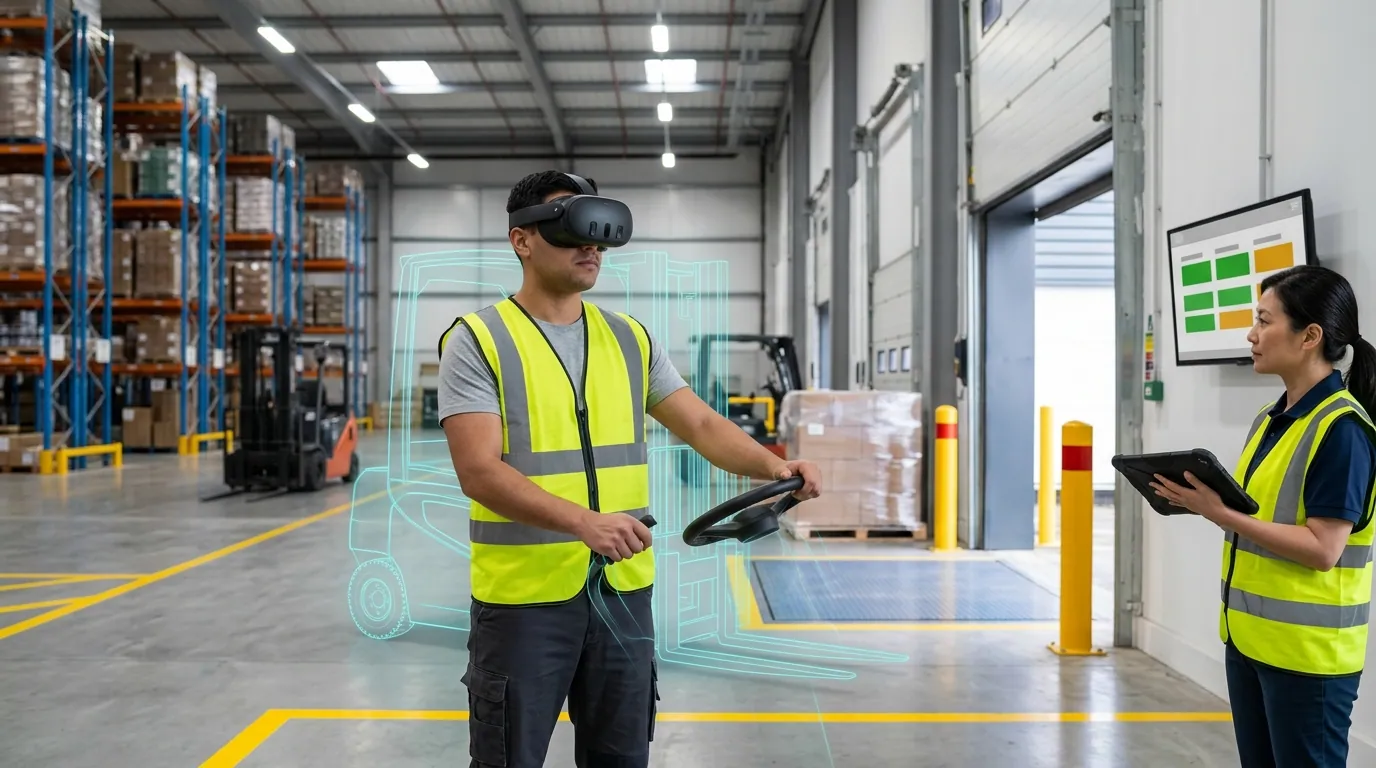
The scenario is an air cargo warehouse at Toronto Pearson. A night shift operator moves uneven pallets of mixed freight between the dock and the racking, a walkway line has faded and ground crew cut through the aisle to reach the apron.
Hazards in This Scenario
- Pedestrians struck in shared aisles
- Unstable mixed loads
- Tip-over when turning with a raised load
- Defects missed at the start of shift
The Procedure the Scenario Rehearses
- Complete the pre-use inspection
- Check the load is stable and within capacity
- Travel with the load low
- Sound the horn at blind corners
- Stop when people enter the aisle
- Park with forks down and power off
Mistakes the Scenario Is Built to Catch
- Skipping the inspection on a busy night
- Turning with forks raised
- Assuming pedestrians will move
- Carrying an uneven load as is
Competence Assessment Matrix
| Decision point | What the assessor sees | Pass standard |
|---|---|---|
| Inspection | Pre-use check | Every shift |
| Load | Stability and capacity | Checked before lift |
| Travel | Forks low and speed | Correct |
| People | Pedestrian response | Stopped and yielded |
What VR Covers
- Pedestrians who behave like real crews
- Load shifts made visible
- Tip-over risk without a real truck
- Scored runs per operator
What VR Does Not Replace
- Hands-on operator training on the real truck
- Traffic management planning
- Equipment maintenance records
Scope of a One-Scenario Pilot
A pilot builds this scenario as a single module, in Unity or Unreal Engine depending on the visual fidelity the task needs and the headsets on site. It runs on standalone headsets, logs every learner decision, and exports a per-person record for your training file. It is measured against your current method with a test cohort before anything is scaled.
Frequently Asked Questions
Which Canadian rule covers forklifts at federal sites?
Part XIV of the COHSR covers materials handling equipment in federally regulated workplaces.
Do provincial sites follow the same rule?
No. Provincially regulated workplaces follow their own provincial regulations.
Is VR operator certification?
No. Operators still need practical training and evaluation on the equipment they use.
Want this scenario built around your site?
We review your current procedure and tell you which parts can be rehearsed in VR and which still need hands-on practice.
Map Your Highest-Risk Scenario