
Working at Heights VR Training for Ontario Construction Projects (O. Reg. 213/91 and O. Reg. 297/13)
VR working at heights scenario for Ontario construction: s.26 fall hazards, guardrails before harnesses, anchor choice and practice alongside CPO-approved training.
QUICK ANSWER
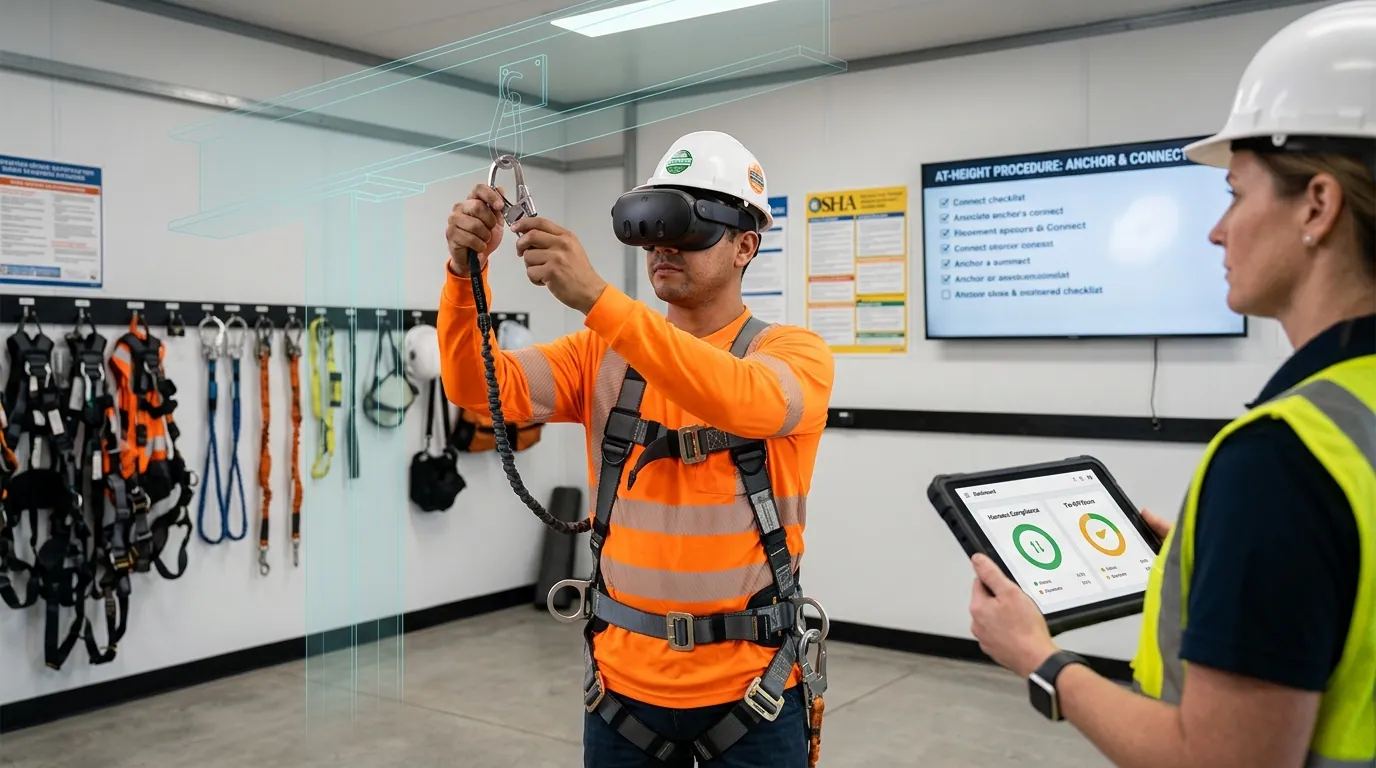
Ontario sets out the fall hazards that trigger protection in section 26 of the Construction Projects regulation, and O. Reg. 297/13 requires workers on construction projects who may use fall protection to complete a working at heights program approved by the Chief Prevention Officer. A VR scenario adds repeated practice of the decisions that program teaches.
What the Rule Requires
O. Reg. 213/91 Construction Projects and O. Reg. 297/13 Occupational Health and Safety Awareness and Training: section 26 of O. Reg. 213/91 lists the situations where sections 26.1 to 26.9 apply, including a possible fall of more than 3 metres, a fall into operating machinery, into water or another liquid, onto a hazardous substance or object, or through an opening in a work surface. O. Reg. 297/13 requires working at heights training for construction workers who may use a fall protection method, delivered by a provider approved by the Chief Prevention Officer, with a validity period set in the regulation.
The scenario is a mid-rise residential frame in the Greater Toronto Area. A floor opening for a stair is covered with loose plywood, the perimeter guardrail is missing one panel where a hoist landing was moved, and a worker is about to tie off to a vent pipe to reach a beam.
Hazards in This Scenario
- Falls of more than 3 metres from slab edges
- Falls through unsecured floor openings
- Anchors that cannot hold an arrest load
- Falls onto rebar or other objects below
The Procedure the Scenario Rehearses
- Check the section 26 triggers on the actual task
- Restore guardrails before anyone works near the edge
- Secure and mark covers over floor openings
- Choose an engineered or rated anchor point
- Inspect the harness, lanyard and connectors before use
- Know the rescue method before going up
Mistakes the Scenario Is Built to Catch
- Treating a cover as safe without checking it is fixed
- Tying off to piping or conduit
- Using a harness where a guardrail could be replaced
- Expired working at heights card
Competence Assessment Matrix
| Decision point | What the assessor sees | Pass standard |
|---|---|---|
| Triggers | Section 26 hazards identified | All named before work |
| Edges | Guardrail gap found | Restored before access |
| Anchors | Anchor selected | Rated or engineered |
| Openings | Floor cover checked | Secured and marked |
What VR Covers
- Openings and edges placed where real sites hide them
- Anchor choices with visible consequences
- Height exposure with no fall risk
- Scores per worker for the supervisor
What VR Does Not Replace
- The CPO-approved working at heights program
- Hands-on harness fitting
- A site-specific rescue plan
Scope of a One-Scenario Pilot
A pilot builds this scenario as a single module, in Unity or Unreal Engine depending on the visual fidelity the task needs and the headsets on site. It runs on standalone headsets, logs every learner decision, and exports a per-person record for your training file. It is measured against your current method with a test cohort before anything is scaled.
Frequently Asked Questions
Is VR accepted as Ontario working at heights training?
No. The mandatory program must be approved by the Chief Prevention Officer and delivered by an approved provider. VR is a practice layer before and after it.
When does Ontario require fall protection on construction?
Section 26 of O. Reg. 213/91 lists the triggers, such as a possible fall of more than 3 metres or a fall into machinery or water.
Does this cover refresher needs?
It helps workers keep the decisions fresh between formal refreshers, and the record shows who practised.
Want this scenario built around your site?
We review your current procedure and tell you which parts can be rehearsed in VR and which still need hands-on practice.
Map Your Highest-Risk ScenarioFurther reading
- Trench and Excavation VR Training for Ontario Construction (O. Reg. 213/91, Part III)
- Heat Stress VR Training for BC Construction and Wildfire-Season Crews (WorkSafeBC Part 7)
- Fall protection VR training
- Scaffolding safety requirements
- All VR training scenarios: Canada
- VR pilot readiness checklist
- How VR training programs are priced