
Confined Space Entry VR Training for Ontario Workplaces (O. Reg. 632/05)
VR confined space scenario for Ontario municipal and industrial crews: hazard assessment, the entry permit, the attendant and on-site rescue under O. Reg. 632/05.
QUICK ANSWER
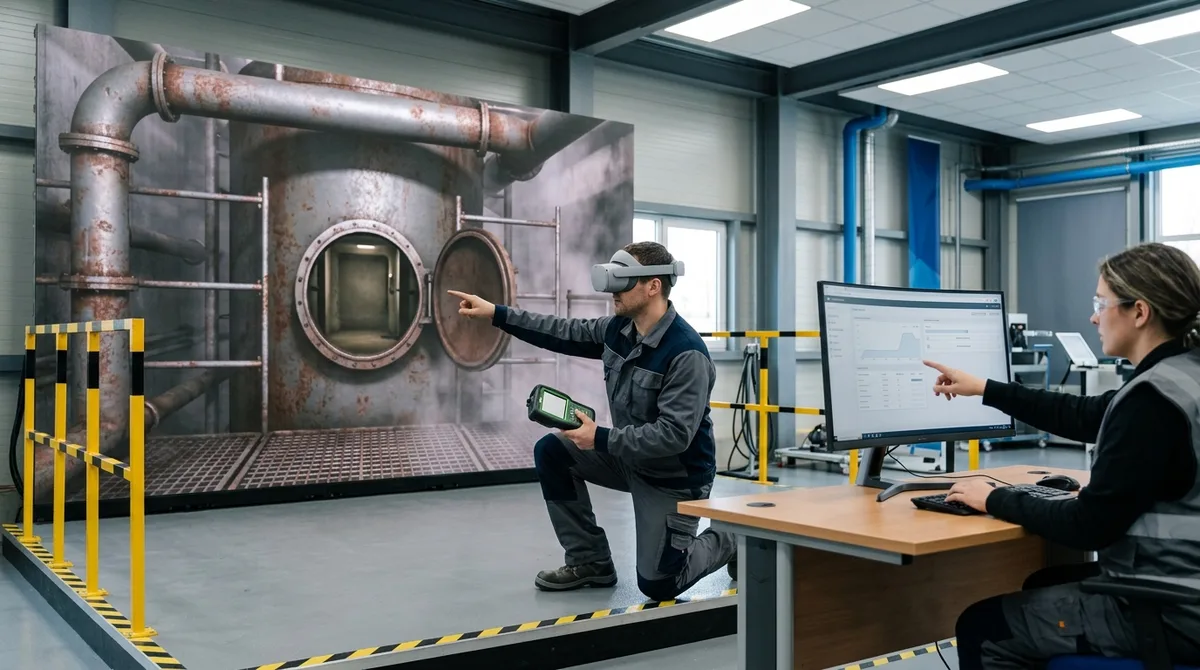
O. Reg. 632/05 requires an assessment and a plan before anyone enters a confined space in Ontario, an entry permit for each entry, an attendant outside, and rescue procedures that can be put into effect on site. A VR chamber lets crews rehearse the permit and the rescue call without a real atmosphere.
What the Rule Requires
O. Reg. 632/05 Confined Spaces: employers must have a program, a hazard assessment and a written plan for confined spaces. An entry permit is required for each entry (section 10), on-site rescue procedures must be developed and ready to put into effect (section 11), rescue equipment and a means of communication must be provided (section 12), and an attendant must be stationed outside the space (section 15).
The scenario is a municipal sewage pumping station in southwestern Ontario. A crew must replace a float switch in a wet well. The permit is drafted, the gas detector is in the truck, and the retrieval tripod has not been set up because the job is expected to take ten minutes.
Hazards in This Scenario
- Hydrogen sulphide and low oxygen in the wet well
- Engulfment if a pump starts
- Entrants who collapse out of reach
- Would-be rescuers entering without protection
The Procedure the Scenario Rehearses
- Read the hazard assessment and plan for this space
- Test the atmosphere before and during entry
- Isolate pumps and inflow before entry
- Complete and sign the entry permit
- Station the attendant with communication
- Set up retrieval equipment before anyone enters
Mistakes the Scenario Is Built to Catch
- Short job used as a reason to skip the permit
- Detector left in the truck
- Attendant doing another task
- Coworker entering to help a collapsed entrant
Competence Assessment Matrix
| Decision point | What the assessor sees | Pass standard |
|---|---|---|
| Assessment | Plan reviewed | Read before entry |
| Atmosphere | Test before and during | Continuous |
| Permit | Completed and signed | Before entry |
| Rescue | Retrieval rigged | Ready before entry |
What VR Covers
- The permit sequence in the right order
- Atmosphere readings that change during the job
- A rescue call with no real gas
- Records of each step per crew member
What VR Does Not Replace
- The employer program and written plan
- Gas detector calibration and bump testing
- Live rescue drills with the equipment
Scope of a One-Scenario Pilot
A pilot builds this scenario as a single module, in Unity or Unreal Engine depending on the visual fidelity the task needs and the headsets on site. It runs on standalone headsets, logs every learner decision, and exports a per-person record for your training file. It is measured against your current method with a test cohort before anything is scaled.
Frequently Asked Questions
What does O. Reg. 632/05 require before entry?
A program, a hazard assessment, a written plan, an entry permit for each entry, an attendant and on-site rescue procedures.
Why rehearse rescue in VR?
Many confined space deaths are rescuers. VR lets the attendant practise calling for rescue instead of going in.
Is VR enough for competent entrants?
No. It supports training and drills with real equipment.
Want this scenario built around your site?
We review your current procedure and tell you which parts can be rehearsed in VR and which still need hands-on practice.
Map Your Highest-Risk Scenario