
Electrical Safety VR Training for Federally Regulated Canadian Workplaces (COHSR, Part VIII)
VR electrical scenario for federally regulated ports, rail and telecom: isolation, guarding live parts and qualified work under COHSR Part VIII.
QUICK ANSWER
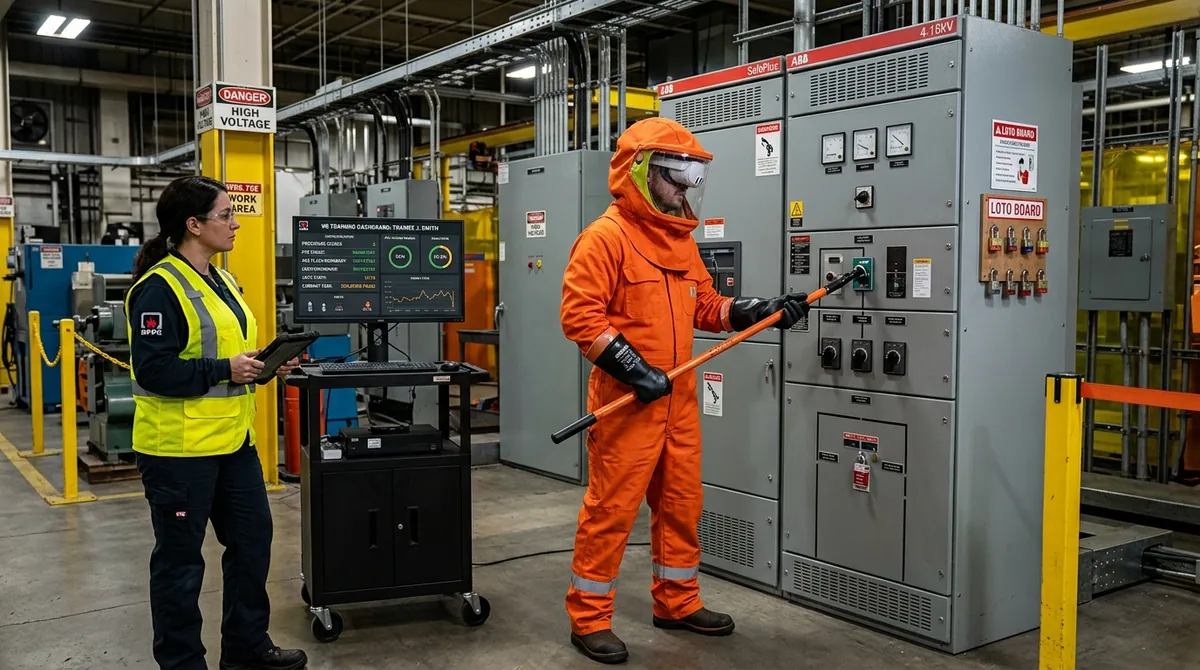
Federally regulated workplaces in Canada, such as ports, railways, interprovincial pipelines and telecommunications, follow the Canada Occupational Health and Safety Regulations. Part VIII covers electrical safety, including isolating equipment before work and protecting workers near live parts. A VR substation lets technicians practise the isolation and testing steps.
What the Rule Requires
Canada Occupational Health and Safety Regulations (SOR/86-304), Part VIII Electrical Safety: Part VIII of the COHSR applies to electrical work in federally regulated workplaces. It requires electrical equipment to be isolated and guarded before work is done on or near it, limits work on live equipment to qualified persons with appropriate procedures and protection, and requires safe work practices around energized parts.
The scenario is a container terminal in the Port of Vancouver. A crane power feeder fault must be traced inside a switchgear room. The single-line diagram is old, two breakers carry similar labels and a contractor technician is waiting to start.
Hazards in This Scenario
- Contact with conductors believed to be dead
- Arc flash during switching
- Back-feed from another source
- Unqualified people near live parts
The Procedure the Scenario Rehearses
- Confirm the correct equipment on the drawing and in the field
- Isolate and lock the source
- Test for absence of voltage with a verified tester
- Check for back-feed paths
- Wear PPE rated for the task
- Keep unqualified people outside the boundary
Mistakes the Scenario Is Built to Catch
- Trusting old labels
- Skipping the tester check before and after
- Ignoring a second source
- Letting a visitor stand at the panel
Competence Assessment Matrix
| Decision point | What the assessor sees | Pass standard |
|---|---|---|
| Identify | Equipment confirmed | Drawing matches field |
| Isolate | Lock applied | At the right source |
| Test | Absence of voltage | Verified tester used |
| Boundary | Unqualified people | Kept out |
What VR Covers
- Mislabelled gear that must be caught
- Arc flash consequences without injury
- The test-before-touch habit repeated
- Step records per technician
What VR Does Not Replace
- Qualified person training
- Updated single-line diagrams
- Live switching under supervision
Scope of a One-Scenario Pilot
A pilot builds this scenario as a single module, in Unity or Unreal Engine depending on the visual fidelity the task needs and the headsets on site. It runs on standalone headsets, logs every learner decision, and exports a per-person record for your training file. It is measured against your current method with a test cohort before anything is scaled.
Frequently Asked Questions
Who follows the COHSR?
Federally regulated employers, such as ports, rail, interprovincial transport, pipelines, banks and telecommunications.
What does Part VIII cover?
Electrical safety, including isolation, guarding and work on or near live equipment.
Can VR qualify an electrician?
No. It builds safe habits for people who are already training or qualified.
Want this scenario built around your site?
We review your current procedure and tell you which parts can be rehearsed in VR and which still need hands-on practice.
Map Your Highest-Risk Scenario