
VR Hospitality Training
For hotel groups, resorts, cruise operators, airlines, airport ground handlers and multi-location restaurant brands. A guest at property 12 gets a different experience than a guest at property 3, not because the standard is different, but because the training that delivers the standard is inconsistent across shifts, trainers and languages. Below: the scenarios a program can cover, how roleplay branching works, multi-language rollout, what a pilot costs, and what you need to provide.
Request a Discovery CallThe call starts with your brand standard and your properties, not a sales deck.
QUICK ANSWER
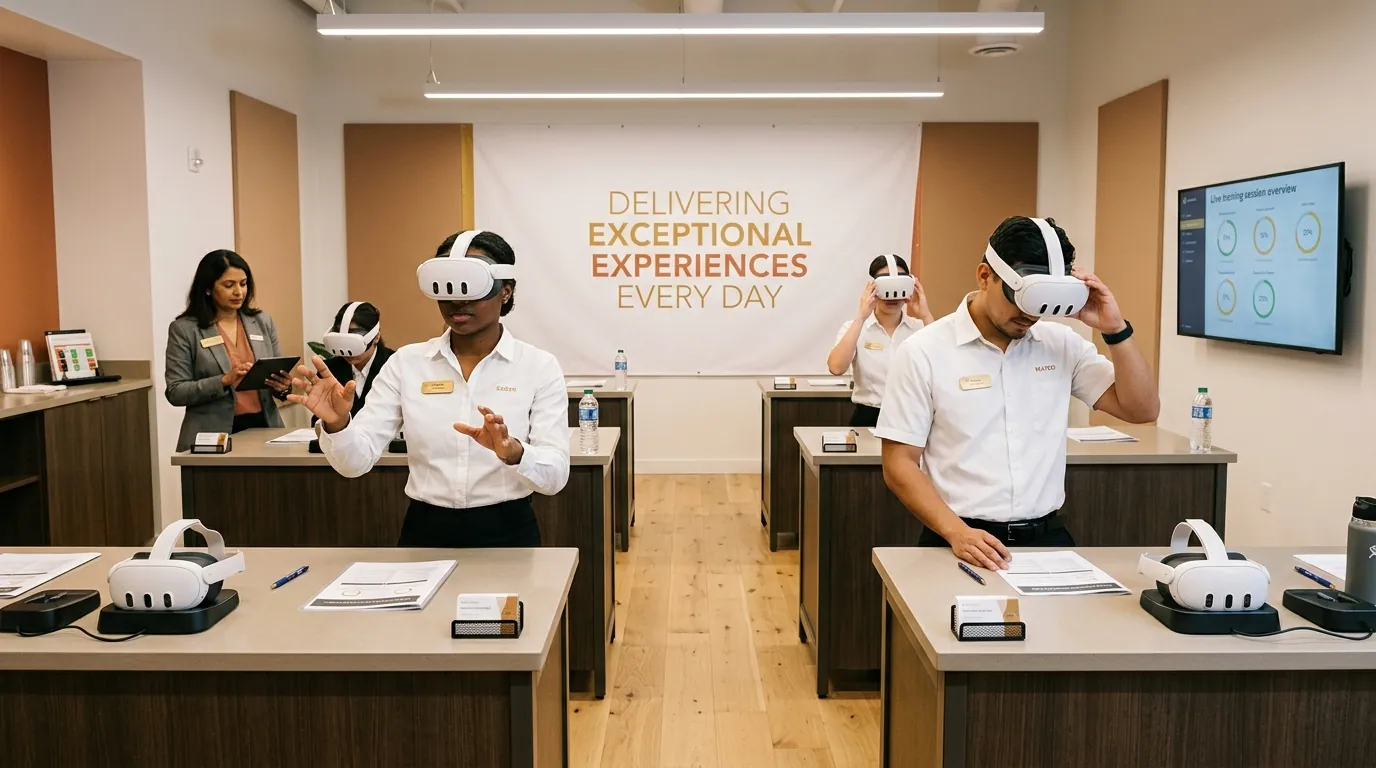
VR hospitality training delivers the same scenario, the same service standard and the same assessment to every employee at every property, in every language, without trainer variability or an inconsistent roleplay partner. Programs cover front desk and guest service, complaint de-escalation, food safety, housekeeping standards, emergency procedures, cruise cabin operations and airport ground handling. The industry results are public: Hilton reported that 87% of team members showed improved on-the-job behavior after its VR empathy program, and Best Western reported a 71% drop in customer complaints after VR training for front-desk employees. Programs are built from your brand standards, start near $30,000 for a single-scenario pilot, and run 8 to 12 weeks.
Who This Is For
The common thread is not the industry, it is the shape of the problem: a guest-facing decision, made by a frontline employee, repeated across many properties, shifts and languages, where the brand carries the consequence.
Hotels, resorts and restaurant groups
Front desk, housekeeping, F&B service, complaint handling, brand standards across properties and franchisees.
Cruise operators
Cabin service, guest interaction, muster and emergency procedures, onboarding crews who join mid-season from many countries.
Airlines, airports and ground handlers
Ramp and turnaround safety, ground service procedures, passenger-facing service, and the aviation hospitality layer between the two.
Hospitality schools and training providers
Organizations that deliver hospitality, aviation and cruise programs to their own learners and need scenario practice at scale.
This is built for L&D directors, training managers, operations directors, brand standards leads, and academy directors. The trigger is usually a quality audit, a complaint trend, a new property opening, or a turnover rate that outruns the training program's ability to keep up.
Scenarios a Hospitality Program Can Cover
Each is modeled on your brand standard and your property, not a generic hotel. This is where most programs start:
Guest service and front desk
Check-in under pressure, a room that is not ready, an overbooking, a VIP arrival, a language barrier. The employee makes the call and the guest reacts accordingly.
Guest complaint de-escalation and conflict resolution
The single most requested hospitality scenario. An upset guest, a real grievance, and a frontline employee who has thirty seconds to change the outcome. This is also the scenario that is nearly impossible to rehearse well with a colleague reading a script, because nobody wants to be genuinely rude to a coworker.
Food and beverage service sequence
Greeting, order accuracy, timing, allergen questions, table recovery, and the upsell that has to feel like service rather than a script.
Food safety and allergen handling
Handwashing protocol, temperature logging, cross-contamination, allergen communication and HACCP sequences. Performed and scored rather than acknowledged on a form, with records that export to your compliance dashboard.
Housekeeping standards
Room sequence, the checklist as it is actually performed, inspection standard, and what to do when a guest returns while the room is being serviced.
Emergency and evacuation procedures
Fire response, medical incident, evacuation routing, guest assistance, muster and headcount. Rehearsed as often as needed instead of once a year on paper.
Cruise cabin and muster operations
Cabin service standards, guest interaction at sea, muster drill roles, and emergency procedure familiarity for crews who join mid-season and must be operational immediately.
Airport ground handling and ramp safety
Turnaround procedures, marshalling, baggage and loading sequence, ramp hazard awareness, and the handoff between ground operations and passenger service. Note the scope: we build procedural and decision-making scenarios. Certification programs such as IATA's exist for the credential itself, and we will point you there when that is what you actually need.
New property and location onboarding
Your layout, your standard, your systems, delivered identically to every new hire at every property, regardless of who is on shift to train them.
Brand standard consistency across locations
The reason multi-property groups call in the first place. Same scenario, same scoring, same standard, whether the employee is at the flagship or at franchise number 40.
How Roleplay and Branching Work
This is the part that makes hospitality worth doing in VR at all, and it is worth being precise about it. A guest scenario is not a video with a quiz at the end. The virtual guest responds to what the employee actually chooses.
Interrupt an upset guest to explain policy and the conversation escalates. Acknowledge the problem first and it de-escalates. Offer the wrong remedy and the guest tells you so. The branch determines what happens next, and the score reflects the path the employee took, not just where they landed. An employee can run the same complaint five times, take a different route each time, and see the consequence of each one.
That is also the honest cost conversation: branching depth is the second-largest driver of what a program costs, right after scenario count. A linear procedure check is much cheaper to build. It is also much less useful for the exact skills hospitality actually hires for.
Multi-Language Deployment
Hospitality has a language problem that most industries do not. A hotel or a cruise operation routinely runs crews speaking five or more languages on the same shift, and translated slide decks are exactly where standards quietly diverge: identical on paper, different in practice.
Each scenario is built once and localized per language, with voice-over and on-screen text, so the decision logic and the scoring stay identical across every language. The employee practices in the language they think in and the operation gets one standard. Language count is a genuine cost driver, so it is worth deciding the list before the build rather than adding to it after.
What You Need to Provide
| You provide | We handle |
|---|---|
| Brand standards or SOPs per scenario | Instructional design, roleplay branching, scoring logic |
| Photos or drawings of a representative property | 3D environment and interior modeling |
| One reviewer who can approve accuracy | Build, QA and revision cycles |
| Your pass and fail standard | Analytics, reporting, LMS and xAPI integration |
| Language list and property count | Localization, headset deployment, device management |
You do not need 3D models, a VR team, or existing digital content.
Start With a Pilot
WHAT A PILOT LOOKS LIKE
- Scope: one scenario at one property. Usually complaint de-escalation or front desk, because that is where guest impact is easiest to measure.
- Timeline: 8 to 12 weeks from kickoff to headsets.
- Participants: typically 20 to 50 frontline employees, in one or two languages.
- What you get back: the built scenario, per-employee performance data, and a readout of where your standard is actually breaking down.
- Investment: starts near $30,000 depending on branching depth.
- The decision after: scale to more scenarios, properties and languages, or stop. The data decides.
Phases run discovery, design, build, deploy. See how VR training development works for the full sequence, and the VR training RFP checklist if you are running a formal procurement process.
Scaling Across Properties
The build is a one-time cost. The rollout is where multi-property groups get the return, because the second property costs almost nothing to train compared to the first. A scenario built once deploys to every property, every shift and every new hire without adding trainer headcount, and without the standard degrading as it travels.
Headsets are standalone and centrally managed, so a property in another country receives updated content without local IT involvement, and scenarios run offline. For the franchise version of this problem see franchise VR training, and for the cost mechanics of scaling, VR training ROI.
Why Restaurant Training Fails at Scale
Restaurant and hotel groups train through a cascade: corporate develops the standard, regional trainers interpret it, location managers implement it, experienced employees pass it to new hires. At each transfer point, something is lost. By location 50, the training looks different from what corporate designed.
The problem is not the standard. The problem is the delivery mechanism. VR removes the cascade. Every employee at every location experiences the exact same scenario, the same guest complaint, the same food safety decision point, the same upsell moment, regardless of who their trainer is or how long they have been with the brand. This is the same consistency logic that makes VR franchise training effective across any multi-unit operator.
96%
Walmart, working with STRIVR, reported cutting a training module from 8 hours to 15 minutes, a 96% reduction, while assessment scores rose 70% across a program reaching roughly 1 million associates. This is a published retail figure at a scale almost no hospitality operator matches, and the module in question was not hotel or restaurant onboarding. Read it as proof the format scales, not as a target for your properties.
What VR Trains Better Than Video or Classroom
Hospitality training that benefits most from VR falls into three categories. First, high-stakes low-frequency scenarios: a guest with a severe allergic reaction, a confrontational guest at close, a food safety failure during a health inspection. These moments are rare enough that most staff never encounter them in real training, but consequential enough that not knowing what to do is unacceptable.
Second, communication and service sequences that require judgment rather than just procedure: an upsell opportunity mid-meal, a complaint that escalates, a guest who is confused about a policy. These are the scenarios where video training fails, watching someone else handle it is not the same as making the decision yourself under social pressure.
Third, food safety compliance scenarios. VR safety training programs for food handling, temperature checks, cross-contamination prevention, handwashing protocols, create documented, repeatable practice that supports inspection readiness and reduces liability exposure.
| Training Content | Video / LMS | VR Simulation |
|---|---|---|
| Food safety procedures | Watch, quiz | Practice with logged decisions |
| Guest complaint de-escalation | Observe example | Make real-time decisions under pressure |
| Upselling and service sequence | Role-play with manager (variable) | Consistent scenario, scored output |
| Location orientation | Walk-through with trainer | Self-paced VR tour before day one |
| Allergen and emergency protocols | Read policy document | Simulated emergency with scored response |
Training ROI for Multi-Unit Operators
The ROI question here has three inputs, and you already own all three: manager hours spent training, ramp time before a new hire reaches full productivity, and turnover among people who left inside the first 90 days. Any honest model starts from your numbers, not from a vendor's. If you do not currently know your ramp time per role, that is worth establishing before a pilot, because it is the figure the pilot has to move.
For external evidence on the format, PwC's 2020 VR Soft Skills Study reported that VR-trained employees reached proficiency 4x faster than classroom-trained peers. That study was run on soft skills training in a corporate setting, not on restaurant or hotel onboarding, so it is a reason to test the format rather than a multiplier to put in your model. What a compression in ramp time would be worth to a group onboarding at your volume is arithmetic on your own labor cost, and it is worth doing before the call rather than after.
What a Hospitality Program Is Designed to Address
These are the design principles a hospitality program should be built on, and the reasons behind each one. What they produce in your operation is what a pilot measures:
- Guest emotion is the hardest thing to train and the reason the format fits. A difficult guest interaction cannot be rehearsed from a slide deck, and a roleplay partner who is a colleague is never quite the guest. A scenario that puts the employee in front of an angry or confused guest is the closest rehearsal available before the real one, which is the case for using VR here rather than video.
- Multi-language deployment solves a structural problem. Hospitality workforces are routinely multilingual. Building each scenario once and localizing it lets the same standard reach every employee without a bilingual trainer at every location, which is where standards otherwise drift.
- Peak-hour simulation is about prioritization, not volume. A new hire's first Saturday rush teaches task triage under pressure, and it teaches it on live guests. Rehearsing that pressure first is what a simulation is for, and the session scores show whether the prioritization actually improved.
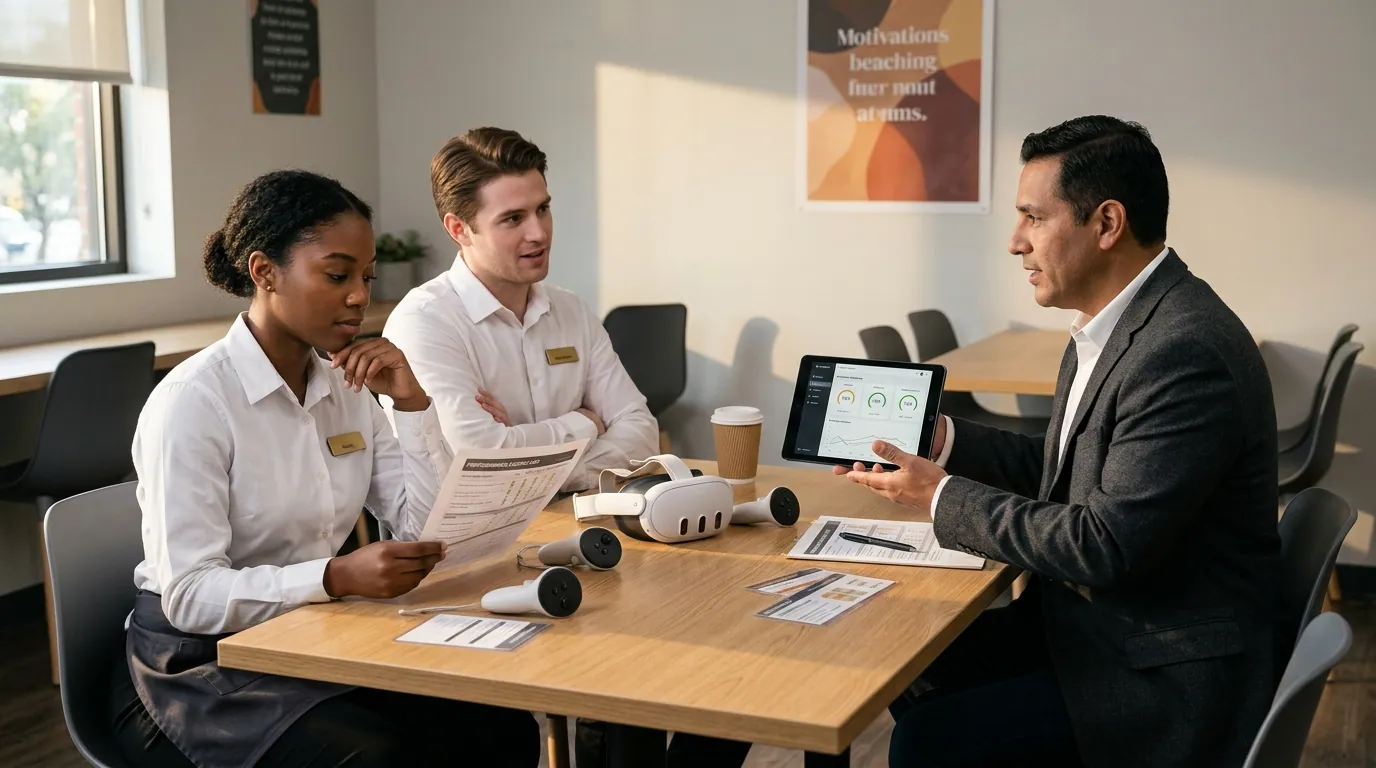
- The debrief is where the learning gets consolidated. A scenario can be designed to end in a data debrief showing exactly where the employee deviated from the service standard rather than a pass/fail score. Published learning research consistently favors specific feedback over binary outcomes, which is why the debrief is worth designing rather than bolting on.
$171B
Workplace injuries, including food service incidents, cost U.S. businesses $171 billion annually (National Safety Council). VR safety training reduces incident rates before they reach the floor.
Frequently Asked Questions
What hospitality scenarios work best in VR? +
Anything where the outcome depends on a decision, a conversation, or a sequence: guest complaint de-escalation, front desk check-in under pressure, upselling, food safety and allergen handling, housekeeping standards, emergency and evacuation procedures, cabin and cruise operations, and airport ground handling safety. What does not belong in VR is pure physical craft. Knife skills and actual cooking technique are better learned on the real equipment, and we will tell you that rather than build it.
Does this work for hotels and cruise lines, or only restaurants? +
All of them, and the shared problem is the same: a guest-facing decision made by a frontline employee, repeated across many locations, shifts and languages. Hotel groups use it for front desk, housekeeping and complaint handling. Cruise operators use it for cabin service, muster and emergency procedures. Airlines and ground handlers use it for ramp safety and turnaround procedures. Restaurant groups use it for service sequence, food safety and peak-hour stress.
How do you handle multiple languages across properties? +
Each scenario is built once and localized into the languages your workforce actually speaks, with voice-over and on-screen text per language. This matters more in hospitality than in almost any other industry: a hotel or cruise operation routinely runs crews speaking five or more languages on the same shift, and translated slide decks are where standards quietly diverge. Language count is one of the real cost drivers, so it is worth deciding early rather than adding later.
How does roleplay and branching actually work? +
A guest scenario is not a video with a quiz at the end. The guest reacts to what the employee chooses. Interrupt an upset guest and the conversation escalates; acknowledge first and it de-escalates. The branch determines what happens next, and the score reflects the path taken, not just the final answer. This is the layer that makes hospitality training worth doing in VR, and it is also the layer that drives the build cost.
What do we need to provide to get started? +
Your brand standards or SOPs for the scenarios you want built, photos or drawings of a representative property, one person who can approve whether a scenario is accurate, your pass and fail standard, and the language list. You do not need 3D models, a VR team, or any existing digital content.
How does VR support food safety and compliance documentation? +
Programs built on xAPI or SCORM export completion and performance records into your LMS and compliance dashboards. Handwashing protocol, temperature logging, allergen handling and HACCP sequences are performed and scored, with every decision timestamped. That produces an auditable record supporting health department inspections and brand standards audits. It supplements certifications such as ServSafe rather than replacing them.
Can VR replace in-person hospitality onboarding? +
No, but it can compress it. VR handles the procedural and decision layers so floor time focuses on real equipment and real guests. The sensible split is to move the content that is pure procedure and judgment into VR, then move people to supervised floor experience sooner. Where exactly that line falls depends on your roles and your properties, and it is one of the things worth settling during a pilot rather than assuming up front.
What does a VR hospitality training program cost? +
Roughly $30,000 to $150,000 for an initial deployment. The drivers are the number of scenarios, how deep the branching goes, whether environments are modeled on your actual properties, the number of languages, LMS integration, and whether it is single-brand or multi-brand. A single-scenario pilot starts near $30,000 and runs 8 to 12 weeks. See the full cost breakdown.
RELATED ARTICLES
Ready to standardize training across every location?
Tell us how many locations you operate and what your biggest training gap is. We will scope a program built for your operation.