
VR Firefighter Training: How Departments Are Using Simulation
A fire department cannot burn a structure every time it needs to practice. The incidents crews most need to rehearse, structural collapse, mayday, complex search, are the ones too dangerous and too expensive to stage. VR lets departments run those scenarios repeatedly, training the decisions that save lives without the cost of real fire.
QUICK ANSWER
VR firefighter training lets departments rehearse the cognitive side of firefighting, scene size-up, search and rescue patterns, incident command, and mayday procedures, repeatedly and without burning a structure. It does not replace live fire training, which builds physical conditioning, but it covers the low-frequency, high-consequence decisions live burns rarely can. According to PwC, VR learners are up to 275% more confident applying skills. Custom firefighter VR programs range from $35,000 to $200,000 depending on scenario scope.
The Training Problem Departments Face
Firefighting competence is built on experience, but the most critical incidents are, by their nature, rare. A firefighter may go years without facing a structural collapse, a mayday, or a complex zero-visibility search, and then must perform flawlessly the first time it happens for real. The incidents that demand the most practiced response are exactly the ones crews get the least natural experience with.
Live fire training helps but is constrained. Burning an acquired structure or running a burn building is expensive, weather-dependent, hard on equipment, and limited in how many scenarios it can present. A department might stage a major live evolution a handful of times a year, giving each firefighter limited reps on a narrow set of conditions. The decision-making layer, reading fire behavior, choosing tactics, commanding the scene, gets practiced least of all.
275%
VR learners are up to 275% more confident applying what they learned, decisive for firefighters who must execute rare, high-stakes procedures correctly the first time (PwC, 2022).
Where VR Fits in Department Training
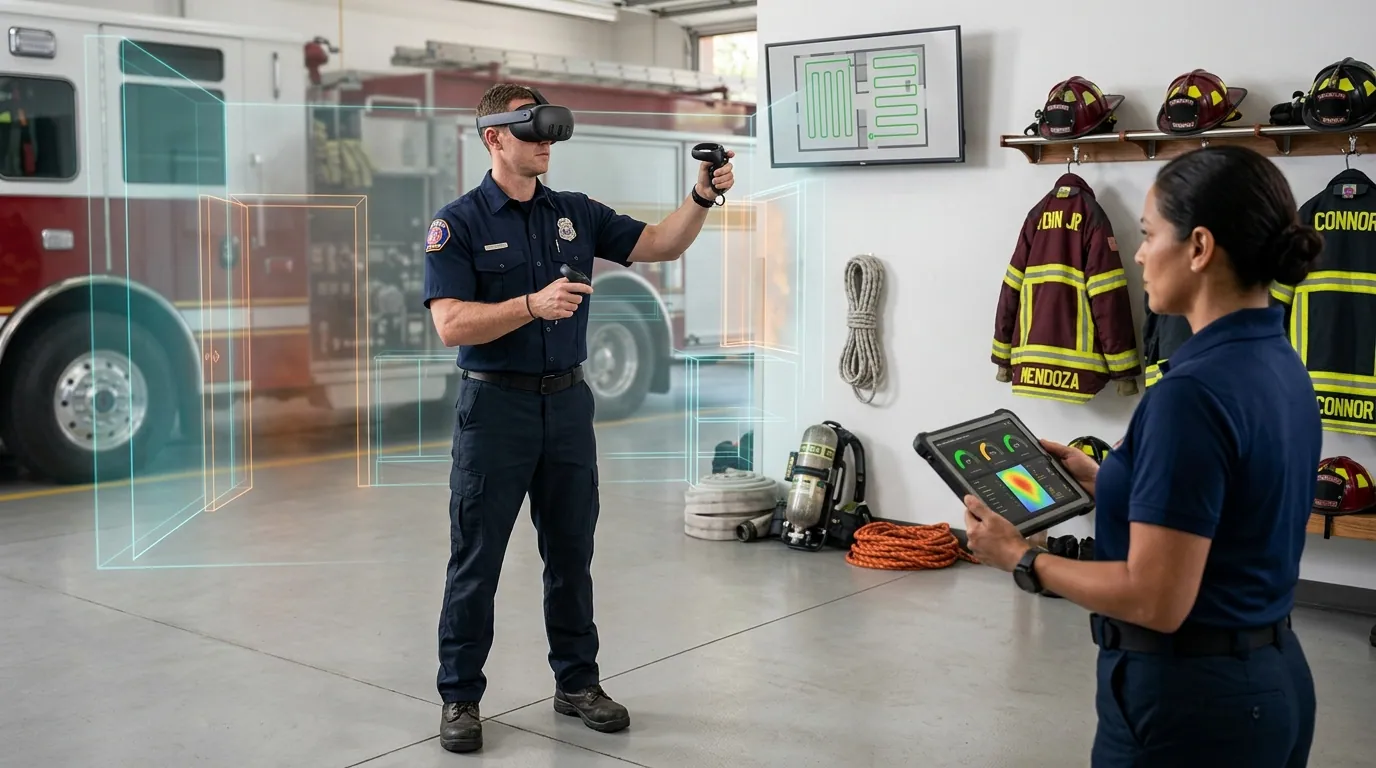
VR firefighter training does not replace live fire, it complements it by owning the cognitive and procedural layer. Crews run the high-consequence scenarios repeatedly, in consistent conditions, as often as the training schedule allows, building the decision speed and procedural memory that real incidents demand. Departments are applying it to:
- Scene size-up: Practice reading a structure, fire behavior, and risk on arrival, the decisions that shape everything that follows.
- Search and rescue patterns: Run systematic search in zero-visibility conditions repeatedly, building the discipline that prevents missed victims and disorientation.
- Incident command: Practice resource assignment and tactical decisions on escalating incidents, seeing how different choices change outcomes.
- Mayday and firefighter-down: Rehearse the procedures that must be automatic under extreme stress, far more often than live training could ever allow.
This sits alongside related emergency response work like fire extinguisher VR training within the broader category of VR safety and operations training.
| Training Need | Live Fire | VR Simulation |
|---|---|---|
| Physical conditioning | Essential | Not a substitute |
| Size-up and tactics | Occasional | Unlimited reps |
| Rare incident types | Rarely staged | On demand |
| Cost per scenario | High | Near zero after build |
| Decision data | Observer notes | Logged per run |
Training Command Without Staging the Incident
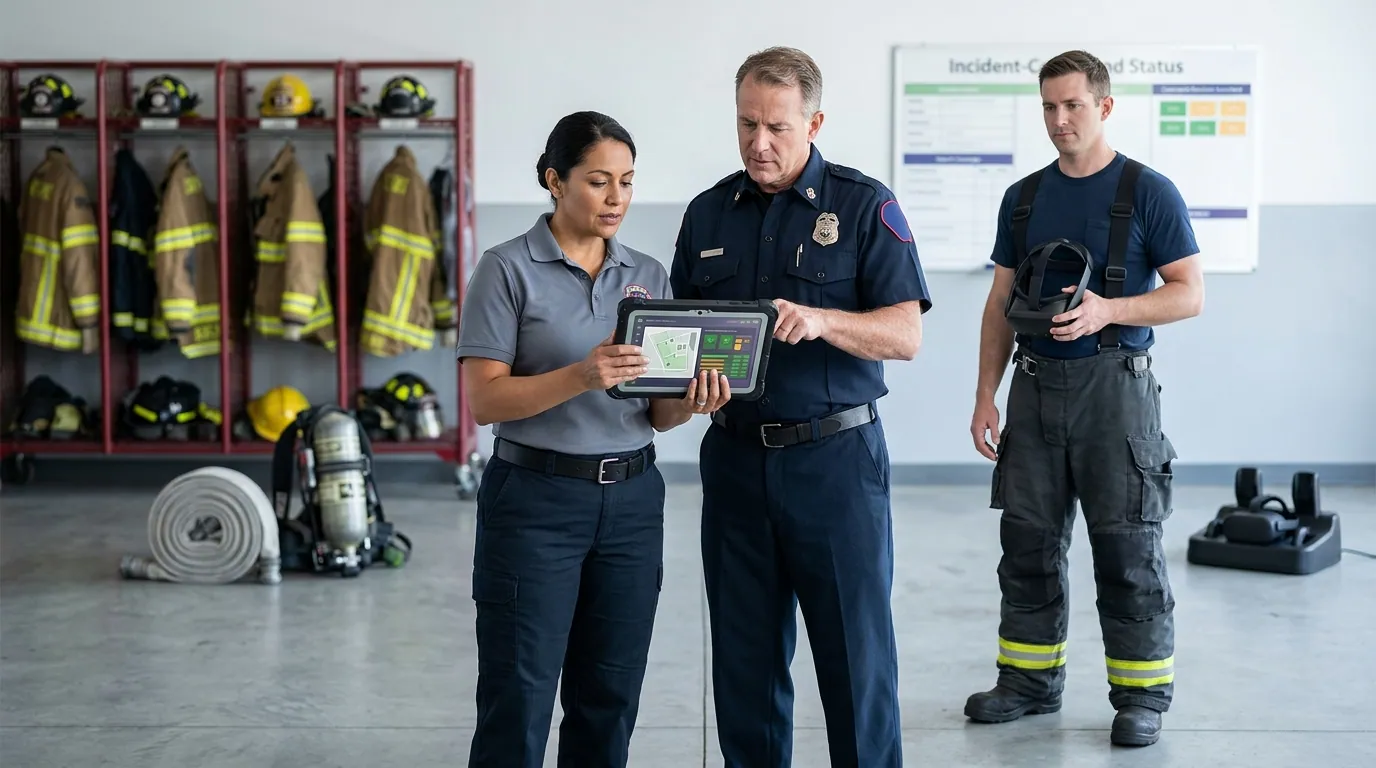
Incident command is the clearest case for VR. Command is decision-making under pressure with incomplete information, and it improves only with repeated practice on varied incidents, which a department cannot physically stage. In VR, a commander runs the same escalating fire repeatedly, practicing size-up, resource assignment, and tactical calls, and because the scenario is consistent, they can see exactly which decisions improved the outcome.
That repeatability extends to multi-company coordination and mutual aid scenarios that would be logistically impossible to stage regularly. A department can train its command structure across dozens of incident types in the time and budget it would take to run a single live evolution.
Repeatable
VR lets a department run a structural collapse or mayday scenario as many times as needed, where live training might stage it once a year or never.
What We See in Fire Department VR Programs
- It complements live fire, it does not compete. The departments that succeed position VR as the decision-and-procedure layer and keep live burns for physical skills, rather than framing it as a replacement.
- Rare scenarios deliver the most value. The collapse, mayday, and complex search scenarios crews can never stage live are where VR repetition pays off most directly.
- Command training is the unlock. Officers gain the ability to practice command decisions on demand, the skill that previously could only be built through real incidents.
- Owned programs serve every recruit class. Because the department owns the scenarios, each new recruit class trains on the same incidents at no added per-scenario cost.
Frequently Asked Questions
What do fire departments use VR firefighter training for? +
Departments use VR firefighter training primarily for decision-making and procedure rehearsal that is expensive or dangerous to stage live: scene size-up, search and rescue patterns, incident command, mayday procedures, hazmat assessment, and multi-company coordination. VR cannot replace the physical conditioning of live fire training, but it excels at the cognitive side, reading fire behavior, making command decisions under pressure, and running scenarios repeatedly that a department could never afford to stage with real structures.
Can VR replace live fire training for firefighters? +
No, and it is not meant to. Live fire training builds the physical conditioning, heat acclimatization, and hands-on hose and tool skills that only real fire can. VR complements it by handling the decision-making and procedural rehearsal layer, which live burns cover only occasionally because of cost and risk. The strongest department programs use both: live fire for physical skills and VR for unlimited repetition of size-up, command, and search decisions.
What scenarios are hard to train without VR? +
Low-frequency, high-consequence incidents are the hardest to train and the best fit for VR: structural collapse, mayday and firefighter-down rescue, large multi-company incidents, hazmat releases, and complex search in zero-visibility conditions. These rarely happen often enough for crews to build experience naturally, and they are too dangerous or expensive to stage live. VR lets a department run them repeatedly so the response is practiced before the real call comes.
How does VR firefighter training help incident command? +
Incident command is decision-making under pressure with incomplete information, exactly what VR trains well. A commander can run the same escalating structure fire repeatedly, practicing size-up, resource assignment, and tactical decisions, and see how different choices change the outcome. Because the scenario is consistent, the commander can isolate which decisions improve results, and the department can train command skills across many incident types without staging any of them physically.
What does a VR firefighter training program cost? +
Custom VR firefighter training programs range from $35,000 for a focused scenario set such as search patterns or size-up to $200,000 or more for a comprehensive program covering command, search, mayday, and multi-company coordination across multiple incident types. Because the program is owned and reused across every shift and recruit class, the per-firefighter cost over time is far lower than the recurring expense of staging equivalent live scenarios.
Want your crews rehearsing the calls they can't afford to stage?
Tell us your department's priority scenarios. We will design a simulation that trains the decisions that matter most.