
Fire Extinguisher VR Training: Simulation vs Live Burn
Live burn fire extinguisher training has been the gold standard for decades, and it works. The problem is logistics: propane props, refills, outdoor space, weather, and a vendor day that gives each employee a single attempt per year. VR delivers the same hands-on practice without the constraints, for every employee, as often as needed.
QUICK ANSWER
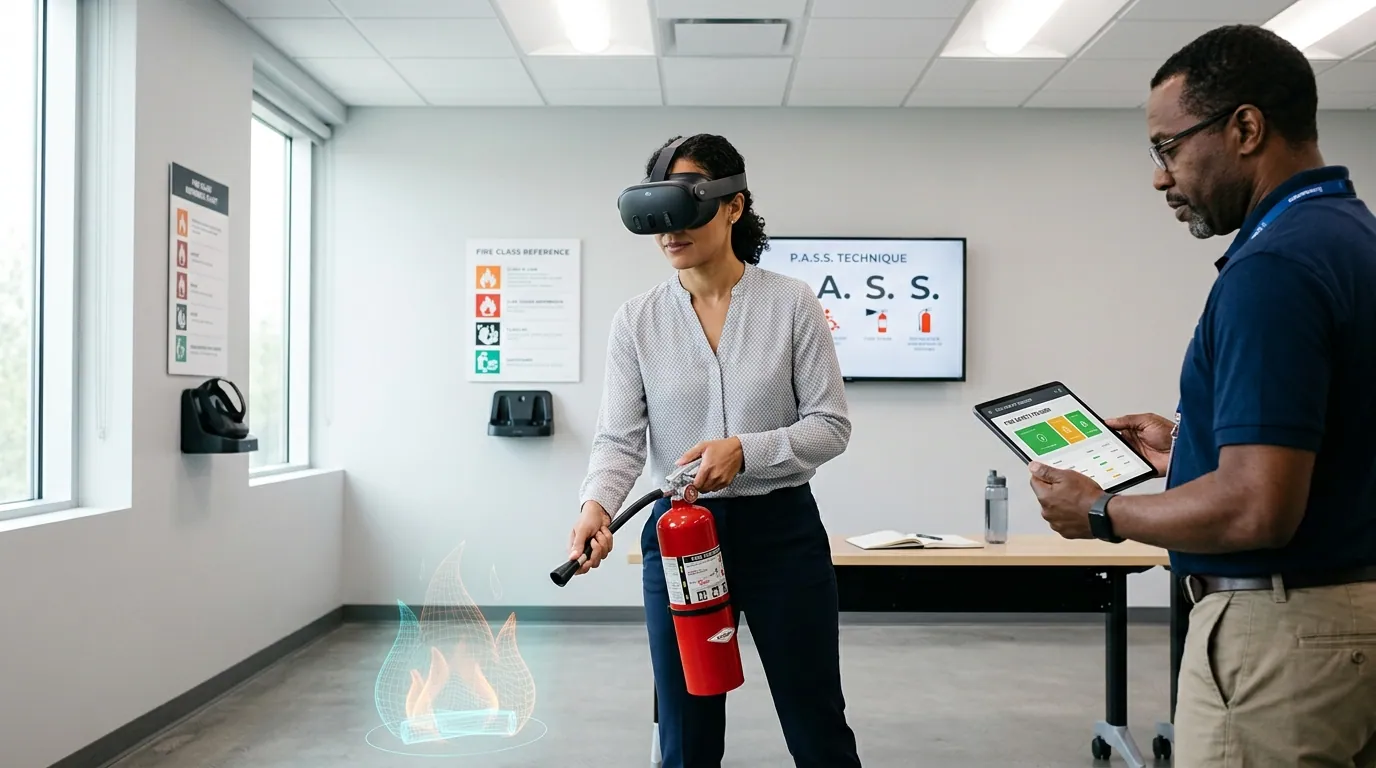
Fire extinguisher simulation lets every employee practice the PASS technique on realistic Class A, B, C, and K fires repeatedly, indoors and on demand, without propane props, extinguisher refills, smoke, or cleanup. For technique and decision-making it is at least as effective as live burn, and it removes the logistics that limit live burn to one attempt per person per year. VR supports OSHA 1910.157 annual training and documents per-employee competence. Custom programs range from $35,000 to $120,000.
What Live Burn Does Well, and Where It Falls Short
Live burn training is genuinely effective. An employee who has actually discharged an extinguisher on a real fire carries muscle memory a slideshow never produces. The technique, the recoil, the distance, the sweep, become real. There is a reason it has been the standard for so long.
The limitation is everything around the burn. It requires propane props or a controlled fire, extinguisher recharging after each use, outdoor space, cooperative weather, and frequently a vendor visit scheduled months ahead. The practical result is that each employee gets one, maybe two, attempts on a single prop day per year. Anyone hired the week after is untrained until the next cycle, and no one gets the repetition that builds reliable response under stress.
1 / yr
Live burn typically gives each employee a single extinguisher attempt per year, while VR delivers unlimited repetitions on demand for everyone, including new hires.
What Simulation Adds
VR fire extinguisher training reproduces the hands-on practice, the employee physically performs the PASS technique, while removing every logistical barrier. It runs indoors, on any day, for every employee, as many times as needed. And it can teach lessons live burn cannot safely deliver, such as the consequence of grabbing the wrong extinguisher class for the fuel type.
- Assess and decide: Practice judging whether a fire is small enough to fight or requires immediate evacuation, the decision that matters most.
- Select the right class: Experience why a water extinguisher on a grease or electrical fire makes things worse, a lesson that is dangerous to teach with real fire.
- Execute PASS technique: Pull, Aim, Squeeze, Sweep, repeated until the motion is automatic, with the simulation scoring distance, aim, and sweep coverage.
- Maintain escape awareness: Practice keeping a safe distance and a clear exit, building the spatial discipline that keeps a fire responder safe.
Fire extinguisher response is one scenario within broader VR safety and operations training, and the same headset and program framework extend to wider VR firefighter training for emergency response teams.
| Factor | Live Burn | VR Simulation |
|---|---|---|
| Reps per employee | 1-2 per year | Unlimited |
| Fire classes practiced | Usually one | A, B, C, K safely |
| Logistics | Props, refills, weather | Indoor, on demand |
| New-hire coverage | Wait for next cycle | Immediate |
| Documentation | Attendance | Per-employee competency |
Compliance and Cost Over Time
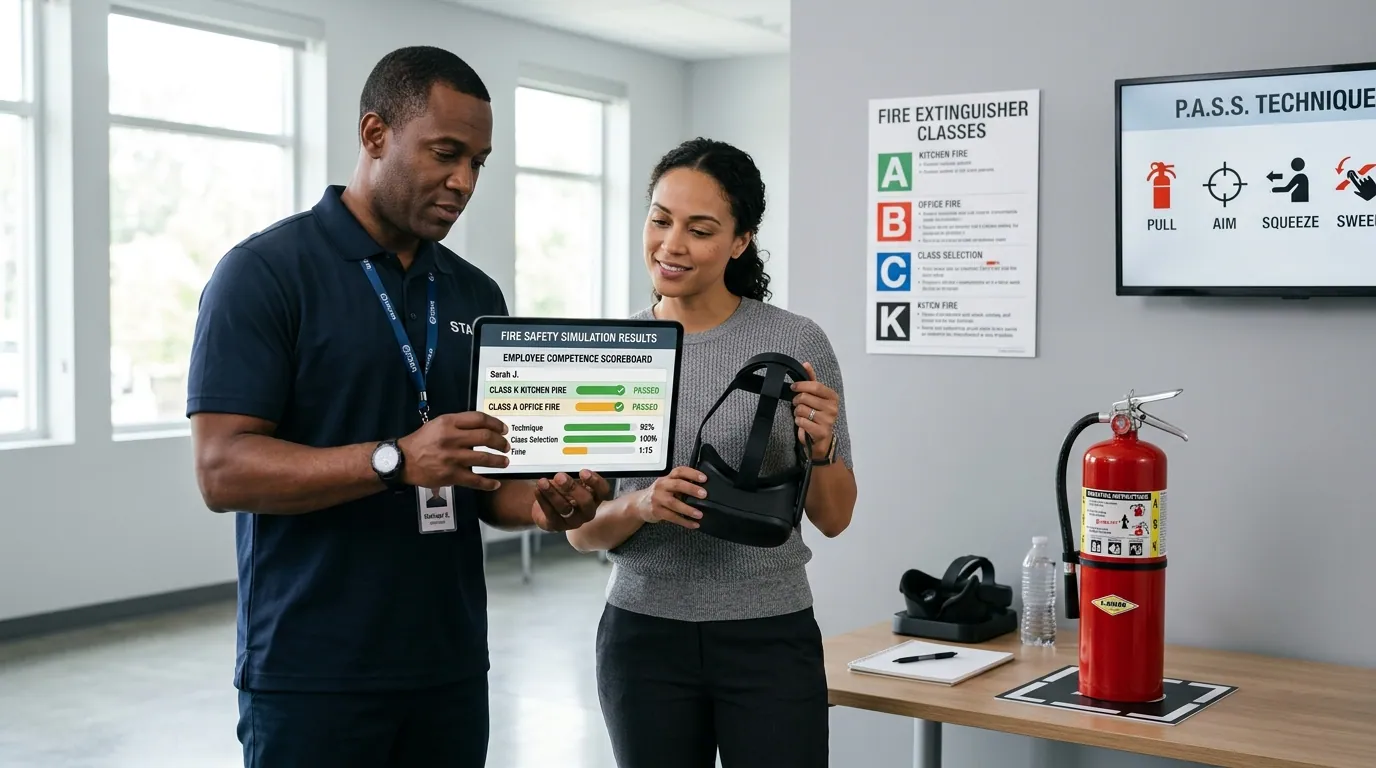
OSHA 1910.157 requires fire extinguisher training upon assignment and annually for employees expected to use extinguishers. VR meets that obligation and documents it better, logging each session and the employee's performance into a competency record rather than a sign-off sheet. For a multi-site employer, that means consistent, documented training everywhere, including for anyone hired mid-cycle.
On cost, an owned VR program reused across years and reused for many other safety scenarios typically costs less per employee over time than recurring live burn vendor visits and prop expenses, while delivering far more practice per person. We detail that math in our breakdown of VR training cost.
320
Monthly U.S. searches for fire extinguisher simulation reflect steady demand from safety teams seeking a practical alternative to live burn logistics.
What We See in Fire Extinguisher VR Programs
- Wrong-class selection is the eye-opener. Letting employees safely experience a water extinguisher worsening a grease fire teaches the class-selection lesson faster than any lecture.
- Repetition reaches everyone, not just the willing. Because there is no scheduled prop day, even mid-cycle hires and reluctant participants get trained and documented.
- The decision to evacuate is trainable. The most valuable outcome is often teaching employees when not to fight a fire, a judgment live burn rarely emphasizes.
- Reuse across scenarios drives the economics. The same headset and program framework that handles extinguisher training extends to evacuation and broader emergency response.
Frequently Asked Questions
Is fire extinguisher simulation as effective as live burn training? +
For technique and decision-making, fire extinguisher simulation is at least as effective as live burn and often more practical. Both let employees practice the PASS technique on a realistic fire, but simulation lets every employee practice multiple fire classes repeatedly without propane props, extinguisher refills, smoke, or cleanup. Live burn delivers one or two attempts per person on a scheduled prop day; simulation delivers unlimited practice on demand, with performance logged. The muscle memory and judgment transfer comparably, while simulation removes the logistics and cost barriers that limit live burn frequency.
What can employees practice in fire extinguisher VR training? +
Employees practice the full response: assessing whether the fire is small enough to fight, selecting the correct extinguisher class for the fuel, executing the PASS technique (Pull, Aim, Squeeze, Sweep), maintaining a safe distance and escape route, and recognizing when to evacuate instead of fight. VR can present Class A, B, C, and K fires and let the employee experience the consequence of choosing the wrong extinguisher type, a lesson far too dangerous to teach with a live burn.
Why do companies move from live burn to VR fire training? +
Companies move to VR fire extinguisher training to remove the logistical and cost barriers that limit live burn. Live burn requires propane props or controlled fires, extinguisher recharging, outdoor space, weather cooperation, and often a vendor visit, which means most employees get one attempt per year at best. VR delivers unlimited, repeatable practice indoors, on demand, for every employee, with documented competence, and the same headset is reused for many other safety scenarios.
Does fire extinguisher VR training meet compliance requirements? +
Fire extinguisher VR training supports OSHA 1910.157 employee training requirements, which call for training on extinguisher use and hazards upon assignment and annually. VR logs each session and the employee performance, producing a documented competency record that demonstrates the training occurred and that the employee performed the technique correctly. Companies should confirm any site-specific or insurer requirements, but VR generally meets and documents the annual training obligation effectively.
What does a fire extinguisher VR training program cost? +
Custom fire extinguisher VR programs range from $35,000 for a focused extinguisher-use module to $120,000 or more when combined with broader fire and emergency response scenarios across multiple sites. Because the program is owned and reused, the per-employee cost over several years is typically lower than recurring live burn vendor visits and prop expenses, while delivering far more practice per person.
Ready to give every employee real extinguisher practice without the prop day?
Tell us your facility's fire risks and headcount. We will design a simulation that trains and documents everyone.