
Police Training Simulation: How VR Builds De-escalation and Decision Skills
The hardest moments in policing are decision moments: a crisis call, a stop that escalates, a split-second judgment under stress. Those skills improve only with repetition against realistic, responsive scenarios, and that is exactly what departments cannot stage often enough with live role-players. VR simulation closes the gap.
QUICK ANSWER
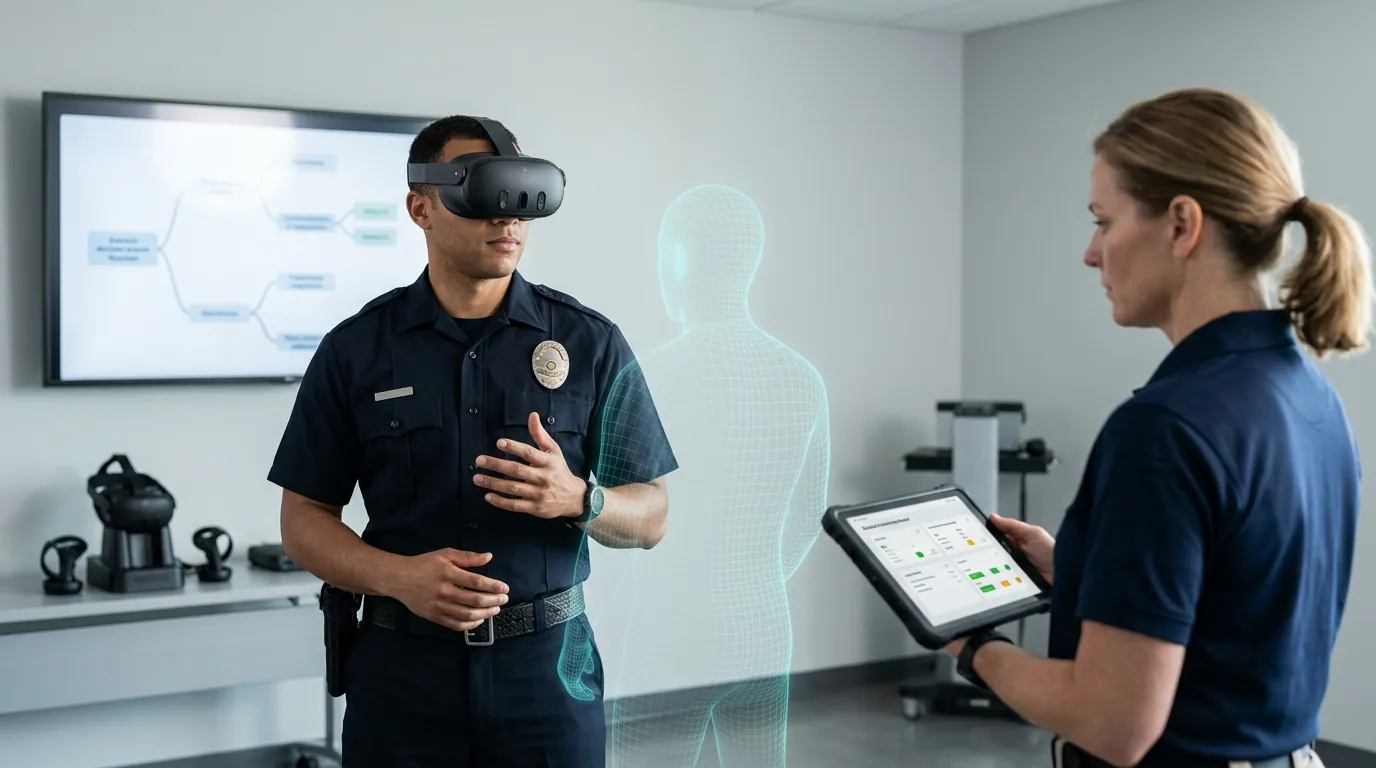
Police training simulation in VR lets officers rehearse de-escalation, decision-making, and judgment in realistic branching scenarios, repeatedly and safely, where their words and choices change how the encounter unfolds. It does not replace live scenario and range training; it adds a high-volume, consistent layer for the cognitive and interpersonal skills departments cannot stage often enough with role-players. According to PwC, VR learners are up to 275% more confident applying skills and complete training up to 4x faster. Custom police simulation programs range from $35,000 to $200,000.
The Training Problem Departments Face
Much of policing competence comes down to judgment and communication under pressure, and those are the hardest skills to train. The encounters that demand them most, crisis and mental-health calls, escalating stops, use-of-force decision points, are by nature infrequent and impossible to repeat on demand in the field. An officer may go months between high-stakes decision moments, then must perform correctly the first time it matters.
Live scenario training with role-players helps but does not scale. It is expensive, requires coordinating actors and space, and gives each officer only a handful of reps on a narrow set of situations. The role-player also plays the encounter differently every time, so officers cannot isolate which communication approach actually improves the outcome. The practice officers need most is exactly the practice a department can least consistently provide.
275%
VR learners are up to 275% more confident applying what they learned, decisive for officers who must execute de-escalation and judgment correctly under real stress (PwC, 2020).
How VR Builds Decision and De-escalation Skill
A VR police simulation places the officer inside a responsive scenario where a civilian persona reacts to their words, tone, and choices, escalating or de-escalating based on how the officer handles it. Because the persona behaves consistently, the officer can run the same crisis encounter repeatedly, try different de-escalation approaches, and see precisely which one changes the outcome, the kind of isolated, repeatable practice a human role-player cannot provide.
- De-escalation encounters: Practice verbal de-escalation with a responsive persona in crisis and mental-health scenarios, building the communication habits that defuse situations.
- Decision-point judgment: Rehearse use-of-force and response decisions with branching outcomes and incomplete information, the moments that must be right.
- Escalating stops: Run traffic and field stops that can turn, practicing the reads and responses that keep an encounter controlled.
- Crisis intervention: Build the recognition and approach skills for mental-health and crisis calls that rarely come often enough to learn naturally.
This decision-and-communication layer mirrors how simulation strengthens other high-stakes fields, from VR firefighter training to the broader category of VR safety and operations training.
| Training Need | Live Role-Play | VR Simulation |
|---|---|---|
| Physical / tactical skills | Essential | Not a substitute |
| De-escalation reps | Few, costly | Unlimited |
| Scenario consistency | Varies each time | Identical, repeatable |
| Decision data | Observer notes | Logged per run |
Measuring What Was Once Unmeasurable
The data layer is what turns simulation into a department tool. Every scenario logs the officer's decisions, communication choices, timing, and outcomes, building a performance profile that shows which encounter types each officer handles well and where they need more practice. That turns subjective scenario debriefs into specific, measurable coaching, and lets a department demonstrate de-escalation training with documented practice, not just attendance.
Because the program is owned software, every academy class and every shift trains on the same scenarios at no added per-officer cost, with PwC's up-to-4x-faster competence compressing how long it takes to build confident judgment.
Repeatable
VR lets a department run the same crisis or de-escalation scenario as many times as needed, where live role-play might stage it once or twice a year.
What We See in Public-Safety Simulation Programs
- It complements live training, it does not compete. Successful departments position VR as the judgment-and-de-escalation layer and keep live scenarios and range time for physical and tactical skills.
- Persona responsiveness matters most. A civilian persona that reacts believably to the officer's tone and choices produces far better practice than a scripted, fixed-outcome scenario.
- Repetition builds verbal habits. The biggest gains come from officers running de-escalation encounters enough times that the calming, controlled response becomes automatic.
- Owned programs serve every class. Because the department owns the scenarios, each academy cohort and in-service cycle trains on them at no added per-scenario cost.
Frequently Asked Questions
What is police training simulation in VR? +
Police training simulation in VR places officers inside realistic, branching scenarios, traffic stops, domestic calls, crisis encounters, where their decisions and communication change how the scenario unfolds. Unlike a video or lecture, it requires the officer to actually make the call, de-escalate, choose a response, communicate under stress, and it measures what they did. The focus is on the cognitive and interpersonal side of policing: judgment, de-escalation, and decision-making, practiced repeatedly and safely.
Can VR simulation train de-escalation effectively? +
Yes. De-escalation is a real-time interpersonal skill that improves only with repeated practice against believable, responsive scenarios, exactly what VR provides. Officers can run the same crisis encounter multiple times, trying different communication approaches and seeing how a responsive persona reacts, building the verbal and decision habits that defuse situations. Because the scenario behaves consistently, departments can measure which approaches improve outcomes, turning de-escalation from an abstract concept into practiced, measurable skill.
Does VR replace live scenario and range training for police? +
No, it complements them. Live scenario training and range time remain essential for physical skills, equipment handling, and team tactics. VR adds a repeatable layer for the decision-making, de-escalation, and judgment scenarios that are expensive or logistically hard to stage live, and which officers rarely get enough reps on. The strongest department programs use live training for physical and tactical skills and VR for high-volume, consistent practice of judgment and communication.
What scenarios are best suited to police VR simulation? +
Decision-heavy, low-frequency, high-consequence encounters are the best fit: crisis and mental-health calls, de-escalation situations, use-of-force decision points, traffic stops that escalate, and complex judgment scenarios with incomplete information. These are situations officers must handle correctly but rarely get to practice safely and repeatedly. VR lets a department run them many times, with branching outcomes and measurable decision data, so the response is rehearsed before the real call.
What does a police training simulation program cost? +
Custom police VR simulation programs range from $35,000 for a focused scenario set such as de-escalation or traffic stops to $200,000 or more for a comprehensive program covering crisis intervention, use-of-force decision-making, and multiple branching scenarios with analytics. Because the program is owned and reused across every shift and academy class, the per-officer cost over time is far lower than the recurring expense of staging equivalent live scenarios with role-players.
Want your officers rehearsing the decisions that matter most, before the real call?
Tell us your priority scenarios and de-escalation goals. We will design a simulation around the encounters your department faces.