
How Photorealistic 3D Makes VR Training Feel Real
A VR training program is only as convincing as the world inside the headset. Here is how the look of that world gets built, and how it works together with the simulation to teach a real skill.
QUICK ANSWER
VR training feels real when the environment is a photorealistic replica of the actual job site. That look is built by a 3D visualization studio that models the equipment, materials, and lighting. Prime VR then layers the interaction, branching decisions, and performance tracking on top. The two are built to fit each other, and that fit is what turns practice into real skill.
Why the Look of the World Matters
In VR training, the goal is skill that transfers to the job. A worker transfers more when the practice looks and feels like the real thing. If the valve, the panel, the warning light, and the lighting all match the real site, the brain treats the practice as real and the lesson sticks. If the environment looks generic, recognition drops and so does transfer. That is why the quality of the 3D environment is not decoration. It is part of how the training works.
Two Crafts, One Program
A photorealistic VR training program is really two crafts working together. One is what you see. The other is what you do.
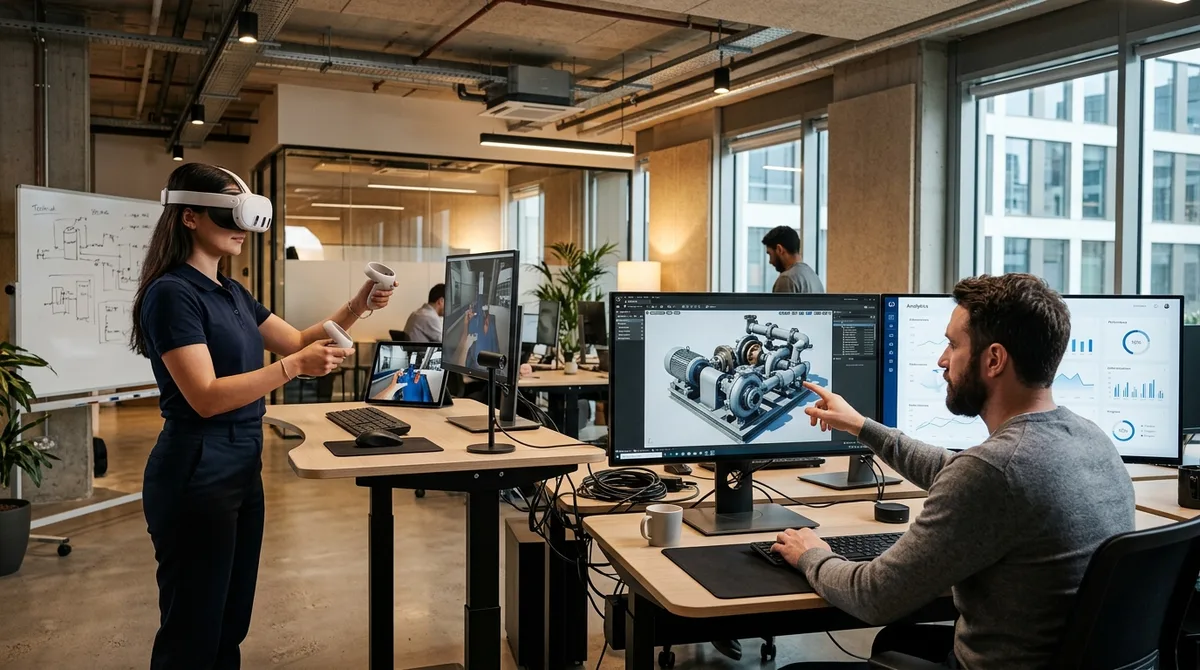
For the part you see, we work with Rendimension, a 3D visualization studio that builds photorealistic environments. They model the equipment, the facility, the materials, and the lighting until the space looks like a real photograph of the real place. For the part you do, Prime VR builds the simulation: the interactions, the branching decisions, the consequences when something goes wrong, and the per-step scoring that proves the skill was learned.
See it, then do it
Rendimension makes the world look real. Prime VR makes the world respond. Neither one alone is training; together they are a simulation a worker can trust.
How the Two Fit Together
The realistic environment and the simulation are not built one after the other and bolted together. They are built to fit. A few examples of how that works:
- Every part the worker touches is modeled to be interactive. A handle is not just a picture of a handle; it is built so it can be grabbed, turned, and respond.
- Lighting and materials carry meaning. A hot surface, a warning color, or a worn label is modeled accurately because the worker is supposed to notice it and react.
- The space matches the real layout. Distances, sightlines, and reach are true to the real site, so muscle memory built in VR still works on the floor.
Because Rendimension also produces still renderings, animations, and walkthroughs of the same environment, the visuals can be reused for marketing, onboarding, and stakeholder buy-in, not just the headset. One environment, many uses.
What We See in VR Training Projects
From building these programs, the lessons that matter most:
- Fidelity earns trust. When the environment looks real, learners take the practice seriously and managers believe the results.
- Model for interaction from the start. An environment built only to look good has to be rebuilt to be used. Modeling and simulation planned together saves weeks.
- A great environment is reusable. The same photorealistic build can power training, a sales walkthrough, and an onboarding tour for years.
Frequently Asked Questions
What makes a VR training environment feel realistic? +
Realism comes from photorealistic 3D modeling of the real equipment, materials, lighting, and space. When the headset shows a faithful replica of the actual job site, the brain treats the practice like the real thing, which is what drives skill transfer.
Who builds the 3D environments for VR training? +
The 3D environments and assets are built by a 3D visualization studio. For our photorealistic builds we work with Rendimension, a studio that models the equipment, facility, and lighting; Prime VR then adds the interaction, logic, and performance tracking on top.
Does environment realism actually affect training results? +
Yes. The more the environment matches the real one, the more reliably a worker recognizes equipment, controls, and hazards on the job. High-fidelity modeling improves recognition and transfer; a generic-looking environment weakens both.
What is the difference between 3D modeling and the VR simulation? +
3D modeling is what you see, the photorealistic environment, equipment, and materials. The simulation is what you do, the interactions, branching decisions, consequences, and scoring. A strong VR training program needs both, built to fit each other.
How long does it take to build a photorealistic VR training environment? +
Modeling a faithful environment typically takes a few weeks, depending on how complex the equipment and facility are and how many spaces are involved. It runs in parallel with scenario design so the full program stays on a typical 12 to 20 week timeline.
Ready to build a VR program that feels real?
Tell us the equipment and procedure your workers need to master. We will outline the build, the environment, and the timeline honestly.