
Custom VR Training Development: The Build Process Explained
When off-the-shelf content cannot teach what is unique to your organization, custom VR training development is the answer. Here is exactly how a custom program is built, stage by stage.
QUICK ANSWER
Custom VR training development builds a simulation modeled on your exact equipment, facility, and procedures. The process runs through discovery and scenario design, 3D modeling of the environment, interaction and branching logic, performance tracking and LMS integration, testing with real users, and deployment with ongoing support. A typical custom program takes roughly 12 to 20 weeks and ranges from $35K to $250K+ depending on complexity.
When Custom Development Is the Right Choice
Custom VR training development costs more than licensing off-the-shelf content, so it has to earn that premium. It does so when the training is specific to your organization: your exact equipment, your facility layout, your proprietary procedures, or your compliance documentation requirements. If generic content would transfer to the job, you should license it. Custom is for when only a replica of the real thing will produce the skill.
12-20 weeks
Typical timeline for a custom VR training program from discovery to deployment, depending on environment complexity, number of scenarios, and integration depth. The build is an asset you own and can reuse across sites and years.
The Custom Development Process
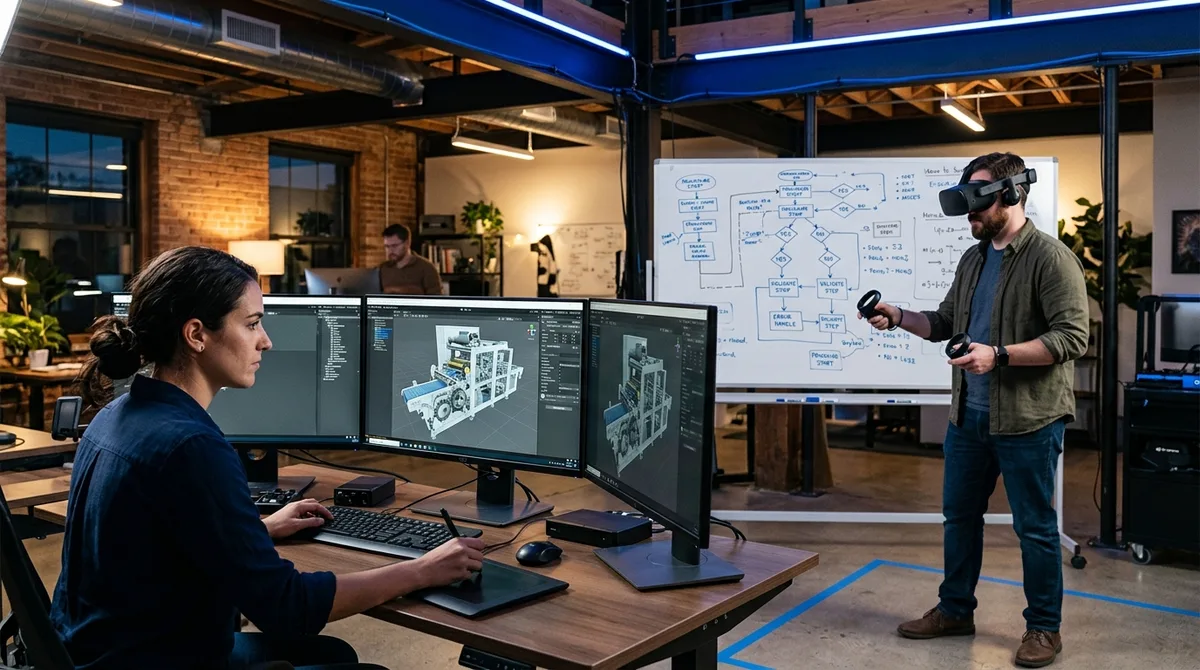
A disciplined custom build runs through six stages. Each one reduces the risk that the finished simulation fails to transfer to the job.
- Discovery and scenario design. Subject-matter experts map the real procedure, the decision points, the common errors, and the success criteria. This is where transfer is won or lost.
- 3D environment modeling. Artists build a faithful replica of the equipment and facility so workers practice in their real context, not a generic one.
- Interaction and branching logic. Engineers make the simulation respond to decisions, with correct paths, realistic consequences, and recoverable errors.
- Performance tracking and LMS integration. Per-step scoring is built in and wired to your LMS via xAPI for audit-ready documentation.
- Testing with real users. Actual workers validate that the simulation feels right and teaches the intended skill, and content is refined from their feedback.
- Deployment and support. The program is rolled out to the headset fleet, with a plan for updates as procedures change.
What Determines Cost and Timeline
Custom development is priced as a build. The drivers are the complexity of the 3D environment, the number and depth of scenarios, the fidelity of interactions, multilingual requirements, and the depth of LMS integration. A single-procedure simulation is faster and cheaper; a multi-scenario, multi-site, multilingual program with deep integration sits at the top of the range. For the full breakdown see our VR training cost guide and how to choose a development partner.
What We See in VR Training Projects
From delivering custom VR programs, the lessons that matter most:
- Discovery determines transfer. The simulation is only as good as the procedure mapping behind it. Skimp here and the build will not teach the real skill.
- Real-user testing is non-negotiable. What designers think is intuitive and what workers experience often differ; testing catches it before deployment.
- Ownership and updatability protect the investment. Procedures change; a program you own and can update remotely keeps its value for years.
Frequently Asked Questions
What is custom VR training development? +
It is the process of building a VR training simulation modeled on your specific equipment, facility, and procedures, rather than licensing generic content. The result is a program where workers practice in a replica of their real environment, which maximizes skill transfer.
How long does custom VR training take to build? +
A typical custom program takes roughly 12 to 20 weeks from discovery to deployment, depending on the complexity of the 3D environment, the number of scenarios, and the depth of LMS integration.
How much does custom VR training development cost? +
Custom programs typically range from $35,000 to $250,000 or more, driven by environment complexity, scenario count, interaction fidelity, languages, and integration depth. It is a build cost for an asset you own, not a recurring license.
What are the steps in custom VR development? +
Discovery and scenario design, 3D environment modeling, interaction and branching logic, performance tracking and LMS integration, testing with real users, and deployment with ongoing support. Discovery and real-user testing are the stages that most determine whether the program transfers to the job.
When should we build custom instead of buying off-the-shelf? +
Build custom when training is specific to your equipment, facility, procedures, or compliance documentation, and only a replica of the real thing will produce the skill. Buy off-the-shelf when the need is generic and existing content already covers it.
Ready to scope a custom VR training build?
Tell us your equipment and the procedure you need workers to master. We will outline the build, timeline, and cost honestly.