
Manufacturing Learning Management System: Why VR Simulation Is the Missing Layer
A manufacturing learning management system is excellent at one thing: proving that training was delivered. What it cannot prove is that the training worked. For the physical, high-consequence procedures that define plant safety, that gap between completion and competence is where incidents live.
QUICK ANSWER
A manufacturing learning management system delivers training content and tracks completion, but it cannot verify that a worker can physically perform a procedure. VR simulation is the missing layer: it makes workers execute the procedure on a virtual replica of their equipment and measures every step. The two are complementary, not competing, the LMS stays the system of record while VR adds practice and competency verification, with session data flowing back via xAPI. PwC’s 2020 soft-skills study found VR learners completed training up to 4x faster than classroom methods, a completion-speed result we extend here, not a figure PwC measured on a factory floor. Custom programs range from $35,000 to $250,000.
What a Manufacturing LMS Does Well
A learning management system was built to solve a real problem: distribute training to a workforce, track who consumed it, and store a compliance record. For the information layer of manufacturing training, it works. Safety orientations, policy acknowledgments, and knowledge quizzes are delivered and documented at scale across every shift and facility, which is genuinely valuable and not something VR replaces.
The trouble starts when manufacturers ask the LMS to do something it was never designed for: prepare a worker to physically perform a high-consequence procedure. A lockout/tagout sequence on a multi-energy machine has 12 to 18 steps that must be executed in the correct order. An LMS can show those steps and quiz on them. It cannot make the worker perform them, and it cannot measure whether they can.
$58K
Average cost of a serious manufacturing injury including direct and indirect costs, the price of the gap a completion-only LMS leaves open (National Safety Council, 2023).
The Layer the LMS Is Missing
VR simulation does not replace the LMS. It adds the practice layer the LMS structurally cannot provide. Instead of watching or quizzing on a procedure, the worker performs it inside a virtual replica of the exact equipment on their floor, repeating the sequence 10 to 15 times before touching the real machine, with every repetition measured. The result is the evidence completion records never contained: which steps were completed, where errors occurred, and what competency each worker actually demonstrated.
This is the difference between a system that delivers content and one that verifies skill, and it is the foundation of our manufacturing workforce simulation systems. The deeper case for the shift is covered in manufacturing training software.
| Capability | Manufacturing LMS | VR Simulation Layer |
|---|---|---|
| Content delivery | Strong | Supported |
| Compliance tracking | Strong | Feeds the LMS |
| Procedure practice | None | 10-15 reps per worker |
| Competency verification | Quiz score only | Per-step performance data |
Integration, Not Replacement
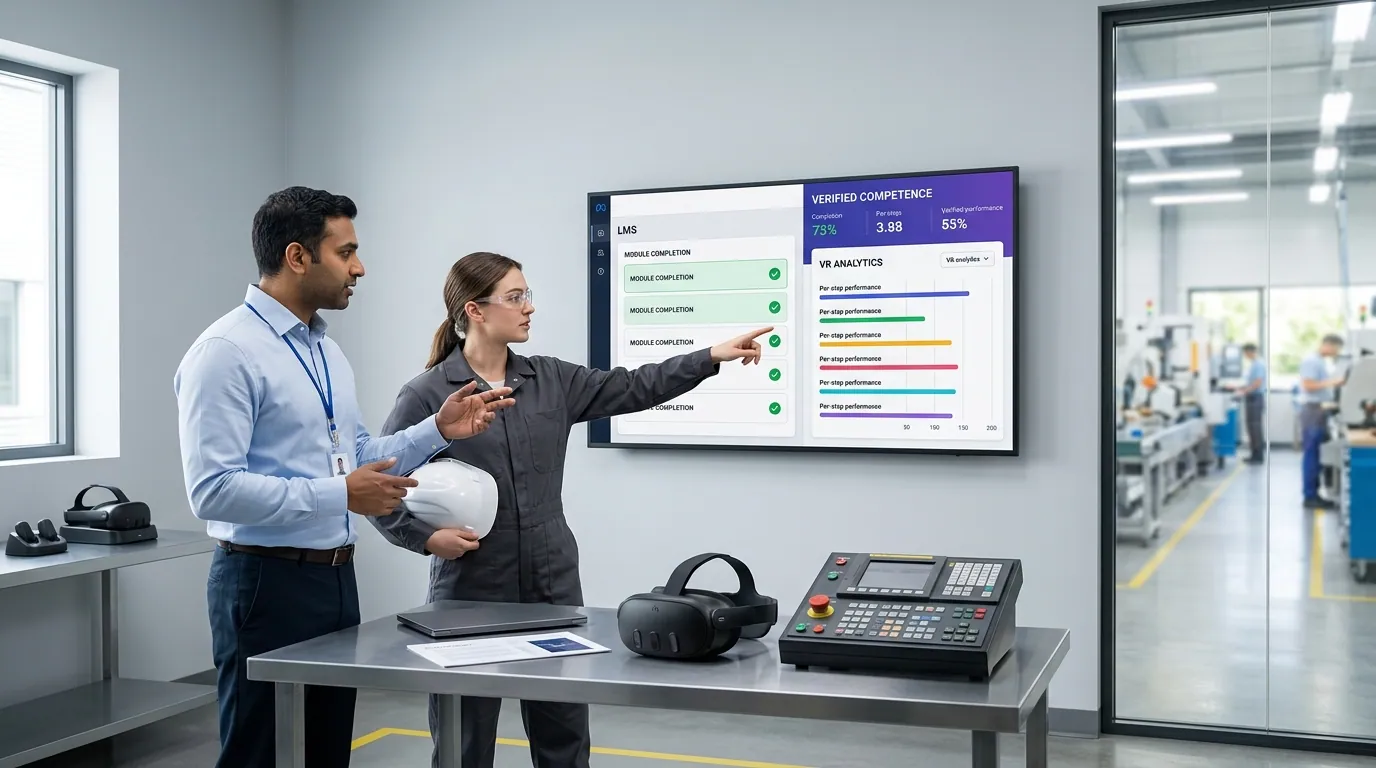
The most successful deployments do not rip out the LMS. They connect VR simulation to it. Every VR session exports per-step performance and competency scores into the existing LMS, HRIS, or learning record store via xAPI or SCORM, so the training and compliance teams keep their system of record while finally gaining the verification layer they were missing. A single platform then shows both that a worker completed the module and that they can actually perform the procedure.
That integration also changes the ROI conversation. PwC’s 2020 soft-skills study found VR learners completed training up to 4x faster than classroom methods, and with the average serious injury near $58,000, the combined system pays back quickly. We break down the full economics in our guide to VR training cost.
4x
PwC’s 2020 soft-skills study found VR learners completed training up to 4x faster than classroom methods. Cited for the completion-speed mechanism, not as a procedural-competence measurement.
What We See When Manufacturers Add the Layer
- The first session is a diagnostic. Performance data almost always reveals that a share of LMS-certified workers cannot complete the correct sequence unprompted, proof the LMS measured completion, not competence.
- Integration wins internal buy-in. Connecting VR data into the existing LMS via xAPI gets adopted; proposing to replace the LMS meets resistance from teams who trust their system of record.
- Equipment fidelity drives transfer. A scenario built on the actual machine, not a generic one, produces procedural memory that carries to the floor.
- Reuse compounds at scale. Once a procedure scenario exists, extending it to another plant costs little, which is where the owned-asset model beats per-seat LMS licensing for practical training.
Frequently Asked Questions
What is a manufacturing learning management system used for? +
A manufacturing learning management system (LMS) is software that delivers training content to plant workers, tracks who completed which modules, and stores compliance records. It is effective for distributing safety orientation, policy acknowledgments, and knowledge quizzes at scale across shifts and facilities. Where it falls short is verifying that a worker can actually perform a physical procedure, which is exactly the gap VR simulation fills.
Why is an LMS alone not enough for manufacturing training? +
An LMS measures completion, not competence. For high-consequence manufacturing procedures such as lockout/tagout, confined space entry, and machine changeover, knowing the steps is not the same as being able to perform them correctly under production conditions. An LMS can deliver and quiz on the content but cannot make the worker execute the procedure or measure whether they can. That verification gap is where incidents originate, and it is why manufacturers pair their LMS with VR simulation.
Does VR simulation replace a manufacturing LMS? +
No. The two are complementary. The LMS remains the system of record for content delivery, compliance tracking, and documentation. VR simulation adds the practice-and-verification layer the LMS cannot provide. Modern programs connect them: VR session data, including per-step performance and competency scores, flows into the existing LMS via xAPI or SCORM, so a single platform shows both completion and demonstrated skill.
How does VR data integrate with an existing manufacturing LMS? +
Custom VR manufacturing programs export performance data through xAPI (Tin Can), SCORM, or direct API integration into your existing LMS, HRIS, or learning record store. Every procedure step, error, and competency score becomes part of your current system of record without replacing it. Integration scope is defined during discovery based on your platform and the compliance documentation you maintain.
What does adding VR simulation to a manufacturing LMS cost? +
Custom VR simulation programs that layer onto an existing manufacturing LMS range from $35,000 for a single high-priority procedure to $250,000 or more for multiple scenarios across several facilities with multilingual delivery and full LMS integration. Because scenarios are reused across workers, shifts, and sites, per-facility cost falls sharply at scale, and the simulation is owned rather than licensed per seat each year.
Your LMS proves training happened. Can it prove your workers are competent?
Tell us your current LMS and your highest-risk procedures. We will show you where the verification layer fits.