
Crane Operator Training Simulator: Practice Lifts Without Risk
Crane operation leaves no room for error, and the riskiest lessons are the most dangerous to teach live. A VR crane simulator lets operators build judgment safely before they ever lift a real load.
QUICK ANSWER
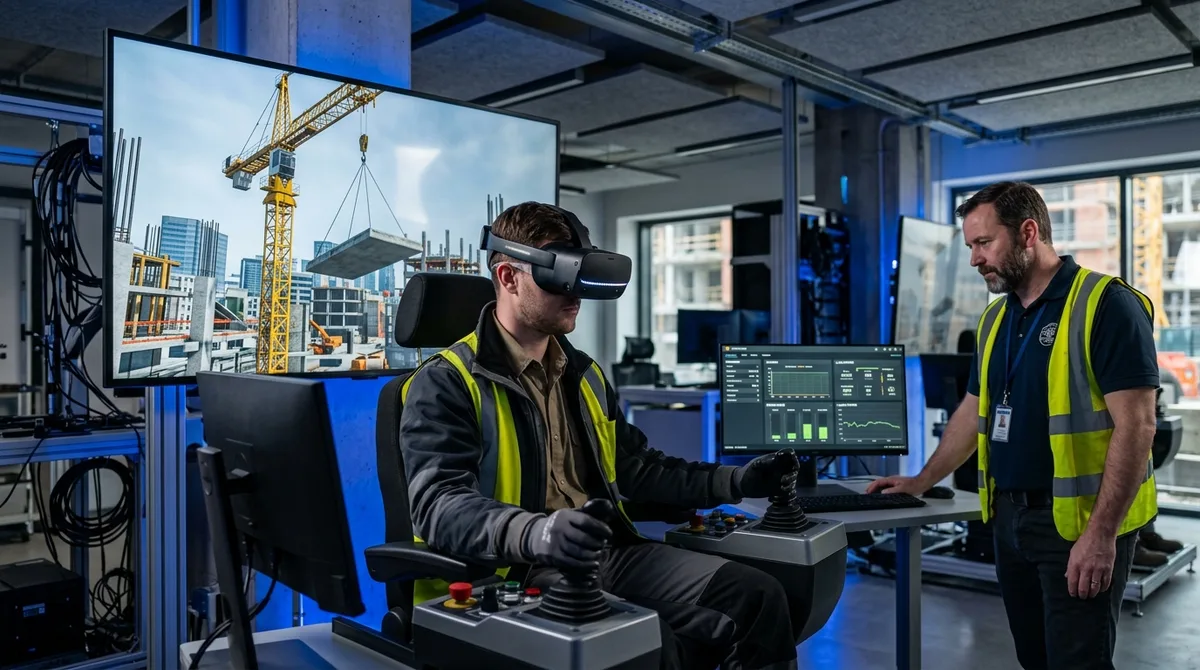
A crane operator training simulator recreates crane operation in VR so operators can practice load control, swing, blind lifts, and rigging judgment without risk to people or property. It builds the fine control and spatial judgment that crane work demands, lets operators rehearse high-consequence scenarios safely, and provides documented practice that supports formal certification programs.
Why Crane Training Needs Simulation
A crane operator manages a suspended load that can swing, drop, or strike with catastrophic consequences. The skills that prevent disaster, smooth load control, anticipating swing, judging blind lifts, are built through practice, but practicing on a real crane with a real load is exactly where the danger lives. A simulator resolves the contradiction: the operator practices the high-risk skills in a virtual environment where a mistake teaches a lesson instead of causing a tragedy.
Zero-risk practice
A simulator lets an operator mishandle a load swing or misjudge a blind lift and see the consequence safely. Those are the highest-value lessons in crane operation and the most dangerous to teach on a real crane.
What a Crane Simulator Builds
- Load control. Smooth acceleration, deceleration, and anti-swing technique become second nature through repetition.
- Blind lift judgment. Operators practice lifts where the load is out of direct sight, relying on signals and spatial reasoning.
- Rigging and load awareness. Understanding load weight, center of gravity, and rigging integrity before the lift.
- Emergency response. Reacting correctly to a swinging load, a power-line proximity, or a ground-condition failure.
How It Supports Certification
A simulator does not replace formal crane certification, but it strengthens the path to it. Operators arrive at certification with far more practiced hours, the simulator documents their progress and competence, and employers reduce the risk and cost of training on real equipment. The simulation approach mirrors VR heavy equipment training and supports broader safety and operations programs.
What We See in VR Training Projects
From crane and lift simulator work, the recurring lessons:
- The high-consequence scenarios are the point. Blind lifts, power-line proximity, and load failures are too dangerous to stage live and ideal to simulate.
- Repetition builds the smoothness certification looks for. Anti-swing control is a practiced skill; the simulator provides unlimited safe repetitions.
- Documentation supports the safety case. A record of practiced competence before live operation matters to certifiers and insurers.
Frequently Asked Questions
What is a crane operator training simulator? +
It is a VR (or cab-based) simulator that recreates crane operation so operators can practice load control, swing, blind lifts, and rigging judgment in a realistic virtual environment without risk to people or property.
Does a crane simulator replace certification? +
No. It does not replace formal crane certification, but it strengthens the path to it by giving operators far more practiced hours, documenting their progress, and reducing the cost and risk of training on real equipment.
What skills does a crane simulator build? +
Smooth load control and anti-swing technique, blind lift judgment, rigging and load awareness, and emergency response to situations like a swinging load or power-line proximity, all practiced safely and repeatedly.
Why is simulation safer for crane training? +
Because the highest-value crane lessons, mishandling a load swing, misjudging a blind lift, reacting to a failure, are the most dangerous to teach on a real crane. A simulator lets operators learn from those mistakes with zero real-world consequence.
Can the simulator model our specific crane? +
Yes. Custom simulations can recreate the specific crane types, controls, and site conditions an operator will face, which maximizes how well the practiced skills transfer to the real equipment.
Training crane operators?
Tell us your crane types and site conditions. We will show you how a VR simulator can build safer operators faster.