
Best Safety Training Companies in Greensboro (2026)
Greensboro anchors the Piedmont Triad, a major logistics hub with a FedEx air-cargo operation at Piedmont Triad International Airport, a growing aviation-manufacturing base home to HondaJet and Boom Supersonic, a deep textile heritage, advanced manufacturing, and a steady construction market. That gives the region a distinctive safety training market, spanning air-cargo and forklift work, aerospace and manufacturing hazards, and construction. This guide compares the safety training companies that actually serve Greensboro, what each is best for, and where immersive practice fits.
QUICK ANSWER
The best safety training companies serving Greensboro in 2026 include Guilford Technical Community College, the Southeastern OSHA Training Institute Education Center, OSHA Training Services, Tri-Lift Industries, Safety Consultants USA, Forklift Safety, and the National Safety Council. Because Greensboro is a logistics and aviation-manufacturing hub with a manufacturing base and a steady construction market, several specialize in forklift, general-industry, and construction OSHA alongside hands-on operator training. For Greensboro employers whose workers must actually perform forklift, lockout/tagout, crane, and fall protection procedures under real conditions, not just pass a course, immersive VR safety training from The Prime VR is the emerging complement that turns knowledge into measured, hands-on practice.
Why Greensboro's safety market runs on cargo and aircraft
Most cities anchor their safety training market to a single industry. Greensboro combines several fast-growing ones. It is a major logistics hub, home to a FedEx Mid-Atlantic air-cargo operation at Piedmont Triad International Airport and a dense base of distribution centers along the region's interstate corridors. It is a rising aviation-manufacturing center, home to HondaJet and the Boom Supersonic Overture facility, which bring aerospace production to the Triad. And it carries a deep textile heritage alongside advanced manufacturing, including major battery investment in the surrounding region, plus a steady construction market.
North Carolina operates its own OSHA-approved state plan, administered by the North Carolina Department of Labor's Occupational Safety and Health Division, covering both private and public employers with standards at least as effective as federal OSHA. So Greensboro warehouses, plants, and contractors train and comply under the North Carolina program, though the core requirements closely mirror the federal standards. The defining feature of this market is the blend of high-volume material handling with precision aviation and advanced manufacturing. The differentiator among providers is whether the training genuinely matches the specific hazards of the work.
The providers, and what each is best for
Guilford Technical Community College
Best for: OSHA-compliant forklift and occupational training
GTCC offers forklift operator training taught by an OSHA-compliant instructor along with occupational safety courses, a fit for Greensboro manufacturers and distribution centers that want structured, hands-on operator training and workforce development close to home.
Southeastern OSHA Training Institute Education Center
Best for: OSHA-authorized construction and general industry
An OSHA-authorized Education Center with a Greensboro presence, delivering trainer courses and construction, general-industry, and food and beverage standards courses, a credible choice for employers that want training tied directly to OSHA's curriculum.
OSHA Training Services
Best for: On-site OSHA 10, 30, and competent person
Provides on-site and online OSHA 10 and 30-hour training plus confined space and competent person certification for Greensboro employers, a straightforward choice for aviation, logistics, and manufacturing operations that want recognized courses at their own location.
Tri-Lift Industries
Best for: Expert forklift training
Offers expert forklift training in Greensboro and Guilford County to help businesses meet OSHA requirements, a fit for the region's distribution and manufacturing employers where powered trucks are the dominant daily hazard.
Safety Consultants USA
Best for: Multi-industry OSHA training and consulting
Provides OSHA safety training and consulting across construction, manufacturing, sanitation, and more in the Greensboro and Archdale area, a fit for employers that want training and program support from a multi-industry provider.
Forklift Safety
Best for: Established OSHA forklift certification
With decades of experience, this provider delivers OSHA-compliant forklift certification training that is easy to present and understand for North Carolina businesses, a fit for Greensboro warehouses that need reliable, repeatable operator certification.
National Safety Council
Best for: Nationally recognized workplace safety
A leading safety nonprofit offering widely recognized workplace safety, first aid, and defensive-driving training, a fit for Greensboro employers that want a national brand for general-industry programs across multiple sites.
Air cargo and logistics: the forklift economy
Greensboro's air-cargo operation and distribution base run on powered industrial trucks and ground-handling equipment. Forklifts are among the leading sources of serious warehouse injuries nationally, and OSHA and NC OSH require operator training and evaluation under the material-handling standard. The daily hazards extend beyond the truck itself: struck-by risk around cargo, ground vehicles, and racking, manual material handling, dock and trailer hazards, lockout/tagout on automated sortation, and confined space in bulk storage. As the FedEx hub and distribution base grow, forklift and cargo safety becomes a core daily discipline for a large share of the workforce.
Because these hazards are procedural and repetitive, the gap between certification and competency shows quickly. An operator can hold a current forklift card and still misjudge a load or a clearance under production pressure during a peak shipping surge. That is why the training that actually reduces incidents in Greensboro logistics is training that lets the operator practice the procedure until it is second nature, not simply pass an evaluation once a year.
Aviation and advanced manufacturing
Greensboro's aviation-manufacturing base, home to HondaJet and Boom Supersonic, brings a demanding hazard profile under general-industry standards. Aircraft production and assembly involve machine guarding, lockout/tagout under 29 CFR 1910.147, overhead crane and rigging safety for moving large components, hot work, hazardous coatings and solvents under hazard communication, confined space entry, and fall protection working on and around aircraft. The region's textile heritage and advanced manufacturing, including battery investment, share many of the same disciplines plus their own machine and chemical hazards. These are high-consequence, closely managed procedures.
Because aerospace and advanced manufacturing are precise and rigorously documented, standardized and repeatable practice fits naturally. A worker who has rehearsed a rigging lift or a lockout on a specific system until it is automatic behaves differently than one who recalls a general class, and in an environment where both safety and product integrity depend on doing the procedure right, that reliability matters.
Construction: building the Triad
Greensboro's construction market builds and maintains the warehouses, aviation facilities, and infrastructure the region's growth demands. Construction employers work under NC OSH construction standards, and the recurring high-consequence hazards are the familiar ones: fall protection under the construction fall protection standard, scaffold safety, OSHA 10 and 30 outreach, and confined space in construction. Falls are the leading cause of death in construction nationally, and on large industrial and commercial projects, fall protection is a daily concern.
As with logistics and manufacturing, the challenge is that these hazards are procedural, and the gap between knowing and doing is where injuries happen. A worker can pass a fall protection class and still take a shortcut on a real deck under schedule pressure. That is why the training that moves the needle in Greensboro construction is the training that lets a worker practice the procedure until it is automatic, rather than simply recall it.
The stakes: why completion is not competency
Across Greensboro's cargo operations, aviation plants, factories, and job sites, the same gap appears. Incidents are rarely caused by a lack of knowledge. They are caused by the gap between what a worker knows and what they do under pressure, on a busy shift, against a schedule, with a load, a component, or a machine in front of them. A worker can hold a current NC OSH card, a forklift certification, or a crane qualification and still make a serious error when a real situation unfolds. Classroom and online training transfer the rules, but they do not build the reflexes that keep a worker safe when a load is unstable, a heavy component is lifted, or a confined space must be entered.
This is the gap every Greensboro safety leader recognizes. The providers above do essential work issuing the certifications the region's industries require. The point is that the certification is the floor, not the ceiling, and that for the highest-consequence procedures, realistic and repeatable practice is what turns a certified worker into a genuinely prepared one.
SPECIAL MENTION: IMMERSIVE TECHNOLOGY
The Prime VR, for VR safety training in Greensboro
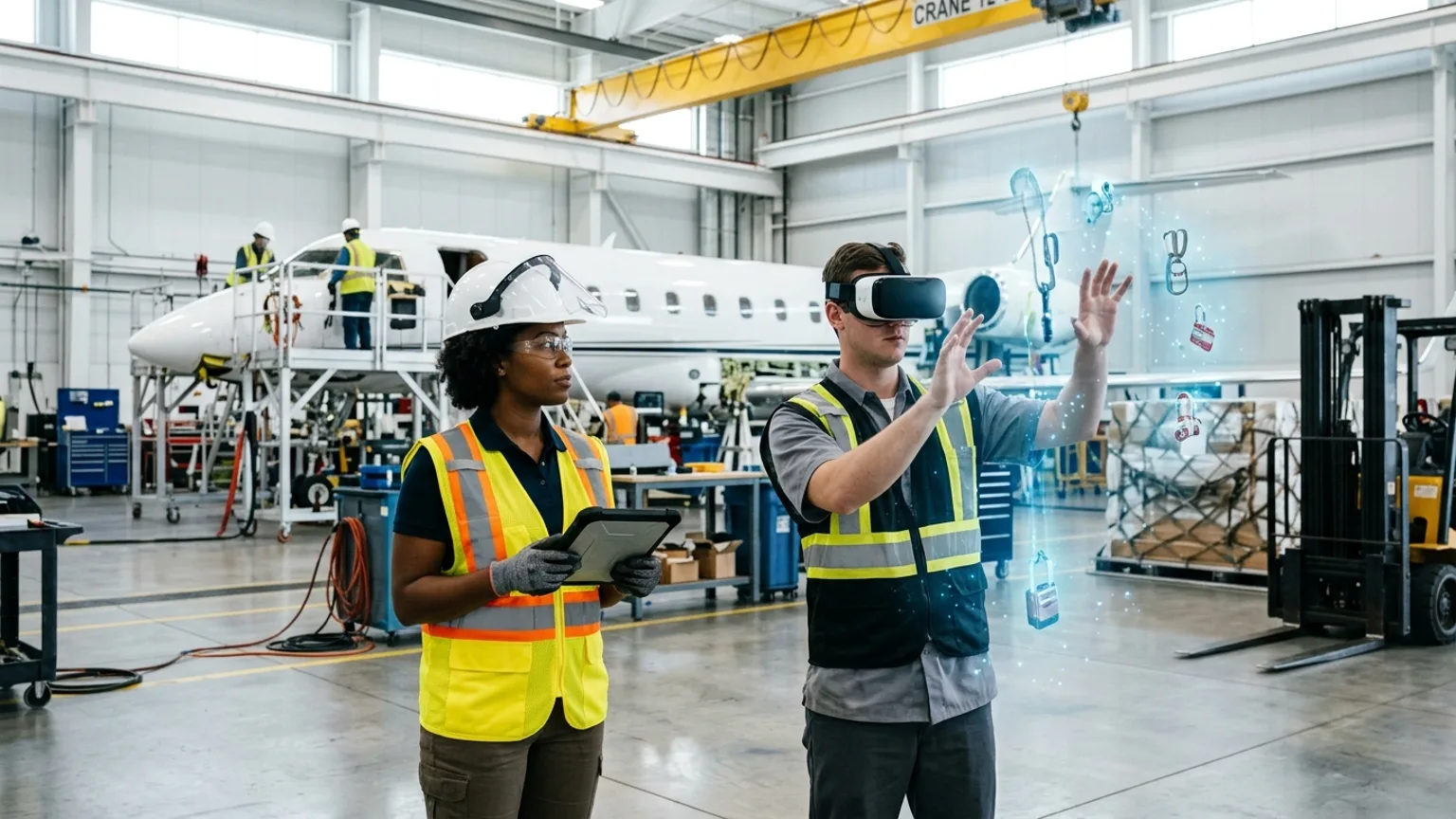
The companies above deliver the OSHA and NC OSH forklift, general-industry, and construction training every Greensboro operation needs. The Prime VR represents the layer most of that training is missing: custom virtual reality programs where Greensboro workers practice forklift and cargo handling, lockout/tagout, crane and rigging, confined space entry, and emergency response in realistic simulations of your actual warehouse, plant, or site, with performance measured step by step.
A forklift or ground-handling operator can rehearse a load and clearance sequence dozens of times in VR with zero real-world risk, an aviation-manufacturing worker can practice a rigging lift or a lockout, and a construction worker can practice a tie-off at height, with every decision recorded so a safety manager can see who is genuinely ready. Because the program is built around your specific systems and owned outright, there are no per-seat fees, and it can be reused for every new hire and every shift across a large workforce, in multiple languages. For a logistics and aviation-manufacturing hub, that repeatable, measured practice is a natural fit.
Learn more about VR safety and operations training, how it applies to construction safety, or confined space VR training.
The bilingual reality of the Greensboro workforce
A share of Greensboro's warehouse, manufacturing, and construction workforce speaks Spanish as a first language, and the region's diverse communities add further language variety. Safety training delivered only in English leaves a real gap. A worker can pass a written test in a second language and still miss a nuance that matters during a forklift load, a lockout, or a rigging lift. Serious Greensboro employers deliver bilingual training and documentation for exactly this reason, both for genuine comprehension and for defensibility if an incident is investigated. Any modern approach, including a custom immersive program, should be authorable in multiple languages so the experience and the assessment are equivalent for every worker on the crew.
The cost of getting it wrong
The financial exposure is real and rising. North Carolina's OSH program applies penalty structures aligned with federal OSHA, where a serious violation can reach the mid five figures per instance and a willful or repeated violation can reach into the six figures, with failure-to-abate penalties accruing daily. For a Greensboro distribution firm, aviation plant, or contractor, an inadequate forklift, lockout/tagout, or fall protection program can generate multiple citations at once. Those figures do not include workers compensation, downtime, litigation, and higher insurance, and a serious incident can halt a cargo operation or a production line. Training is one of the least expensive forms of protection available, but only if it actually changes what a worker does under real conditions. For operations where throughput and precision depend on people working safely, that is not a compliance line item, it is a core business risk.
How to choose a Greensboro safety training partner
Start with your world. If you run air cargo or logistics, prioritize forklift and powered-truck training, dock and material-handling safety, and struck-by awareness around ground equipment. If you work in aviation or advanced manufacturing, prioritize crane and rigging, machine guarding, and confined space. If you are a contractor, prioritize fall protection and scaffold specialists who can train across shifts on-site. Across all, confirm bilingual delivery and familiarity with the NC OSH program. And if your problem is that workers are certified but incidents still happen, that is the signal you need practice, not more paperwork.
Many Greensboro employers end up with a blend: local specialists for the required certifications and compliance, plus an immersive layer for the highest-consequence procedures and for keeping a large workforce genuinely ready. The certifications keep you compliant. The practice keeps your people safe and gives you an objective record to show during an NC OSH inspection or an internal safety review. In a market defined by logistics volume and aviation-grade precision, that demonstrable competency is not just a safety asset, it is a business one that protects throughput, quality, and reputation together.
What a VR pilot looks like for a Greensboro operation
A custom immersive program starts with your hazards, not a headset. A typical build runs in four phases. Discovery maps the specific procedures you want workers to practice, drawing on your incident history, your facilities or sites, and the people who run the work. Design turns those into interactive scenarios with defined success criteria. Build develops and tests the environment against your real operation, from a forklift load to a rigging lift to a lockout/tagout. Deploy handles hardware, learning management system integration, and train-the-trainer so your team runs it without an outside vendor.
For a Greensboro operation, a sensible starting point is a single high-consequence procedure tied to your dominant hazard, often forklift and dock safety for logistics, crane and rigging for aviation and manufacturing, or fall protection for construction, delivered as a pilot before expanding. That keeps the investment contained while proving whether measured practice moves your leading indicators, from near-miss reports to new-worker readiness. Because the finished program is owned rather than licensed per seat, the economics improve every time you onboard another crew, add another shift, or open another facility.
Frequently Asked Questions
Who are the best safety training companies in Greensboro?+
The leading providers serving Greensboro include Guilford Technical Community College, the Southeastern OSHA Training Institute Education Center, OSHA Training Services, Tri-Lift Industries, Safety Consultants USA, Forklift Safety, and the National Safety Council. Because Greensboro is a logistics and aviation-manufacturing hub with a manufacturing base and a steady construction market, several specialize in forklift, general-industry, and construction OSHA alongside hands-on operator training. The right choice depends on whether your gap is logistics, aviation and manufacturing, or construction. For teams that must actually perform procedures under real conditions rather than only pass a course, immersive VR safety training from The Prime VR is an emerging complement.
How much does safety training cost in Greensboro?+
Pricing in Greensboro follows national ranges. OSHA 10 or 30 cards run roughly 80 to 250 dollars per seat, forklift, confined space, and specialized courses run per seat, and on-site group delivery is priced per class. Custom immersive VR safety training, built around your real Greensboro warehouse, aviation plant, or construction operation and owned rather than licensed per seat, typically runs from 25,000 to 500,000 dollars depending on scope.
Why is Greensboro's safety training market distinctive?+
Greensboro anchors the Piedmont Triad and is a major logistics hub, home to a FedEx Mid-Atlantic air-cargo operation at Piedmont Triad International Airport and a dense distribution base. It is also a growing aviation-manufacturing center, home to HondaJet and the Boom Supersonic Overture facility, alongside a deep textile heritage and advanced manufacturing, including major battery investment in the region. That mix creates safety needs spanning air-cargo and forklift work, aerospace and manufacturing hazards, and construction, a distinctive combination for a mid-sized metro.
What safety training does Greensboro's aviation and manufacturing sector need?+
Aviation manufacturing and the region's broader industrial base operate under general-industry standards. Core needs include machine guarding, lockout/tagout under 29 CFR 1910.147, overhead crane and rigging safety, hot work, hazardous coatings and solvents under hazard communication, confined space entry, and fall protection on aircraft and structures. Battery and advanced manufacturing add chemical and process hazards. These procedures are high-consequence and repeat across shifts, exactly the profile where measured practice adds value beyond a completion certificate.
What is VR safety training and how does it fit Greensboro employers?+
Immersive VR safety training puts workers in realistic simulations where they practice real procedures such as forklift and cargo handling, lockout/tagout, crane and rigging, confined space entry, and emergency response, and the system measures how they perform step by step. It complements an OSHA course by turning knowledge into repeatable, measured practice, built around your actual Greensboro operation and owned rather than licensed per seat. For logistics, aviation, and manufacturing employers with turnover, that reuse changes the economics.
Does North Carolina use federal OSHA or a state plan?+
North Carolina operates its own OSHA-approved state plan, administered by the North Carolina Department of Labor's Occupational Safety and Health Division, covering both private and public employers with standards at least as effective as federal OSHA. Greensboro warehouses, plants, and contractors train and comply under the North Carolina program rather than federal OSHA directly, though the core requirements closely mirror the federal standards.
Do Greensboro providers offer bilingual training?+
Yes. A share of Greensboro's warehouse, manufacturing, and construction workforce is Spanish-speaking, and several providers deliver bilingual courses. Bilingual delivery matters for genuine comprehension of life-safety procedures and for defensible documentation if an incident is investigated. Any modern approach, including a custom VR program, should be authorable in multiple languages so the experience and the assessment are equivalent for every worker on the crew.
Can VR training prove competency for audits and prequalification?+
Yes. A custom VR program records each worker's decisions, response times, and completion, and can pass that data to your learning management system. For Greensboro distribution firms, aviation plants, and contractors preparing for an NC OSH inspection or a customer prequalification, that objective per-worker record helps demonstrate that workers can actually perform a procedure such as a forklift load, a crane lift, or a fall-protection tie-off, not just that they attended a class.
Want Greensboro crews to practice the procedure before it counts?
We build custom VR training around your real warehouse, plant, or site. Tell us your setup and we will scope it.