
Mobile Plant VR Training for Queensland Quarries (Mining and Quarrying Safety and Health Act 1999)
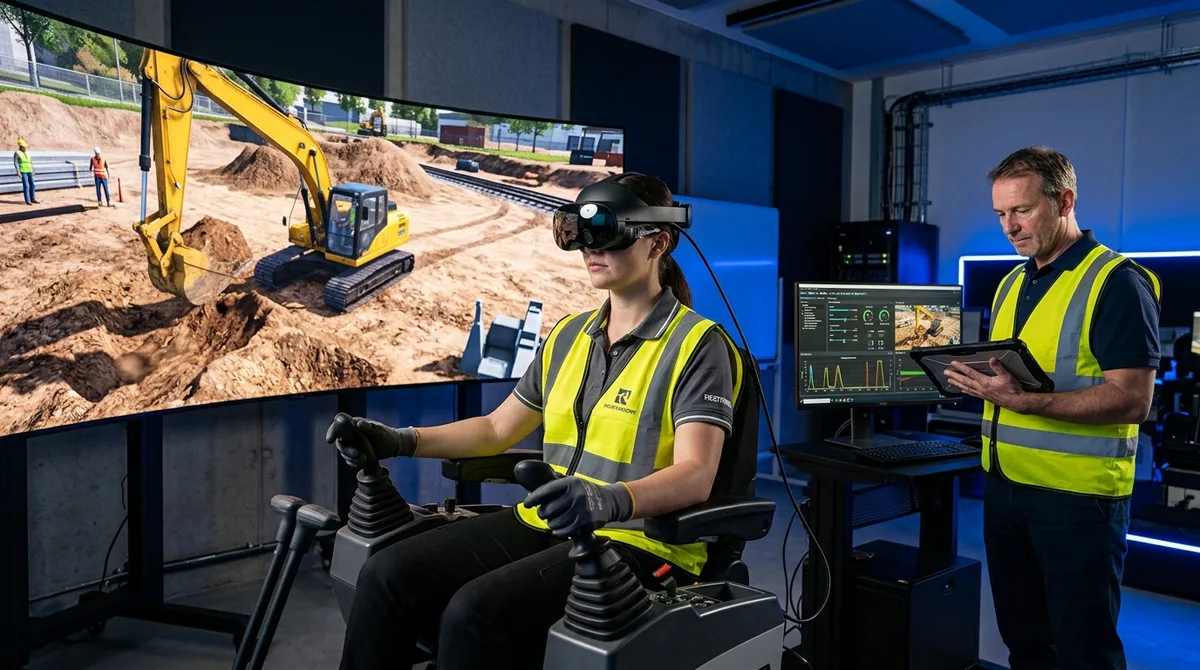
VR mobile plant scenario for Queensland quarries and metal mines under the MQSH Act 1999: pre-start checks, ramps, interactions and exclusion zones.
QUICK ANSWER
Queensland metalliferous mines and quarries operate under the Mining and Quarrying Safety and Health Act 1999, which requires a safety and health management system and competent workers. A VR quarry lets operators practise pre-start checks, ramp driving and interactions with other plant and people.
What the Rule Requires
Mining and Quarrying Safety and Health Act 1999 (Qld): the Act applies to Queensland metalliferous mines and quarries. It requires a safety and health management system to keep risk at an acceptable level, places duties on the site senior executive, supervisors and workers, and requires workers to be competent for their tasks. Workers may withdraw from danger.
The scenario is a hard rock quarry near Toowoomba. A loader operator starts a shift with a cracked mirror, a service truck is parked near the face and a contractor walks into the loading area to talk to the excavator operator.
Hazards in This Scenario
- Collisions between plant and light vehicles
- People on foot in exclusion zones
- Rollovers on ramps and benches
- Plant faults missed at pre-start
The Procedure the Scenario Rehearses
- Complete the pre-start and report defects
- Confirm radio contact before entering the area
- Keep exclusion zones clear of people
- Use the correct gear on ramps
- Stop when a person enters the zone
- Park on level ground with the bucket down
Mistakes the Scenario Is Built to Catch
- Running with a damaged mirror
- Entering without radio contact
- Waving a pedestrian through
- Parking on a slope
Competence Assessment Matrix
| Decision point | What the assessor sees | Pass standard |
|---|---|---|
| Pre-start | Defect found | Reported before use |
| Comms | Radio contact | Before entering |
| Zones | Person in zone | Plant stopped |
| Parking | Position | Level, bucket down |
What VR Covers
- Interactions with plant and people
- Ramp handling without rollover risk
- Defects hidden in the pre-start
- Records per operator
What VR Does Not Replace
- Site competency assessment
- Traffic management plans
- Plant maintenance systems
Scope of a One-Scenario Pilot
A pilot builds this scenario as a single module, in Unity or Unreal Engine depending on the visual fidelity the task needs and the headsets on site. It runs on standalone headsets, logs every learner decision, and exports a per-person record for your training file. It is measured against your current method with a test cohort before anything is scaled.
Frequently Asked Questions
Which law covers Queensland quarries?
The Mining and Quarrying Safety and Health Act 1999 covers metalliferous mines and quarries.
Can VR count toward competency?
It supports competency. The site still assesses each operator under its system.
Why focus on interactions?
Collisions between plant, light vehicles and people are among the most serious quarry risks.
Want this scenario built around your site?
We review your current procedure and tell you which parts can be rehearsed in VR and which still need hands-on practice.
Map Your Highest-Risk ScenarioFurther reading
- Confined Space Entry VR Training for Australian Industry (Model Code of Practice: Confined Spaces)
- Coal Mine Safety VR Training for Queensland Operations (Coal Mining Safety and Health Act 1999)
- Noise and Hearing Loss VR Training for Australian Mines and Plants (Model Code: Managing Noise)
- Welding Safety VR Training for Australian Workshops and Sites (Model Code of Practice: Welding Processes)
- Heavy equipment simulator training
- Heavy equipment operator safety
- All VR training scenarios: Australia
- VR pilot readiness checklist
- How VR training programs are priced