
Forklift and Pedestrian Safety VR Training: Cross Aisles, Blind Corners and Shared Floors
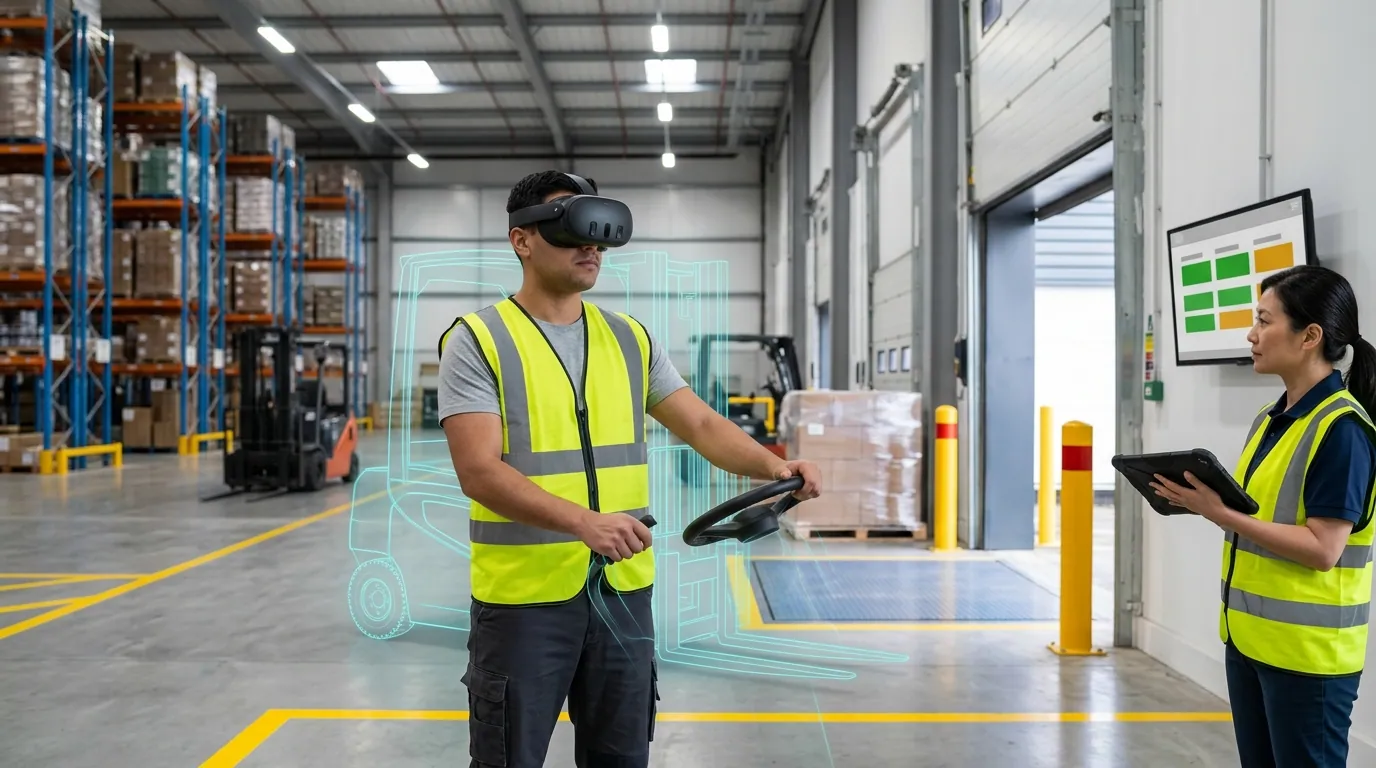
VR scenario on forklift and pedestrian interaction under OSHA 1910.178(n) and (m): cross aisles, blind corners, traveling with the load trailing and walkers who do not look.
QUICK ANSWER
OSHA 1910.178(n)(4) requires operators to slow down and sound the horn at cross aisles and other places where vision is obstructed, and (m)(2) bars anyone from standing or passing under a raised load. A VR scenario trains both sides of the problem: operators who must expect pedestrians, and walkers who must expect trucks, on a busy shared floor.
What the Rule Requires
29 CFR 1910.178(n), Traveling: the driver must slow down and sound the horn at cross aisles and other locations where vision is obstructed, travel with the load trailing if the load blocks the forward view, look in the direction of travel and keep a clear view of the path. Under 1910.178(m)(2), no person may stand or pass under the elevated portion of any truck, loaded or empty.
Struck-by incidents between forklifts and walkers happen where routes cross: at dock doors, at the end of rack aisles and at the break room door. The scenario is a peak-hour cross-dock with three trucks working, a picker on foot with earbuds, a visitor led by a supervisor, and a stack of empty pallets blocking the sight line at the end of aisle 14.
Hazards in This Scenario
- Pedestrians stepping out from the end of rack aisles
- Loads that block the operator view in the travel direction
- Walkers passing under or next to a raised load
- Noise, earbuds and reversing alarms that people stop hearing
The Procedure the Scenario Rehearses
- Read the floor plan: marked walkways, crossings and truck-only aisles
- Slow down and sound the horn at each cross aisle and blind corner
- Travel in reverse with the load trailing when the load blocks the view
- Stop and make eye contact before passing a pedestrian
- Keep everyone out from under the forks while lifting and lowering
- Report the blocked sight line so it is cleared, not driven around
Mistakes the Scenario Is Built to Catch
- Honking but not slowing down at a cross aisle
- Driving forward with a tall load and leaning out to look around it
- Waving a walker through while the forks are raised
- Walking down a truck aisle to save time because it is shorter
Competence Assessment Matrix
| Decision point | What the assessor sees | Pass standard |
|---|---|---|
| Cross aisle approach | Speed and horn use at intersections | Slows and sounds the horn at every cross aisle |
| Load blocking view | Travel direction with a tall load | Load trailing, looking in the travel direction |
| Pedestrian contact | Behavior when a walker appears | Stops, makes eye contact, then proceeds |
| Raised load | Anyone under or near the raised forks | No one under the elevated portion |
What VR Covers
- Both roles in the same scenario: operator and pedestrian
- Near misses shown from the walker point of view without risk
- Traffic density that can be raised as the learner improves
- Records that show when each learner slowed, honked and stopped
What VR Does Not Replace
- Physical separation: barriers, marked walkways and traffic plans
- Supervised driving on your real floor
- Site rules for visitors and contractors
Scope of a One-Scenario Pilot
A pilot builds this scenario as a single module, in Unity or Unreal Engine depending on the visual fidelity the task needs and the headsets on site. It runs on standalone headsets, logs every learner decision, and exports a per-person record for your training file. It is measured against your current method with a test cohort before anything is scaled.
Frequently Asked Questions
What does OSHA require at cross aisles?
Operators must slow down and sound the horn at cross aisles and other places where vision is obstructed, under 1910.178(n)(4).
Who should receive pedestrian training?
Anyone who works on a floor with trucks, not only drivers. OSHA puts the duty on operators, but walkers who know the hazards make the floor safer.
Can the scenario use our floor layout?
Yes. The scenario can be built from your floor plan, rack layout and traffic rules.
Want this scenario built around your site?
We review your current procedure and tell you which parts can be rehearsed in VR and which still need hands-on practice.
Scope One ScenarioFurther reading
- Forklift Pre-Shift Inspection VR Training (OSHA 1910.178(q)(7))
- Forklift Refresher Training and Three-Year Evaluation in VR (OSHA 1910.178(l)(4))
- Forklift Ramps and Grades VR Training: Load Upgrade, Tilt and Unattended Trucks
- Forklift Stability and Tip-Over VR Training: The Stability Triangle and What to Do in a Tip
- Forklift training simulators
- Warehouse safety training programs
- All VR training scenarios: United States
- VR pilot readiness checklist
- How VR training programs are priced
VR scenario designs related to this topic
Proposed practice scenarios and checklist guides built around specific tasks. Each one lists what VR does not replace.
- Warehouse Pedestrian Safety: VR Scenarios for Teams
- Forklift Safety Rules in Warehouse: What to Cover and Check
- Forklift Pedestrian Safety in VR: Scenario and Pilot
- Safety Harness for Forklift in VR: Scenario and Pilot
- Forklift Safety Plan: VR Scenarios for Teams
- Safety Awareness for Forklift Equipment Safe Lift
- Safety Awareness for Forklift Equipment: VR Scenarios
- Forklift Battery Charging Safety with VR Practice Scenarios