
Construction Site Traffic VR Training: Reversing Plant, Banksmen and Pedestrian Routes (CDM 2015, Regulation 27)
VR site traffic scenario on CDM 2015 regulation 27: segregated pedestrian routes, reversing plant, banksmen, blind spots and delivery management.
QUICK ANSWER
Regulation 27 of CDM 2015 requires a construction site to be organised so that pedestrians and vehicles can move safely, with traffic routes that are suitable and do not put people at risk. Most site transport deaths involve reversing vehicles. A VR scenario shows workers the blind spots from the cab and the banksman role.
What the Rule Requires
CDM 2015, regulation 27 (traffic routes) and regulation 28 (vehicles): a construction site must be organised so that, so far as is reasonably practicable, pedestrians and vehicles can move without risks to health or safety. Traffic routes must be suitable for the persons or vehicles using them, sufficient in number, in suitable positions and of sufficient size. Regulation 28 requires steps to prevent unintended movement of vehicles and to give warning of movement.
The scenario is a busy housing site with a dumper, a telehandler and a concrete delivery arriving at once. The pedestrian route is blocked by stored pallets, the banksman is on a phone call and a labourer walks behind the reversing dumper.
Hazards in This Scenario
- People struck by reversing plant
- Blocked pedestrian routes
- Unmanaged deliveries
- Blind spots on dumpers and telehandlers
The Procedure the Scenario Rehearses
- Keep pedestrians and plant apart with routes and barriers
- Plan deliveries to avoid conflict
- Use a trained banksman for reversing
- Make eye contact with the driver before approaching
- Keep pedestrian routes clear of materials
- Stop plant if anyone enters the danger zone
Mistakes the Scenario Is Built to Catch
- Walking behind reversing plant
- Banksman distracted
- Materials stored on walkways
- Several deliveries at once with no plan
Competence Assessment Matrix
| Decision point | What the assessor sees | Pass standard |
|---|---|---|
| Routes | Pedestrian route clear | Cleared or reported |
| Banksman | Control of reversing | Attentive and in position |
| Approach | Contact with driver | Eye contact first |
| Stop | Response to pedestrian in zone | Plant stopped |
What VR Covers
- Blind spots seen from the cab
- Busy site conditions
- Banksman practice
- Records per worker
What VR Does Not Replace
- A real traffic management plan
- Plant operator training
- Physical barriers and route layout
Scope of a One-Scenario Pilot
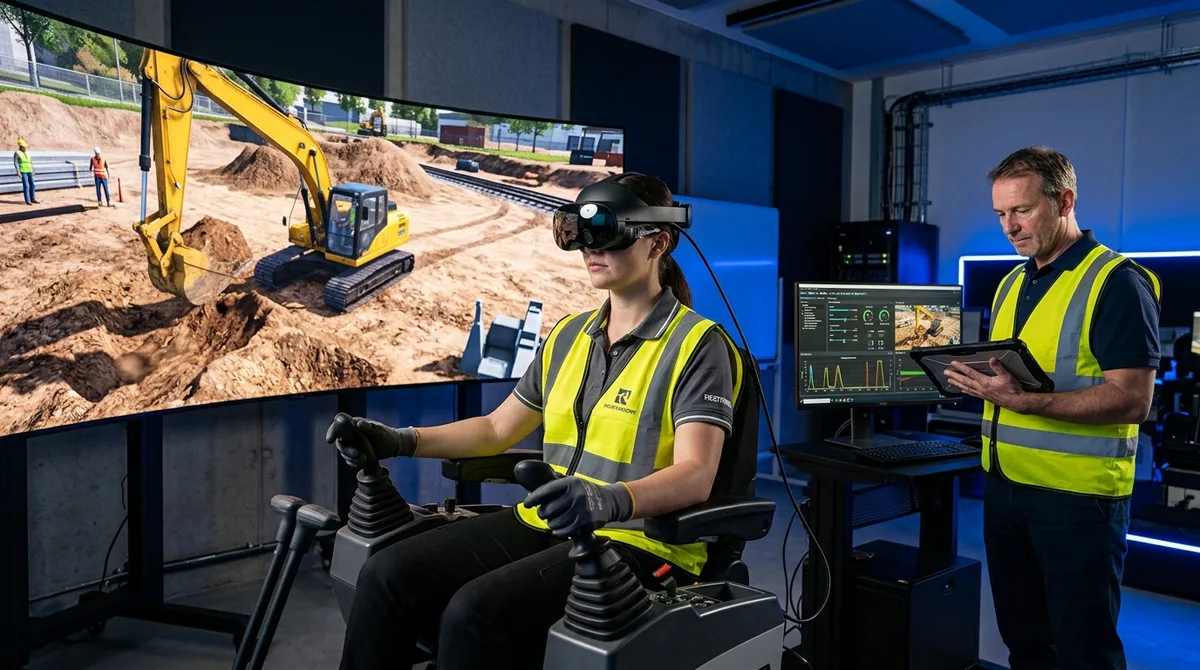
A pilot builds this scenario as a single module, in Unity or Unreal Engine depending on the visual fidelity the task needs and the headsets on site. It runs on standalone headsets, logs every learner decision, and exports a per-person record for your training file. It is measured against your current method with a test cohort before anything is scaled.
Frequently Asked Questions
What does CDM require for site traffic?
Safe organisation of the site so pedestrians and vehicles can move safely, with suitable traffic routes.
Is a banksman always required?
Where reversing cannot be avoided and visibility is limited, a trained banksman is a common control.
Can VR show plant blind spots?
Yes. Learners sit in the cab and see what the driver sees.
Want this scenario built around your site?
We review your current procedure and tell you which parts can be rehearsed in VR and which still need hands-on practice.
Map Your Highest-Risk ScenarioFurther reading
- Work at Height VR Training for UK Construction Sites (Work at Height Regulations 2005)
- Scaffold Inspection VR Training: 7-Day Checks and Reports (Work at Height Regulations, Regulation 12)
- Ladder and Stepladder VR Training for UK Sites (Work at Height Regulations, Schedule 6)
- MEWP VR Training: Scissor and Boom Lift Operation, Entrapment and Rescue (PUWER and LOLER)
- Heavy equipment simulator training
- All VR training scenarios: United Kingdom
- VR pilot readiness checklist
- How VR training programs are priced