
Legionella Control VR Training for Hotel Maintenance Staff (COSHH and HSE ACOP L8)
VR legionella scenario on COSHH 2002 and HSE ACOP L8: water temperatures, flushing little-used outlets, shower heads, records and when to escalate.
QUICK ANSWER
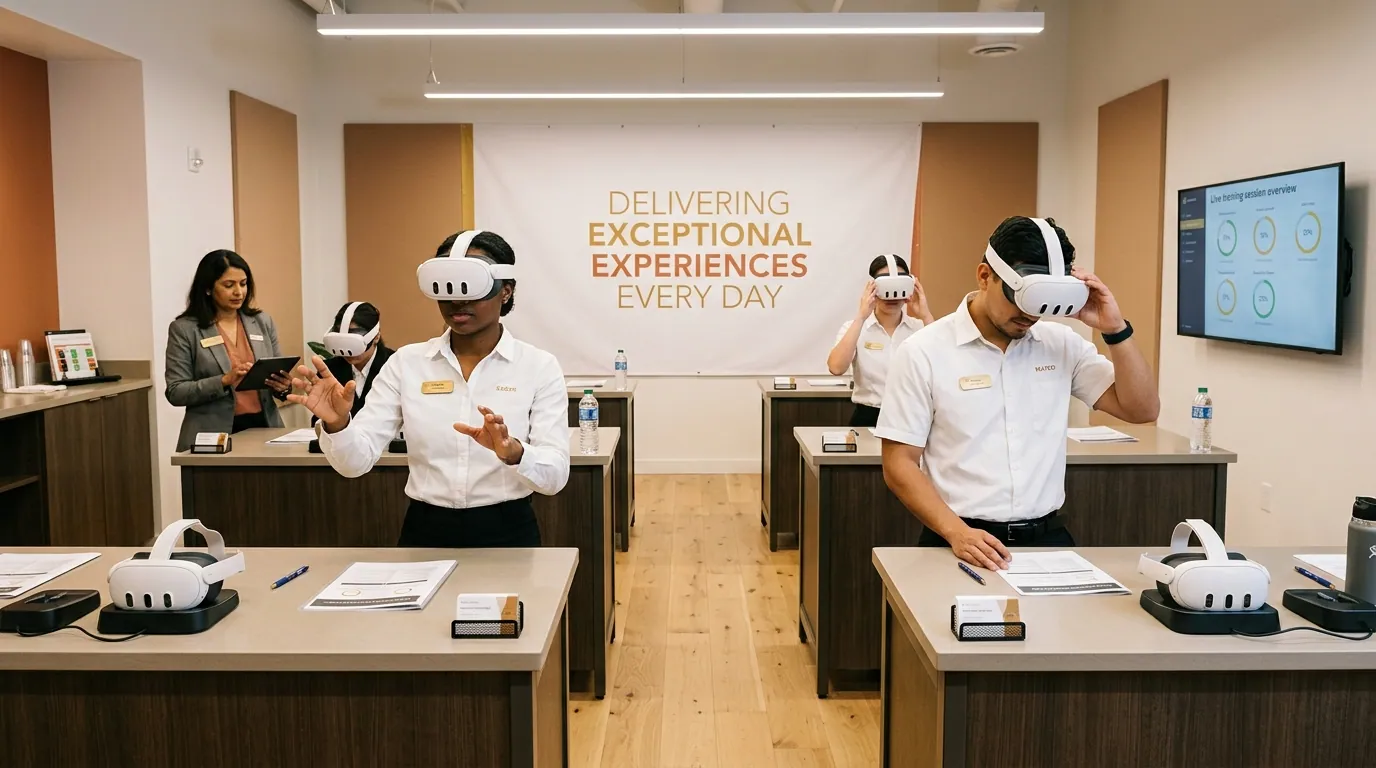
HSE Approved Code of Practice L8 explains how to control legionella in water systems under COSHH 2002, including a risk assessment, a responsible person, temperature checks and flushing outlets that are rarely used. Hotels have many such outlets. A VR scenario trains maintenance staff on the routine.
What the Rule Requires
COSHH 2002, with HSE Approved Code of Practice L8: L8, Legionnaires disease: the control of legionella bacteria in water systems, gives practical advice for dutyholders. It requires a risk assessment, a written control scheme, a responsible person, monitoring such as temperature checks, and measures such as flushing little-used outlets. COSHH applies because legionella is a hazardous biological agent.
The scenario covers a hotel floor after a quiet month. Several rooms have not been used, a shower head is scaled, the hot water at an outlet reaches only 45 degrees after a minute and the record sheet is incomplete.
Hazards in This Scenario
- Legionella growth in stagnant water
- Low hot water temperatures
- Scale and sludge in shower heads
- Missing or incomplete records
The Procedure the Scenario Rehearses
- Flush little-used outlets on schedule
- Check hot and cold temperatures
- Clean and descale shower heads
- Record every check in the log
- Escalate out-of-range readings
- Follow the written scheme
Mistakes the Scenario Is Built to Catch
- Skipping flushing in empty rooms
- Ignoring a lukewarm hot outlet
- Leaving scaled shower heads in place
- Doing checks but not recording them
Competence Assessment Matrix
| Decision point | What the assessor sees | Pass standard |
|---|---|---|
| Flushing | Little-used outlets flushed | Weekly, per the written scheme |
| Temperatures | Hot and cold readings | Hot at 50 C or above, cold below 20 C, out-of-range spotted |
| Shower heads | Scale and sludge | Cleaned and descaled on schedule |
| Escalation | Out-of-range reading | Reported to the responsible person the same day |
What VR Covers
- Building walk with outlets
- Temperature reading practice
- Escalation decisions
- Records per technician
What VR Does Not Replace
- The risk assessment
- Water treatment contractors
- Sampling and testing
Scope of a One-Scenario Pilot
A pilot builds this scenario as a single module, in Unity or Unreal Engine depending on the visual fidelity the task needs and the headsets on site. It runs on standalone headsets, logs every learner decision, and exports a per-person record for your training file. It is measured against your current method with a test cohort before anything is scaled.
Frequently Asked Questions
Do hotels need legionella control?
Yes. Hotels have water systems where legionella can grow.
What is L8?
L8 is the HSE Approved Code of Practice on controlling legionella bacteria in water systems.
Can VR train legionella checks?
It trains the routine and the decisions. Sampling and the risk assessment stay with competent people.
Want this scenario built around your site?
We review your current procedure and tell you which parts can be rehearsed in VR and which still need hands-on practice.
Map Your Highest-Risk ScenarioFurther reading
- Hotel Fire Evacuation VR Training (Regulatory Reform (Fire Safety) Order 2005)
- Kitchen Slips and Trips VR Training (Workplace Regulations 1992, Regulation 12)
- Food Hygiene VR Training for UK Food Handlers (Regulation 852/2004, Annex II, Chapter XII)
- Allergen VR Training for Restaurant and Hotel Staff (Food Information Regulations 2014)
- VR hospitality training
- All VR training scenarios: United Kingdom
- VR pilot readiness checklist
- How VR training programs are priced