
Dropped Objects from Height VR Training for NEOM Construction Crews
Practise dropped objects from height decisions in NEOM with custom VR: spot changed conditions, stop unsafe work and verify controls.
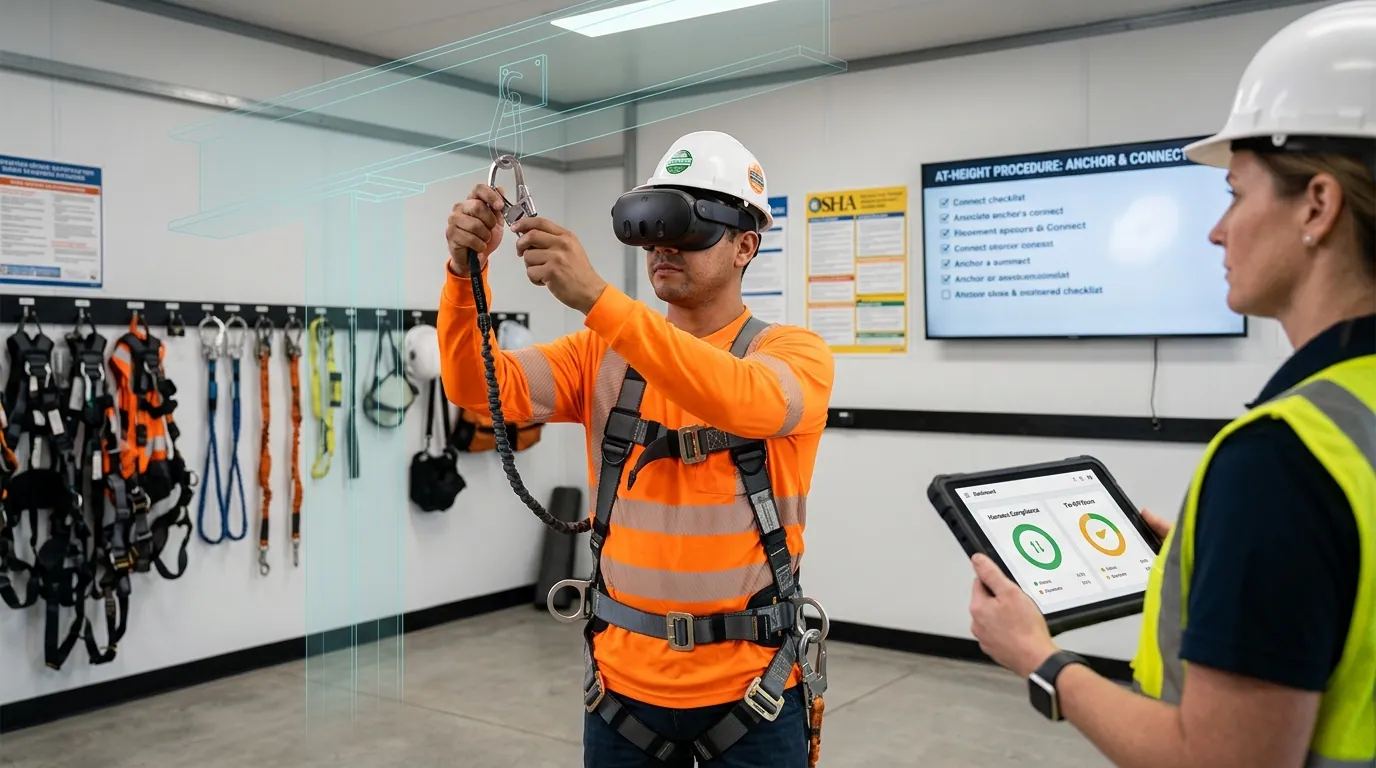
QUICK ANSWER
A NEOM construction crew can use VR to rehearse controlling loose equipment above another construction crew without entering the live hazard. The proposed scene is a coastal accommodation stair tower, where loose cladding clips collect beside an open stairwell edge. Learners investigate the containment, tool retention and exclusion arrangement, challenge an unsafe request and explain the conditions needed for release.
What the Rule Requires
Saudi Labor Law (Royal Decree No. M/51): The Saudi Labor Law provides the cited starting point for reviewing dropped objects from height at the coastal accommodation stair tower. Map the containment, tool retention and exclusion arrangement to the approved method and retain the evidence behind the stair containment and lower access exclusion for content review. The employer must confirm current requirements with the regulator and the operator for the NEOM coastal accommodation stair tower.
A fictional NEOM coastal accommodation stair tower provides the work front for this exercise. The crew discovers that loose cladding clips collect beside an open stairwell edge, while ground crews carry materials through the entrance below. The learner takes the reporting role and must explain the issue to the supervisor coordinating cladding and delivery crews.
What can go wrong with dropped objects from height at this NEOM site?
The NEOM scenario begins during controlling loose equipment above another construction crew, with an ordinary work request rather than an emergency. At the coastal accommodation stair tower, loose cladding clips collect beside an open stairwell edge. A learner who relies on yesterday's briefing may miss the consequence: a tool or fitting falling onto people below. The competing demand is equally visible because ground crews carry materials through the entrance below. Inspection should cover the containment, tool retention and exclusion arrangement, with enough information to recognise uncertainty rather than guess. The exercise is fictional.
A remote or multi-package work front needs a clear owner for the decision to stop overhead work until loose items and the area below are controlled. In this NEOM exercise, that escalation reaches the supervisor coordinating cladding and delivery crews, who must resolve the issue before the crew relies on the stair containment and lower access exclusion. For dropped objects from height, let the trainee describe the safe waiting state and who needs to know about the hold. The debrief should address assuming helmets make work beneath loose materials acceptable, including how programme pressure can make it sound reasonable. Ask what the next crew would see at the coastal accommodation stair tower if the original supervisor left before the issue was closed.
How is the NEOM dropped objects from height scenario built and assessed?
To build this NEOM module, The Prime VR first separates the worker's decisions from the responsibilities associated with rated retention equipment and physical containment design. The employer provides the work sequence for the coastal accommodation stair tower and identifies the documents that establish the stair containment and lower access exclusion. Introduce small fixings left beside an unsealed platform gap as something the learner can investigate, not an object carrying an answer label. A colleague can then request progress while ground crews carry materials through the entrance below. Review the dialogue with the supervisor coordinating cladding and delivery crews so the correct response is possible within the actual reporting system, including a safe option when the responsible reviewer is temporarily unavailable.
The assessment should show whether a learner understood the containment, tool retention and exclusion arrangement before committing the crew to exposure. For the coastal accommodation stair tower, record the first choice, the explanation and any support needed from the trainer. Set a critical stop around a tool or fitting falling onto people below; do not let several easy answers cancel an unsafe decision there. The employer can use the matrix to define what secured tools, contained materials and an enforced drop zone looks like in the NEOM setting. Practical performance of tool retention setup, material storage and physical barrier inspection remains a separate matter, requiring the real equipment, suitable supervision and the employer's normal competence process.
Who needs dropped objects from height practice in Saudi Arabia, and when should they repeat it?
For dropped objects from height, the initial group should include overhead trades, platform supervisors and workers controlling lower access from the relevant work package. At the coastal accommodation stair tower, their learning needs differ: one person recognises the problem, another controls access, and someone else accepts the stair containment and lower access exclusion. Keep those responsibilities explicit. Give learners a quiet practice period before scoring controller actions, then discuss small fixings left beside an unsealed platform gap in their own words. For the NEOM coastal accommodation stair tower, the review should resolve this question: who works above versus who closes access.
For this task, work moving above a new route or a platform opening being exposed is a practical reason to review what was taught. Have the supervisor coordinating cladding and delivery crews check whether the accepted procedure still matches the coastal accommodation stair tower. A new subcontractor or an observed unsafe decision may also justify targeted rehearsal around the containment, tool retention and exclusion arrangement. The dropped objects from height exercise does not replace certification, permits or hands-on training. Workers still need the required authorisation and supervised practice, including tool retention setup, material storage and physical barrier inspection, before taking on duties beyond their established competence.
How would a dropped objects from height pilot run at the coastal accommodation stair tower?
Scope the NEOM pilot around one decision chain at the coastal accommodation stair tower, not every safety issue across a large programme. The scoping call should establish how learners will stop overhead work until loose items and the area below are controlled and who will accept the resulting evidence. Use that early review to agree the work boundaries, language needs and depiction of the stair containment and lower access exclusion. Development timing follows the accepted scope. Ask the supervisor coordinating cladding and delivery crews to identify any project procedure that cannot be reproduced or shared, so the training uses approved information without implying a relationship with the wider development.
Pilot review for dropped objects from height should ask whether the simulated choice carries over into a supervised conversation at the real work front. At the coastal accommodation stair tower, the useful evidence is whether learners recognise small fixings left beside an unsealed platform gap, explain the hold and seek the stair containment and lower access exclusion. Let the supervisor coordinating cladding and delivery crews review unexpected answers before changing the scoring. For the NEOM coastal accommodation stair tower, the review should resolve this question: how lower access remains protected.
Hazards in This Scenario
- Loose fittings near platform gaps
- Unsecured hand tools
- People below simultaneous work
- Materials disturbed during lifting
The Procedure the Scenario Rehearses
- Identify people working below
- Inspect platform containment
- Use suitable tool retention
- Contain small parts securely
- Enforce lower exclusion zones
- Reassess when overhead work moves
Mistakes the Scenario Is Built to Catch
- Balancing tools on a rail
- Leaving fixings in open piles
- Working over an occupied doorway
- Using improvised tool attachments
Competence Assessment Matrix
| Decision point | What the assessor sees | Pass standard |
|---|---|---|
| Containment | Open gap beside loose parts | Contain parts and address the opening |
| Tools | Unsecured tool at the edge | Use an approved retention arrangement |
| Below | Crew enters drop zone | Stop overhead work |
| Move | Task shifts above a doorway | Reassess and relocate the exclusion |
What VR Covers
- Changed-condition rehearsal at the coastal accommodation stair tower
- Inspection choices involving the containment, tool retention and exclusion arrangement
- Reporting practice with the supervisor coordinating cladding and delivery crews
- Feedback linked to the stair containment and lower access exclusion
What VR Does Not Replace
- Practical instruction in tool retention setup, material storage and physical barrier inspection
- Competent decisions about rated retention equipment and physical containment design
- Real permits, certification and work authorisation for the coastal accommodation stair tower
Scope of a One-Scenario Pilot
A pilot builds this scenario as a single module, in Unity or Unreal Engine depending on the visual fidelity the task needs and the headsets on site. It runs on standalone headsets, logs every learner decision, and exports a per-person record for your training file. It is measured against your current method with a test cohort before anything is scaled.
Frequently Asked Questions
What is the first decision in NEOM dropped objects from height training?
The first decision at the coastal accommodation stair tower is whether the change that loose cladding clips collect beside an open stairwell edge invalidates the planned work. Let the learner investigate the containment, tool retention and exclusion arrangement before making a commitment.
What practical work stays outside the NEOM dropped objects from height module?
For this NEOM work package, keep tool retention setup, material storage and physical barrier inspection within the employer's practical competence arrangements. The coastal accommodation stair tower simulation rehearses decisions, not equipment skill or engineering acceptance. The training review should identify who verifies the stair containment and lower access exclusion on site and prevent a headset completion record from being treated as that physical verification.
Which inputs are useful when scoping NEOM dropped objects from height?
Bring the procedure used at the coastal accommodation stair tower and the decision records associated with the stair containment and lower access exclusion. Explain that ground crews carry materials through the entrance below, because the competing request shapes the dialogue and the safe waiting response.
What could trigger a refresher for NEOM dropped objects from height?
At the coastal accommodation stair tower, the employer should review training when work moving above a new route or a platform opening being exposed affects the work method. The NEOM coastal accommodation stair tower reviewer should also explain how the stair containment and lower access exclusion supports the decision.
How is language understanding checked for NEOM dropped objects from height?
Test the language for the containment, tool retention and exclusion arrangement with the people assigned to the coastal accommodation stair tower, including supervisors who receive reports. Ask the supervisor coordinating cladding and delivery crews to confirm that the translated instruction identifies the actual escalation route, especially when several work packages share a boundary.
What does the 48-hour mockup offer mean for NEOM dropped objects from height?
A scoping call about the coastal accommodation stair tower is followed by The Prime VR's offer of a scenario mockup within 48 hours. It should show how a learner requests the stair containment and lower access exclusion, while final delivery and acceptance follow the scope agreed with the employer.
Running this scenario across several sites or contractors?
We review your current procedure and tell you which parts can be rehearsed in VR and which still need hands-on practice.
Plan a Multi-Site PilotFurther reading
- Heat Stress VR Training for Saudi Construction Sites (Saudi Labor Law, Article 122)
- Multilingual Safety Instructions in VR for Saudi Contractors (Saudi Labor Law, Article 122)
- PPE Issue and Use VR Training for Saudi Contractors (Saudi Labor Law, Articles 123 and 124)
- Fire and Emergency Exit VR Training for Saudi Sites (Saudi Labor Law, Article 125)
- Dropped Objects from Height
- Construction safety training programs
- All VR training scenarios: Saudi Arabia
- VR pilot readiness checklist
- How VR training programs are priced