
Crane Operator Training Programs
Three separate obligations sit between a new hire and a crane, and having a certification card satisfies only one of them.
QUICK ANSWER
29 CFR 1926.1427(a)(1) requires that each operator be trained, certified or licensed, and evaluated before operating covered equipment. Those are three distinct obligations with three different owners: the employer trains, a licensing entity or accredited organization certifies, and the employer separately evaluates the operator on the specific equipment and configurations assigned. A crew full of certified operators who were never evaluated is out of compliance, and it is the most common way this rule is missed.
This page is for the contractor, rental house, or training organization building the program. Every requirement is cited to its section, with regulatory text retrieved from the eCFR API rather than paraphrased.
Three Obligations, Not One
The opening sentence of 1926.1427(a)(1) is compact and it does a lot of work: the employer must ensure that each operator is trained, certified/licensed, and evaluated in accordance with the section before operating any equipment covered under subpart CC, except the equipment listed in paragraph (a)(2).
| Obligation | Who performs it | What it establishes |
|---|---|---|
| Training | The employer | Safe operation of the equipment the operator will actually use (1926.1430) |
| Certification or licensing | A government licensing entity or an accredited testing organization | Tested competence against recognized criteria |
| Evaluation | The employer | That this operator can safely handle the specific equipment and configurations assigned |
Certification is portable, and that is exactly why the evaluation exists. A card demonstrates that someone passed a test on a category of equipment. It does not demonstrate that they can run your machine, in your configurations, on your site. The regulation closes that gap by putting a separate determination on the employer, and an employer who treats a new hire's existing certification as sufficient has skipped a requirement rather than saved a step.
What Is Covered, and What Is Not
Scope matters before anything else, because a program built for the wrong equipment set either over-invests or leaves a gap.
1926.1427 does not apply to operators of derricks (addressed in 1926.1436), sideboom cranes (1926.1440), or equipment with a maximum manufacturer-rated hoisting or lifting capacity of 2,000 pounds or less (1926.1441).
The 2,000-pound threshold deserves attention because it is a manufacturer rating, not an assessment of what is being lifted that day. A machine rated above the threshold stays in scope even when it is used for light work, and a fleet that mixes small and large units cannot apply one policy across the yard without checking ratings.
Being outside 1926.1427 also does not mean being outside the subpart. Those equipment types have their own sections, and the general training duties in 1926.1430 still apply.
Exempt From Certification Is Not Exempt From the Subpart
The 2,000-pound exemption is frequently read as putting small equipment outside the rules entirely. 29 CFR 1926.1441 says the opposite, and it is worth reading before a fleet policy is written around the exemption.
That section specifies requirements for employers using equipment with a maximum rated hoisting or lifting capacity of 2,000 pounds or less, and 1926.1441(a) lists the provisions of the subpart with which the employer must still comply, including 1926.1400 (scope), 1926.1401 (definitions), 1926.1402 (ground conditions), 1926.1403 (assembly and disassembly, selection of manufacturer or employer procedures), and 1926.1406 (assembly and disassembly, employer procedures), among others.
It also imposes a configuration requirement with real teeth. Under 1926.1441(b), the employer must ensure that the selection of components and the configuration of the equipment that affect capacity or safe operation comply with the manufacturer instructions, recommendations, limitations, and specifications. Where those documents and that information are unavailable, a registered professional engineer familiar with the type of equipment involved must approve the selection and configuration in writing.
For older machines with missing documentation, that is a concrete and often expensive obligation. It is also a training point: an operator who cannot locate the applicable manufacturer information does not have a judgment call to make, they have a stop condition.
The Operator-in-Training Pathway
The rule does not require certification before touching a machine. It creates a supervised pathway, and it constrains that pathway tightly.
Under 1926.1427(a)(3), an employee who has not been certified or licensed and evaluated for the assigned equipment may only operate it as an operator-in-training under supervision in accordance with paragraph (b). Under 1926.1427(b), the employer must provide each operator-in-training with sufficient training, through a combination of formal and practical instruction, to ensure that the trainee develops the skills, knowledge, and ability to recognize and avert risk necessary to operate the equipment safely.
The supervision requirement is the operative constraint. Under 1926.1427(b)(4), while operating the equipment the operator-in-training must be continuously monitored by an individual, the operator's trainer, who meets all of the requirements set out in that paragraph.
Continuous monitoring by a qualified trainer means every hour a trainee spends in the seat consumes an hour of a qualified person's attention. As with the HVAC apprentice exemption and the CDL behind-the-wheel rule, the training capacity of the organization is set by supervisor availability, not by equipment or classroom space.
There are also hard stops. 1926.1427(b)(3) lists circumstances in which the operator-in-training may not operate the equipment unless certified under paragraph (c), including situations turning on the proximity of any part of the equipment, the load line, or the load to specified hazards, subject to the exception in (b)(3)(v). Those circumstances should be reproduced verbatim where trainers work rather than paraphrased into a rule of thumb, because they are the boundary between a lawful training lift and an unlawful one.
Certification Routes
Where a government licenses operators, that license governs locally. Under 1926.1427(c)(1), when a state or local government issues operator licenses for equipment covered under subpart CC, the operator must be licensed by that entity for operation of equipment within that jurisdiction, provided the licensing program meets the listed requirements.
One of those requirements is substantive rather than administrative: the testing must meet industry-recognized criteria for written testing materials, practical examinations, test administration, grading, facilities and equipment, and personnel. A license from a program that does not meet those criteria does not discharge the obligation.
Where an operator is not required to be licensed under (c)(1), the operator must be certified in accordance with paragraph (d) or (e), the accredited testing organization and audited-employer-program routes respectively.
For multi-state contractors this creates a planning problem worth solving before mobilization rather than during it: an operator properly licensed in one jurisdiction may need a different credential to work in the next.
The Employer Pays
1926.1427 states it plainly: whenever operator certification or licensure is required under the section, the employer must provide the certification or licensure at no cost to employees.
This is the same structure that appears in the construction confined space standard, where training must be provided at no cost to the employee. Where a federal training obligation attaches to the employer, the cost generally travels with it, and arrangements that recover certification costs from operators through payroll deduction or training repayment agreements deserve legal review rather than assumption.
Retraining Is Triggered by Evidence
The rule requires the employer to provide retraining in relevant topics for each operator when, based on the performance of the operator or an evaluation of the operator's knowledge, there is an indication that retraining is necessary.
Like the PPE retraining duty in 1910.132(f)(3), this is an evidence trigger rather than a calendar one. It attaches when the employer learns something, which means near-misses, observed errors, and evaluation results are all inputs to a legal obligation and not merely to a safety culture. Organizations that record near-misses but do not connect them to a retraining decision are collecting the trigger and discarding it.
The Training the Employer Still Owes
29 CFR 1926.1430 sets out employer training duties across the subpart, and they extend past the operator.
- Each operator must be trained in accordance with 1926.1427(a) and (b) on the safe operation of the equipment the operator will be using. The training follows the machine, not the job title.
- Employees specified in 1926.1408(g) and 1926.1410(m) must be trained in the overhead powerline topics listed in 1926.1408(g). Powerline contact remains one of the defining fatality mechanisms in crane work.
- Each employee assigned to work as a signal person who does not meet the requirements of 1926.1428(c) must be trained in the areas that paragraph addresses.
The signal person duty is the one most often left to informality. A lift involves an operator who frequently cannot see the load and a person who can, and the regulation treats the second role as requiring qualification, not availability.
What This Means for Program Design
The structure above produces a predictable set of constraints.
Evaluation capacity is a scheduling problem. Because evaluation is per-operator and per-equipment-configuration, it does not scale by adding classroom seats. A fleet with several machine types multiplies the obligation.
Trainer hours cap trainee throughput. Continuous monitoring means the ratio is effectively one to one during operation, which is the single largest cost driver in developing new operators.
The knowledge layer is separable and reusable. Load chart interpretation, configuration selection, ground condition assessment, powerline awareness, and signal communication are all knowledge and judgment objectives. They can be taught, tested, and retested without a machine, and doing so means trainee seat time is spent on the part that genuinely requires the machine.
Ground Conditions: the Requirement That Precedes the Lift
Operator competence is not the only variable a program should address, and one of the most consequential sits outside the cab. Ground conditions appear in 1926.1402, and notably they remain applicable even for the small equipment otherwise exempt from certification, per the list in 1926.1441(a).
The practical significance for training is that an operator can execute a lift flawlessly on ground that will not hold the machine. Outrigger placement, mat selection, backfilled trenches, buried structures, and recent excavation are assessment questions that occur before the boom moves, and they are frequently the actual cause when a lift goes wrong.
A program that treats the operator as the sole unit of competence will teach controls and charts and leave ground assessment to whoever happens to be looking. Building it in explicitly, alongside the powerline topics required by 1926.1408(g), addresses the two mechanisms that produce most catastrophic crane events.
Where Simulation Fits
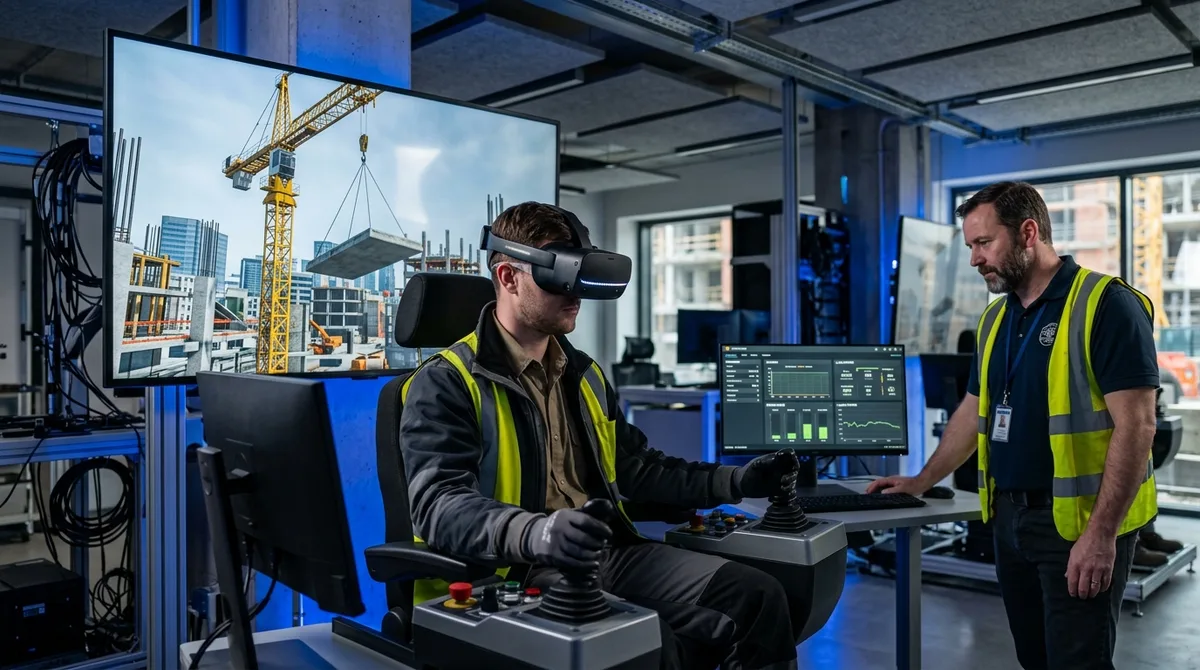
Crane work has an unusually favorable profile for simulation, because the highest-consequence scenarios are the ones no organization can rehearse: a load swinging near an energized line, a configuration that exceeds the chart, ground that gives under an outrigger, a signal misread at the moment it matters.
Those can be run repeatedly in a simulated environment, including with the wrong answer allowed to play out, which is not available on a real site at any price. It also directly serves the standard's own framing: 1926.1427(b) describes the goal of trainee instruction as developing the ability to recognize and avert risk. Recognition is a perception skill, and perception skills improve with varied repeated exposure.
What simulation does not do is satisfy the certification requirement, which runs through a licensing entity or accredited organization, or the employer evaluation, which is explicitly about safe operation of the assigned equipment. Any vendor claiming otherwise is describing something the rule does not permit.
There is one further alignment worth noting. Because the retraining duty triggers on evidence that an operator has a gap, a program needs a way to detect gaps that is cheaper and safer than waiting for a near-miss on a live site. Structured scenarios that record which decisions an operator got wrong produce exactly that evidence, and they produce it before the consequence rather than after it. That turns the retraining obligation from a reactive burden into something the program can actually manage.
Building a crane operator program?
We build the knowledge and hazard recognition layer so that scarce trainer and machine hours go to the work that legally requires them.
Scope a pilotFrequently Asked Questions
What does OSHA require before someone operates a crane?
Three separate things. Under 29 CFR 1926.1427(a)(1), the employer must ensure that each operator is trained, certified or licensed, and evaluated in accordance with that section before operating any equipment covered under subpart CC, except for the equipment listed in paragraph (a)(2).
Is certification the same as being evaluated?
No, and this is the distinction that most often produces a violation. Certification is obtained from a licensing government entity or an accredited testing organization under paragraphs (c) through (e). The evaluation is a separate employer obligation to determine that the operator can safely operate the specific equipment and configurations they will be assigned. A certified operator who has not been evaluated by the employer has not satisfied 1926.1427.
What equipment is exempt from the crane operator certification rule?
Under 29 CFR 1926.1427, operators of derricks (1926.1436), sideboom cranes (1926.1440), and equipment with a maximum manufacturer-rated hoisting or lifting capacity of 2,000 pounds or less (1926.1441) are not required to comply with 1926.1427.
Can an uncertified employee operate a crane at all?
Only as an operator-in-training under supervision. Under 1926.1427(a)(3), an employee who has not been certified or licensed and evaluated to operate the assigned equipment may only operate it as an operator-in-training in accordance with the requirements of paragraph (b).
How closely must an operator-in-training be supervised?
Continuously. Under 1926.1427(b)(4), while operating the equipment the operator-in-training must be continuously monitored by an individual, the operator's trainer, who meets the requirements set out in that paragraph. It is not periodic check-in supervision.
What is an operator-in-training prohibited from doing?
1926.1427(b)(3) lists circumstances in which the operator-in-training may not operate the equipment unless certified under paragraph (c), including situations involving proximity of any part of the equipment, load line, or load to specified hazards, subject to the exception in paragraph (b)(3)(v). The list is specific and should be posted where trainers work rather than summarized.
Who pays for crane operator certification?
The employer. 29 CFR 1926.1427 states that whenever operator certification or licensure is required under the section, the employer must provide the certification or licensure at no cost to employees.
Does a state or local license satisfy the requirement?
It can. Under 1926.1427(c)(1), when a state or local government issues operator licenses for equipment covered under subpart CC, the operator must be licensed by that entity for operation within its jurisdiction, provided the licensing program meets the requirements listed, including that the testing meets industry-recognized criteria for written testing materials, practical examinations, test administration, grading, facilities and equipment, and personnel.
When is retraining required for a crane operator?
Under 1926.1427, the employer must provide retraining in relevant topics for each operator when, based on the performance of the operator or an evaluation of the operator's knowledge, there is an indication that retraining is necessary. The trigger is evidence of a gap, not a fixed interval.
What training does the employer owe beyond certification?
Under 29 CFR 1926.1430, the employer must train each operator in accordance with 1926.1427(a) and (b) on the safe operation of the equipment the operator will be using, and must train employees on overhead powerline topics specified in 1926.1408(g), and train each employee assigned to work as a signal person who does not meet the requirements of 1926.1428(c).
Do signal persons have their own requirements?
Yes. 29 CFR 1926.1428 addresses signal person qualifications, and 1926.1430 requires the employer to train each employee assigned to work as a signal person who does not already meet those requirements in the areas that paragraph addresses.
Is small equipment under 2,000 pounds exempt from the whole subpart?
No. 29 CFR 1926.1441 specifies requirements for employers using equipment with a maximum rated capacity of 2,000 pounds or less, and lists provisions of subpart CC that still apply, including scope, definitions, ground conditions, and the assembly and disassembly procedure sections. The exemption is from the certification requirement in 1926.1427, not from the subpart.
What if manufacturer information for a machine is unavailable?
Under 29 CFR 1926.1441(b), the employer must ensure that component selection and equipment configuration affecting capacity or safe operation comply with manufacturer instructions, recommendations, limitations, and specifications. Where those documents and that information are unavailable, a registered professional engineer familiar with the type of equipment must approve the selection and configuration in writing.
Do ground conditions requirements apply to smaller equipment too?
Yes. 29 CFR 1926.1402 addresses ground conditions, and it is among the provisions listed in 1926.1441(a) that continue to apply to equipment with a rated capacity of 2,000 pounds or less.
Can a simulator be used in crane operator training?
For the training component, simulation is well suited to load chart interpretation, configuration decisions, hazard recognition, and rehearsing lifts that would be unsafe or uneconomical to stage. It does not replace the employer evaluation, which is about the operator demonstrating safe operation of the specific equipment and configurations assigned, nor does it replace certification obtained through a licensing entity or accredited testing organization.
Sources
- 29 CFR 1926.1427 — Operator training, certification, and evaluation
- 29 CFR 1926.1430 — Training requirements across subpart CC
- 29 CFR 1926.1428 — Signal person qualifications
- 29 CFR 1926.1441 — Equipment with a capacity of 2,000 pounds or less
Regulatory text retrieved from the eCFR versioner API, Title 29, snapshot dated 2026-01-01. This page summarizes federal requirements and is not legal advice. State plans and local licensing programs impose additional requirements, and the paragraph (b)(3) prohibitions should be read in full rather than relied on in summary.