
Lockout VR Training for Ontario Industrial Establishments (R.R.O. 1990, Reg. 851)
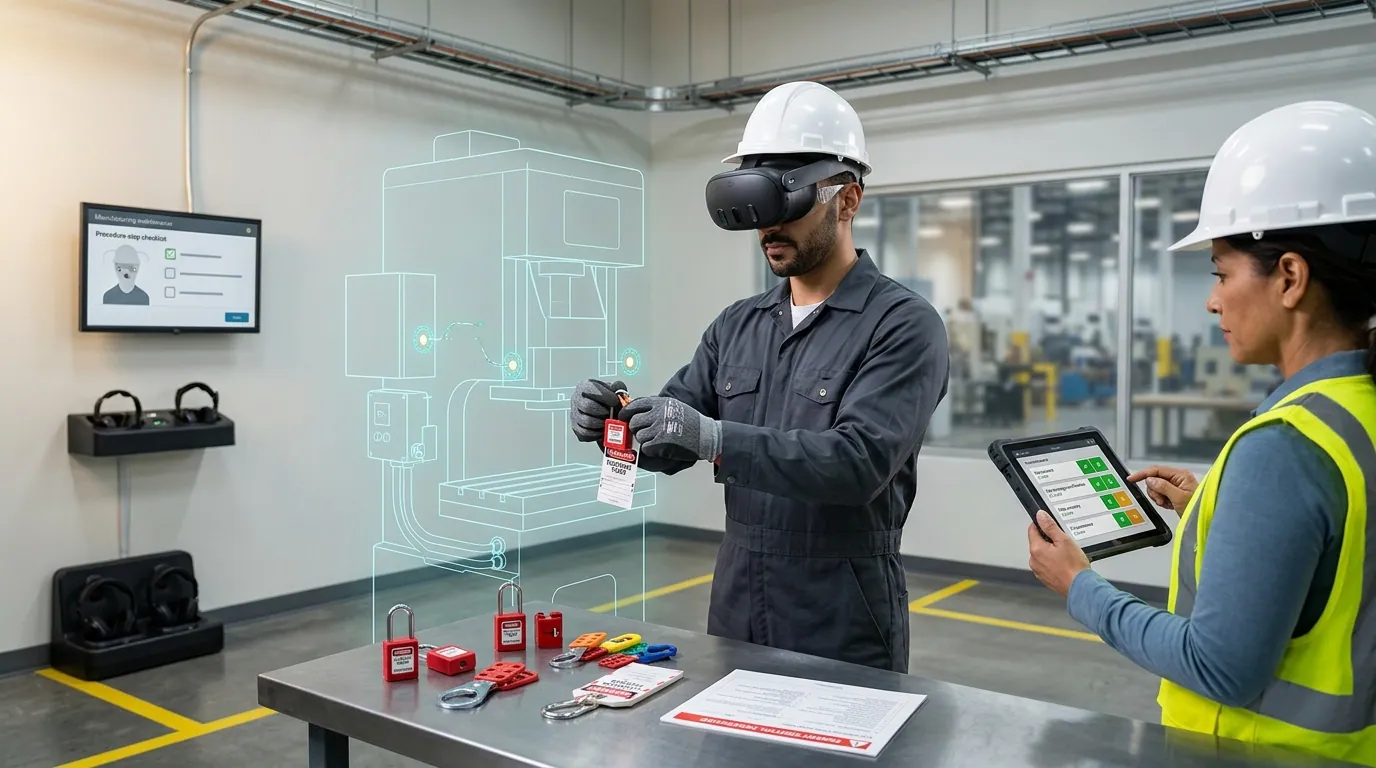
VR lockout scenario for Ontario plants under Reg. 851: disconnect, lock and tag, block stored energy and verify the machine is dead before reaching in.
QUICK ANSWER
Ontario Regulation 851 for industrial establishments requires electrical installations and equipment to be disconnected, locked out and tagged before work on them, and requires machine parts to be locked out where starting them could endanger a worker. A VR line lets maintenance staff practise the full isolation sequence on a stopped machine that can still bite.
What the Rule Requires
R.R.O. 1990, Reg. 851 Industrial Establishments: section 42 requires electrical installations, equipment and conductors to be disconnected, locked out of service and tagged before work is done on them, with the regulation setting out the limited cases where live work is allowed. Other provisions of Reg. 851 require machinery and parts to be blocked or locked out where their starting or movement could endanger a worker during maintenance or repair.
The scenario is a corrugated packaging plant in Mississauga. A jam in a die cutter has stopped the line. The operator has pressed the stop button, the hydraulic accumulator is still charged and the motor control centre is on the other side of the plant.
Hazards in This Scenario
- Unexpected start from a second control point
- Stored hydraulic pressure
- Gravity drop of a raised platen
- A lock applied to the wrong disconnect
The Procedure the Scenario Rehearses
- Identify every energy source for this machine
- Notify affected operators
- Open the disconnect and apply a personal lock and tag
- Bleed or block stored energy
- Try to start the machine to verify isolation
- Remove locks only after the area is clear
Mistakes the Scenario Is Built to Catch
- Relying on the stop button
- Group lock with no personal lock
- Accumulator left charged
- No try-start check
Competence Assessment Matrix
| Decision point | What the assessor sees | Pass standard |
|---|---|---|
| Sources | Energy sources listed | All identified |
| Isolation | Disconnect and lock | Personal lock applied |
| Stored energy | Accumulator and gravity | Released or blocked |
| Verify | Try-start | Done before work |
What VR Covers
- Energy sources that are easy to miss
- A wrong disconnect that looks right
- Verification practised every time
- Step records per technician
What VR Does Not Replace
- Written machine-specific procedures
- Lock and tag hardware on the floor
- Supervisor audits of real lockouts
Scope of a One-Scenario Pilot
A pilot builds this scenario as a single module, in Unity or Unreal Engine depending on the visual fidelity the task needs and the headsets on site. It runs on standalone headsets, logs every learner decision, and exports a per-person record for your training file. It is measured against your current method with a test cohort before anything is scaled.
Frequently Asked Questions
What does Reg. 851 say about lockout?
It requires electrical equipment to be disconnected, locked out and tagged before work, and machine parts to be locked out where movement could endanger a worker.
Why is stored energy part of the scenario?
Hydraulic, pneumatic and gravity energy stay after the power is off and cause many lockout injuries.
Can VR replace written procedures?
No. It trains people to follow them.
Want this scenario built around your site?
We review your current procedure and tell you which parts can be rehearsed in VR and which still need hands-on practice.
Map Your Highest-Risk ScenarioFurther reading
- Machine Guarding VR Training for Ontario Plants (Reg. 851, Sections 24 and 25)
- Noise and Hearing Loss VR Training for BC Workplaces (WorkSafeBC OHS Regulation, Part 7)
- Lockout tagout VR training
- Lockout tagout procedure steps
- All VR training scenarios: Canada
- VR pilot readiness checklist
- How VR training programs are priced