
Electrician Career and Training Online: The Real Paths Compared
IBEW/NECA apprenticeship, technical school, and online coursework, compared honestly by cost, pay, and what each one actually qualifies you to do.
QUICK ANSWER
There are three real paths into the electrical trade: a joint union-employer apprenticeship (IBEW/NECA electrical training ALLIANCE), a technical school or community college program, or online coursework. Only the first two, combined with logged, supervised field hours, actually lead to licensure, no jurisdiction licenses an electrician on classroom instruction alone. Apprenticeship is typically paid, not tuition-based, and runs 4 to 5 years to journeyman status. Median pay for electricians was $62,350 as of May 2024 per BLS, with the field projected to grow 9% through 2034, faster than average.
1. IBEW/NECA Joint Apprenticeship (Electrical Training ALLIANCE)
The electrical training ALLIANCE is the joint program between the International Brotherhood of Electrical Workers (IBEW) and the National Electrical Contractors Association (NECA), funding and standardizing apprenticeship programs run through hundreds of local union-contractor training centers nationwide. Apprentices are paid a wage from day one, earning while they log roughly 2,000 hours of on-the-job training per year alongside related technical instruction, over a typical 4 to 5 year program leading to journeyman status. Because the program is funded by the union and signatory contractors rather than charged as tuition to the apprentice, it is financially a fundamentally different model than a for-profit trade school: an apprentice earns income throughout training instead of taking on tuition debt for it.
This model also means admission is genuinely competitive rather than open enrollment: local programs typically accept applicants on a ranked basis as openings appear, driven by real contractor demand for apprentices in that area, rather than admitting every applicant who applies. That competitiveness is a direct tradeoff for the paid, tuition-free structure, a for-profit school with open enrollment will take any paying student, while a program that pays its students selects for the candidates it believes will complete the multi-year commitment and perform well for signatory contractors.
2. Technical School or Community College Programs
Technical schools and community colleges offer electrical certificate and diploma programs covering wiring, safety, and electrical theory, often completed in under a year of classroom study. This path gets a student real foundational knowledge and can make them a more competitive apprenticeship candidate, but it does not by itself satisfy licensing requirements, the supervised, logged field hours an apprenticeship or equivalent on-the-job program provides are still required afterward. Unlike a paid union apprenticeship, this route generally requires paying tuition for the classroom portion, then separately securing an apprenticeship or entry-level position to accumulate the required field hours.
3. Online Electrical Courses
Online programs cover the same classroom-based theory, code, and safety content as an in-person technical school, letting students complete coursework remotely on their own schedule. The limitation is identical to the technical-school path: online coursework alone does not qualify anyone for licensure in any jurisdiction, since every path to becoming a licensed electrician requires the supervised, hands-on field hours a classroom, however well taught, structurally cannot provide. Online courses are best understood as preparation and prerequisite knowledge, a way to build a stronger foundation before or during an apprenticeship, not a substitute for the apprenticeship itself.
What the Apprenticeship Aptitude Test and Interview Actually Involve
The electrical training ALLIANCE (IBEW/NECA) aptitude test, sometimes called the NJATC aptitude test, covers algebra and reading comprehension, commonly around 33 math questions to complete in 46 minutes. Applicants are scored on a 1-to-9 scale, and a score of 4 or higher qualifies the applicant for the next step, an interview roughly a month later. A score below 4 typically means a mandatory 3-month wait before reapplying and retesting, not an immediate retry. The interview itself is conducted by a panel, commonly 4 to 10 representatives from the local union, the training center, and the contractors association, reviewing the applicant's transcripts and background and asking several questions; some locals also include a brief mechanical-aptitude component alongside the oral interview. The interview score determines an applicant's placement on the ranked eligibility list, which is why simply passing the aptitude test does not guarantee an immediate apprenticeship slot, competitive locals rank and admit from that list as openings come available.
Specializations Beyond Commercial and Residential
The trade splits first into two broad categories, then further into specialties within the building-wiring side:
- Linemen (outside electricians): work on electric utility distribution systems at higher voltages, a physically demanding and distinctly different career track from the "inside" trades below.
- Wiremen (inside electricians): the broader category most people picture, generally trained in one of several specialties: residential, commercial, light industrial, industrial, and low-voltage.
- Low-voltage / VDV (Voice-Data-Video): a distinct specialization installing and maintaining low-voltage systems, phone and data circuits, computer networking, video distribution, and security/access-control systems, a meaningfully different skill set from line-voltage power wiring even though it is still electrical work.
Choosing a specialization early shapes which apprenticeship program and which contractors are the right fit, since a VDV-focused program and a heavy-industrial program train toward genuinely different day-to-day work despite both falling under the broad "electrician" label.
The Path That Actually Leads to a License
Regardless of which starting point a person chooses, technical school first, straight into an apprenticeship, or online coursework alongside a job search, the licensure path converges on the same requirement: an apprenticeship or state-recognized equivalent combining a multi-year run of logged, supervised field hours (commonly benchmarked around 8,000 hours total in states like Texas, California, and Colorado) with related technical instruction, followed by a state exam based on the National Electrical Code. Most states also list a high school diploma or equivalent as the baseline entry requirement. Understanding this convergence up front helps set realistic expectations: no shortcut skips the field-hours requirement, the real choice is how a person gets to the apprenticeship starting line, not whether they need one.
This convergence is also why comparing paths purely on upfront cost misses the more important number: total time and income across the whole journey. A paid union apprenticeship earning a wage from year one, even a modest apprentice wage that increases over the program, compares very differently on a five-year horizon to a path that starts with a year of paid tuition and no income, then still needs to independently secure an apprenticeship or qualifying job afterward. Evaluating "which path is cheaper" without accounting for lost or earned wages during the training years understates the real financial difference between the routes.
Evaluating an Online Program Before Paying For It
Because online electrical coursework alone cannot produce a license, the honest evaluation question for any paid online program is not "will this make me an electrician" but "does this get me closer to an apprenticeship, and is the cost proportional to what it actually delivers." A few practical checks before enrolling and paying: does the program clearly disclose, upfront, that field hours through an apprenticeship are still required afterward, rather than implying the course alone leads to licensure; is the program accredited by a recognized body, and does that accreditation actually matter for the specific state's licensing requirements; and does the program's own placement data or track record show graduates actually landing apprenticeships, not just completing the course. A program that is vague about the apprenticeship requirement, or markets itself as a complete path to "become a licensed electrician" without qualification, is a red flag worth taking seriously before paying tuition.
Calling a local IBEW local or NECA chapter directly to ask what they actually look for in an apprenticeship applicant, before enrolling anywhere, costs nothing and often produces more useful, locally specific guidance than a national online program's marketing material, since the exact math, aptitude, and background expectations can vary meaningfully between local training centers.
Commercial vs. Residential: Two Different Day-to-Day Jobs
Residential electricians work primarily on homes and smaller structures, standard single-phase 120/240V systems, panels, and fixtures. Commercial electricians work on larger buildings, frequently involving 3-phase power (120/208V or 277/480V), larger equipment loads, and more extensive code requirements around larger-scale distribution. Many electricians build experience across both over a career, but the day-to-day work, the systems involved, and even which sections of the electrical code come up most often genuinely differ between the two specializations, worth understanding before choosing which type of employer or apprenticeship program to pursue.
Light industrial and full industrial work sit further along that same spectrum, larger equipment, higher fault currents, and more specialized code sections (arc-flash hazard analysis, motor control circuits, process equipment) than either standard commercial or residential work typically involves. An apprentice choosing between a residential-focused contractor and an industrial-focused one is effectively choosing which of these systems they will spend years becoming fluent in, a decision worth making deliberately rather than simply accepting whichever contractor happens to be hiring first.
WHERE VR FITS ALONGSIDE ALL THREE PATHS — THE PRIME VR
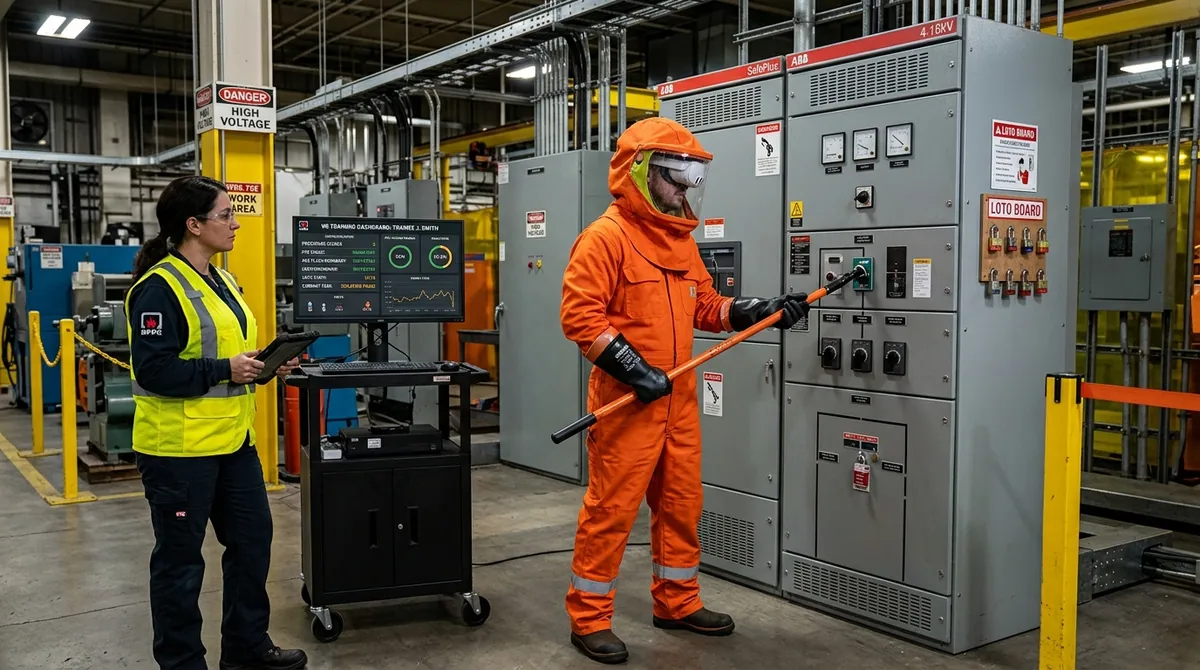
None of these paths replace hands-on practice, and none of them are a VR company's certification to award. What we build is the practice layer that sits alongside an apprenticeship or technical program: realistic VR scenarios where an apprentice rehearses panel diagnostics, 3-phase measurement, and lockout/tagout procedures before doing them live for the first time, whichever path got them into the trade.
Book a discovery callFrequently Asked Questions
How much does an entry-level electrician make? +
The median annual wage for electricians overall was $62,350 as of May 2024 per the Bureau of Labor Statistics, with entry-level apprentices earning less than a full journeyman and pay increasing as apprentices log hours and advance toward licensure. Apprentices are paid while they train, not charged tuition for the on-the-job portion of their education.
How do you get an electrician apprenticeship? +
Through a joint union-employer program like the IBEW/NECA electrical training ALLIANCE, through a non-union contractor's own apprenticeship program, or through a state-registered apprenticeship listed with the Department of Labor. Most require a high school diploma or equivalent, passing an aptitude test, and an interview; some also require specific math coursework. Apprenticeship is paid work from day one, not a program you pay to attend.
What is an electrician apprentice? +
A trainee learning the trade through a structured, multi-year program combining paid on-the-job work under a licensed electrician's supervision with technical classroom instruction, typically around 2,000 hours of on-the-job training per year alongside related coursework. Apprentices are not yet licensed to work unsupervised and advance toward journeyman status as they log required hours and pass exams.
How long does it take to become a journeyman electrician? +
Most apprenticeship programs run 4 to 5 years, combining logged on-the-job hours (commonly a benchmark around 8,000 hours in states like Texas, California, and Colorado) with related technical instruction, followed by a state licensing exam based on the National Electrical Code. Technical school coursework can shorten some of the classroom component but does not replace the required on-the-job hours.
Can you become an electrician entirely through online courses? +
No. Online coursework can cover the classroom-based theory, code, and safety instruction, and some accredited online certificate or diploma programs complete that portion in under a year, but every path to licensure still requires supervised, logged field hours through an apprenticeship or equivalent on-the-job program. No jurisdiction licenses an electrician on classroom instruction alone.
Is electrician training free through an apprenticeship? +
IBEW/NECA joint apprenticeship programs are typically funded by the union and signatory contractors rather than charged to the apprentice as tuition, and apprentices are paid a wage for their on-the-job hours throughout the program. This is a meaningfully different financial model than a for-profit trade school, where the student pays tuition for classroom instruction and often still needs to separately secure an apprenticeship or entry-level job afterward.
What is on the electrician apprenticeship aptitude test? +
Algebra and reading comprehension, commonly around 33 math questions in a 46-minute window for the widely used electrical training ALLIANCE test. Applicants are scored on a 1-to-9 scale, with a 4 or higher qualifying for a follow-up interview; a lower score typically means a mandatory wait, often around 3 months, before reapplying and retesting.
What is a VDV or low-voltage electrician? +
A specialization distinct from standard line-voltage residential or commercial wiring, focused on installing and maintaining low-voltage systems: telephone and data circuits, computer networking, video distribution, and security or access-control systems. It is a genuinely different day-to-day skill set from power wiring even though both fall under the broad electrician category.
What is the difference between a commercial and residential electrician? +
Residential electricians focus on homes and smaller structures: standard 120/240V single-phase wiring, panels, and fixtures. Commercial electricians work on larger buildings and often 3-phase systems (120/208V or 277/480V), larger equipment loads, and more complex code requirements. Many electricians cross-train across both, but the systems, code sections, and typical job scope differ meaningfully between the two.
Do you need a license to work as an electrician? +
In most states, yes, though requirements vary by state and sometimes by municipality. Licensure generally requires completing an apprenticeship (or equivalent documented hours plus coursework) and passing a state exam based on the National Electrical Code, and working unlicensed on electrical systems beyond what an apprentice is permitted to do under supervision is a compliance risk for both the worker and the employer.
Give apprentices real practice before the real panel
We build electrical diagnostics and safety procedures into scored VR training.