
3-Phase Power Explained
Why industry runs on 3-phase instead of single-phase, what wye and delta actually mean, and where the numbers 120/208, 277/480, and 240 delta actually come from.
QUICK ANSWER
3-phase power delivers three AC voltage waveforms offset 120 degrees apart on three conductors instead of one, so power delivery never drops to zero the way single-phase does. It comes in two configurations, wye (with a neutral, giving both a line-to-line and a lower line-to-neutral voltage) and delta (no neutral, one voltage only). Common systems are 120/208V wye (standard commercial buildings), 277/480V wye (larger commercial and industrial), and 240V delta (dedicated motor and equipment loads). Industrial motors run on it because the phase offset alone creates a rotating magnetic field, starting and running smoothly without the extra components a single-phase motor needs.
Why Three Waveforms Instead of One
Single-phase AC power rises and falls in a sine wave that crosses zero twice every cycle, which means instantaneous power delivery actually drops to zero twice per cycle too, sixty times a second on a standard 60 Hz system. Three-phase power generates three of those same sine waves, each offset by 120 electrical degrees from the other two, on separate conductors. Because the three waveforms are staggered, at least one of them is always contributing meaningful power at any given instant, so total power delivery stays far smoother and closer to constant. That smoother, more constant delivery is the entire reason the format exists: it is fundamentally better suited to spinning a motor or running heavy continuous equipment than single-phase ever is.
This also explains why 3-phase transmission and distribution is more efficient over long distances for a given amount of delivered power: spreading the same total load across three conductors instead of concentrating it on one or two lets each conductor carry less current for the same power delivered, which in turn allows smaller, less expensive conductors and lower resistive losses across the miles of line between a substation and an industrial site. That efficiency argument is a large part of why utilities build out 3-phase distribution to serve industrial and large commercial customers even when much of the surrounding area only needs single-phase.
That offset is not a mathematical trick applied after the fact, it comes straight from how the generator or transformer is physically built. A 3-phase alternator has three separate sets of windings spaced 120 physical degrees apart around the stator, so as the rotor spins past them in sequence, each winding produces its own sine wave timed 120 degrees behind the one before it. The waveform offset is a direct consequence of the hardware layout, not something added electronically afterward.
Residential vs. Commercial: Why Most Homes Never See It
Most homes run on single-phase service, typically 120/240V in North America, because household loads, lighting, outlets, small appliances, do not need the smoother power delivery or motor-starting advantages 3-phase provides, and running an extra conductor and more complex transformer to every house would add cost for no real benefit. Three-phase service gets pulled specifically to buildings with a genuine reason for it: elevators, large HVAC equipment, commercial kitchen equipment, industrial machinery, or a mix of heavy motor loads and standard lighting under one roof. A building's electrical service is sized and configured around what it actually needs to run, not a fixed default, which is why the same commercial block can have one building on 120/208V wye and its neighbor on 480V for a very different equipment load.
Single-Phasing: When a 3-Phase Motor Loses a Leg
One of the most common 3-phase motor failures in the field is not electrical at all in its trigger, a blown fuse, a corroded connection, or a tripped single-phase breaker on a 3-phase circuit removes one of the three legs feeding the motor. A running motor will often keep turning on the remaining two phases (a condition called single-phasing), but it draws significantly more current on those remaining phases trying to make up the lost torque, overheats, and can burn out the winding within minutes if thermal overload protection does not catch it first. A motor that hums loudly, struggles to start, or trips its overload repeatedly is a standard field indicator that a phase has been lost somewhere upstream, and checking all three legs with a meter is the fast way to confirm it before replacing a motor that was never actually the problem.
Wye vs. Delta: The Two Configurations
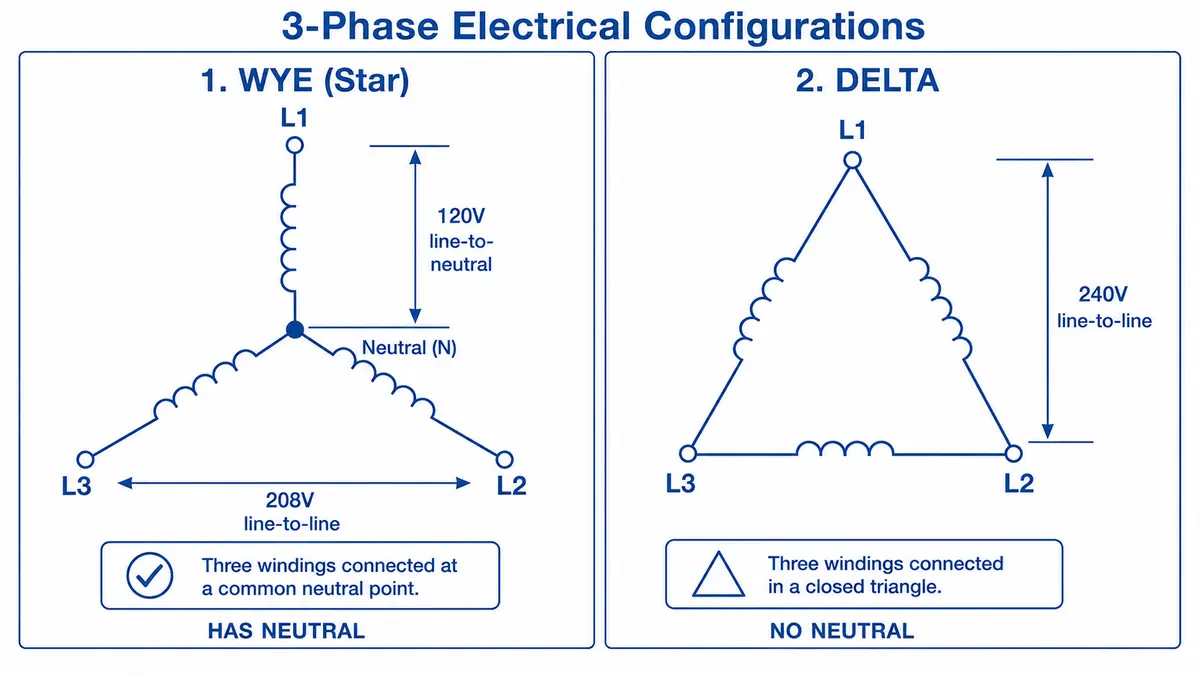
- Wye (star): all three windings connect together at a shared center point, the neutral. Because that neutral exists, a wye system can supply two different voltages at once: a higher line-to-line voltage between any two of the three phases, and a lower line-to-neutral voltage from any single phase to the neutral. This is why wye is the default for commercial buildings, one service feeds both 3-phase equipment and standard single-phase lighting and receptacles.
- Delta: the three windings connect to each other in a closed triangle instead, with no shared center point and (in its standard form) no neutral at all. A delta system supplies only one voltage, line-to-line, which makes it simpler but limits it to dedicated 3-phase loads, motors, pumps, compressors, and shop or industrial equipment, unless a special center-tapped variant is used.
Where the Numbers 120/208 and 277/480 Actually Come From
On a wye system, line-to-line voltage is not simply double the line-to-neutral voltage, it is the line-to-neutral voltage multiplied by the square root of 3, roughly 1.732:
- 120/208V wye: 120V line-to-neutral (the standard voltage for outlets and lighting) times 1.732 gives 208V line-to-line. This is the most common commercial building electrical service in North America, powering standard receptacles and lighting from the same system as smaller 3-phase equipment.
- 277/480V wye: 277V line-to-neutral (used to directly power 277V fluorescent and HID lighting ballasts without a step-down transformer) times 1.732 gives 480V line-to-line, used in larger commercial and industrial buildings for bigger motors and HVAC equipment. Standard 120V receptacles still need a separate step-down transformer to bring 480V down to 120/208V.
- 240V delta: a standard delta system with no neutral, one voltage, 240V line-to-line, sized for dedicated 3-phase motor and equipment loads rather than mixed lighting and receptacle use.
High-Leg (Wild-Leg) Delta: The Exception
Some older commercial delta systems add a center tap on one winding specifically to provide a 120V reference for lighting alongside the 240V three-phase power, a configuration called high-leg or wild-leg delta. The tradeoff is that the third phase conductor, the "high leg," reads a non-standard, higher voltage to neutral (commonly around 208V) that is not usable for standard 120V loads and must be clearly identified, by code, typically with orange conductor coloring, so nobody connects a 120V circuit to it by mistake. Technicians who assume every delta system has no neutral at all get caught by this exception regularly.
Why Motors Specifically Need It
A 3-phase induction motor gets its rotating magnetic field for free, directly from the 120-degree offset between the three phases energizing three sets of windings around the stator in sequence. That rotating field is what spins the rotor. A single-phase motor has no such natural rotation to exploit, it needs extra components, a starting capacitor, a shaded pole, or a centrifugal switch, just to kick the rotor in a direction and get it turning, and it never runs as smoothly or efficiently as the three-phase version once it's up to speed. That is the mechanical reason 3-phase motors dominate everything above a modest horsepower: pumps, compressors, conveyor drives, and most industrial machinery.
Balancing Loads Across the Three Phases
A 3-phase panel feeding a mix of single-phase circuits, lighting on phase A, receptacles on phase B, another set of receptacles on phase C, only performs the way it is designed to if that load is spread roughly evenly across all three legs. An unbalanced panel, where one phase carries far more single-phase load than the other two, wastes capacity on the underloaded legs, increases losses, and can create a higher-than-necessary current on the neutral conductor in a wye system. Balancing loads during panel design and again whenever circuits are added or moved is routine electrical practice, not an optional refinement, and it is one of the first things an electrician checks when a 3-phase panel is running hotter or less efficiently than it should.
When a Building Only Has Single-Phase: Phase Converters
Not every building has 3-phase service available, especially rural and older commercial sites, but plenty of shop and industrial equipment is built exclusively for 3-phase motors. Three approaches bridge that gap, and they are not interchangeable:
- Static phase converters: the simplest and cheapest option, but they only get a 3-phase motor started and typically derate it to somewhere around 50 to 80 percent of its nameplate horsepower, since the "manufactured" third leg does not carry a full, balanced share of the load. Fine for single, lightly loaded motors, not for continuous full-load duty.
- Rotary phase converters: an idler motor generates a genuine third leg, close enough to a real 3-phase supply that connected equipment can run at its full rated power, and can support multiple machines. The tradeoff is upfront cost and the space for a second rotating machine.
- VFDs (variable frequency drives): many drives in the smaller horsepower range accept single-phase input directly and synthesize a 3-phase output for the motor, but nameplate documentation commonly shows meaningful derating, often to roughly half of the drive's 3-phase-input rating, when it is fed from single-phase. Matching or slightly oversizing the VFD to the motor's full-load amperage (FLA) is standard practice, not an afterthought.
Reading a 3-Phase Motor Nameplate
Every 3-phase motor carries a nameplate that specifies the exact system it expects: rated voltage (often shown as a range or dual rating, such as 208-230/460V, since 208V wye and 240V delta systems both exist in the field), phase count, frequency (60 Hz in North America), and full-load amperage (FLA), the current the motor draws at its rated output. Connecting a motor to the wrong voltage on its nameplate, even one that looks close, is a common and expensive mistake: too low a voltage causes the motor to draw excess current trying to make rated power and overheat, while too high a voltage stresses the winding insulation. FLA is also the number a technician uses to size a VFD or verify a phase converter is not being asked to carry more than it can deliver.
Measuring 3-Phase Power Safely
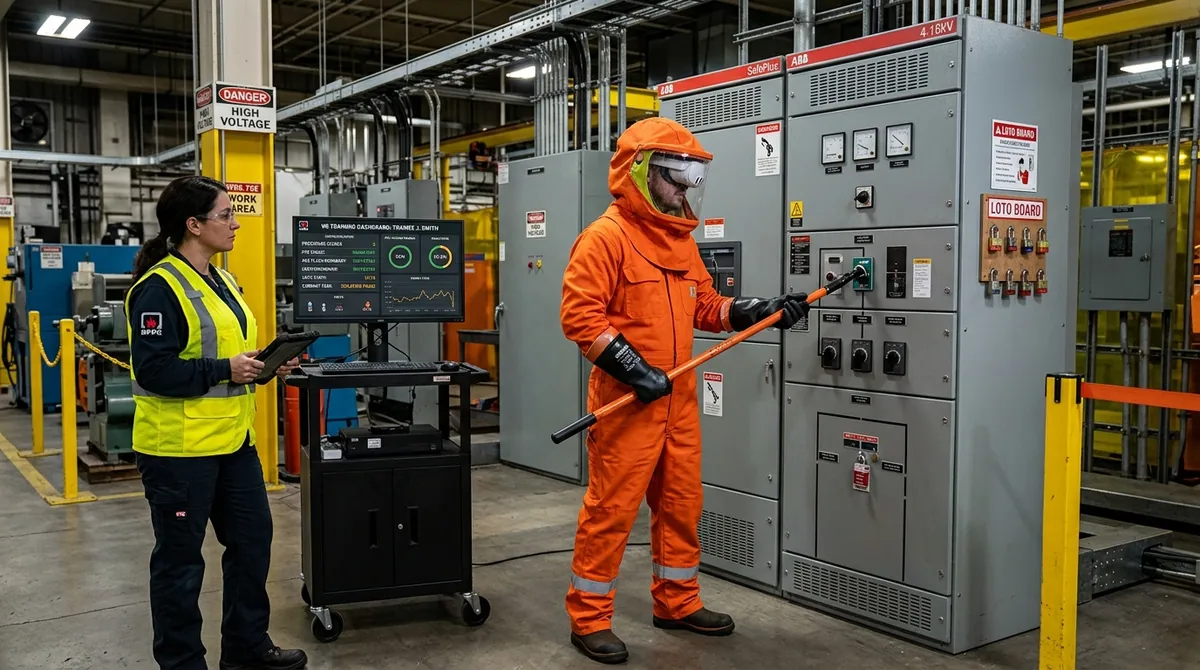
Confirming a 3-phase system's actual configuration and voltage starts with a multimeter set to AC volts: line-to-line readings taken between each pair of the three phase conductors, and, on wye systems, line-to-neutral readings from each phase to the neutral conductor. The meter's voltage rating and category (CAT) must exceed the system's voltage class, and appropriate PPE and lockout/tagout procedures apply before opening any panel, since 480V and even 208V can cause a lethal arc flash event under fault conditions. Getting comfortable with a multimeter on a single-phase circuit first is the standard prerequisite before a technician is trusted to take live readings on a 3-phase panel.
WE BUILD THIS IN VR — THE PRIME VR
We build 3-phase panels, wye and delta terminations, and live-voltage measurement into VR so trainees practice identifying a system's configuration, taking correct meter readings, and following lockout/tagout on a realistic panel before they ever open a live one. The scoring layer flags a wrong meter setting, a missed PPE step, or a misidentified high-leg conductor, the mistakes that turn a routine measurement into an arc flash incident.
Book a discovery callFrequently Asked Questions
What is 3-phase power? +
Three separate AC voltage waveforms, generated 120 electrical degrees apart from each other, delivered on three (or four, with a neutral) conductors instead of the two used for single-phase power. The offset waveforms mean power delivery never drops to zero the way single-phase power does twice per cycle, which is why motors and heavy equipment run smoother and more efficiently on it.
What is the difference between wye and delta? +
Wye (star) connects all three windings to a shared neutral point, which lets it supply both a line-to-line voltage and a lower line-to-neutral voltage from the same system. Delta connects the three windings in a closed triangle with no neutral point, supplying only one line-to-line voltage. Wye is the standard for most commercial buildings because it can serve both 3-phase equipment and single-phase lighting and receptacles from one service; delta is common for dedicated 3-phase motor and equipment loads.
What is 120/208 3-phase? +
A wye system where the line-to-neutral voltage is 120V (the standard voltage for plugs and lighting) and the line-to-line voltage is 208V, not 240V, because in a wye system line-to-line voltage equals line-to-neutral voltage multiplied by the square root of 3 (about 1.732), not simple doubling. It is the most common commercial building service in North America.
What is 277/480 3-phase? +
A larger wye system used in bigger commercial and industrial buildings, where line-to-neutral is 277V (used to directly power 277V fluorescent and HID lighting ballasts) and line-to-line is 480V, again related by the square root of 3. Buildings on 277/480 typically step 480V down to 120/208 through a separate transformer for standard receptacles and small equipment.
Why don't gas or electrical stations always list a 3-phase voltage? +
Because 3-phase service is a decision made at the utility and building level, not a universal default. Most homes only receive single-phase service; 3-phase is typically brought in specifically for buildings with heavy motor loads, elevators, large HVAC equipment, or industrial machinery, and the exact voltage (208, 240 delta, or 480) depends on what the building's equipment was designed to run on.
Can you get 120V out of a 240V delta system? +
Only from a special configuration called high-leg delta (or wild-leg delta), where one winding is center-tapped to provide a 120V reference for lighting alongside the 240V three-phase power, at the cost of a third leg that reads a higher, non-standard voltage to neutral that must be identified and handled carefully. Standard delta systems without a center tap have no neutral and no built-in 120V option at all.
How do you safely measure 3-phase voltage? +
With a multimeter set to AC voltage, checking line-to-line readings between each pair of the three phase conductors and, on wye systems, line-to-neutral readings from each phase to the neutral conductor, always confirming the meter's voltage rating exceeds the system voltage and following lockout/tagout and PPE requirements for the voltage class involved.
Why do industrial motors need 3-phase power? +
A 3-phase motor produces a naturally rotating magnetic field just from the phase offset of the three windings, so it starts and runs smoothly without the extra starting components (capacitors, centrifugal switches) a single-phase motor needs. Three-phase motors are also more efficient and deliver more power for their physical size, which is why they are the default for pumps, compressors, and industrial machinery above a certain horsepower.
What happens if a 3-phase motor loses one phase? +
It often keeps running on the remaining two phases, a condition called single-phasing, but it draws much higher current trying to compensate for the missing leg's torque and can overheat and burn out within minutes without thermal overload protection. Loud humming, hard starting, or repeated overload trips are the standard warning signs, and checking all three legs with a meter should come before condemning the motor itself.
Can I run a 3-phase motor on a single-phase supply? +
Not directly, but a static phase converter, a rotary phase converter, or a VFD with single-phase input can bridge the gap. Static converters are cheapest but typically derate the motor to 50-80% of its nameplate horsepower; rotary converters can support full rated power and multiple machines; VFDs are common for smaller motors but commonly derate as well when fed from single-phase input, so matching the converter or drive to the motor's actual full-load amperage matters more than matching its horsepower label.
Train 3-phase safety before the panel is live
We build the system, the meter, and the mistakes into scored VR practice.