
Best OSHA Training Companies (2026)
The leading OSHA training companies cover outreach courses, compliance content, and EHS platforms. This guide compares the top providers by what each is best for, then covers where immersive VR adds the hands-on practice that high-risk OSHA topics demand.
QUICK ANSWER
The best OSHA training companies in 2026 are OSHA Education Center for authorized 10/30 outreach cards, 360training and ClickSafety for broad low-cost online courses, the National Safety Council for standards-based and on-site training, and HSI for enterprise EHS software plus content. These cover compliance and knowledge. For high-risk physical work, immersive VR (such as custom scenarios from The Prime VR) adds safe hands-on practice of the dangerous tasks, alongside the required course and evaluation.
The companies, and what each is best for
OSHA Education Center
Best for: OSHA 10 and 30 outreach courses
Authorized online OSHA 10/30 outreach training, a common default for the cards employers require for general industry and construction.
360training
Best for: Broad, low-cost OSHA catalog
A wide catalog of OSHA and compliance courses with bulk pricing, suited to large employers training many workers on standard topics.
ClickSafety
Best for: Interactive online OSHA courses
Interactive OSHA courses with strong construction coverage and 24/7 access for distributed crews.
National Safety Council (NSC)
Best for: Standards authority and on-site training
A trusted nonprofit authority used for foundational safety content, on-site instruction, and train-the-trainer.
HSI (Health & Safety Institute)
Best for: Enterprise EHS platform plus content
Combines EHS software with a large library of safety and compliance courses for organizations managing programs at scale.
SPECIAL MENTION: IMMERSIVE TECHNOLOGY
The Prime VR, for hands-on OSHA practice
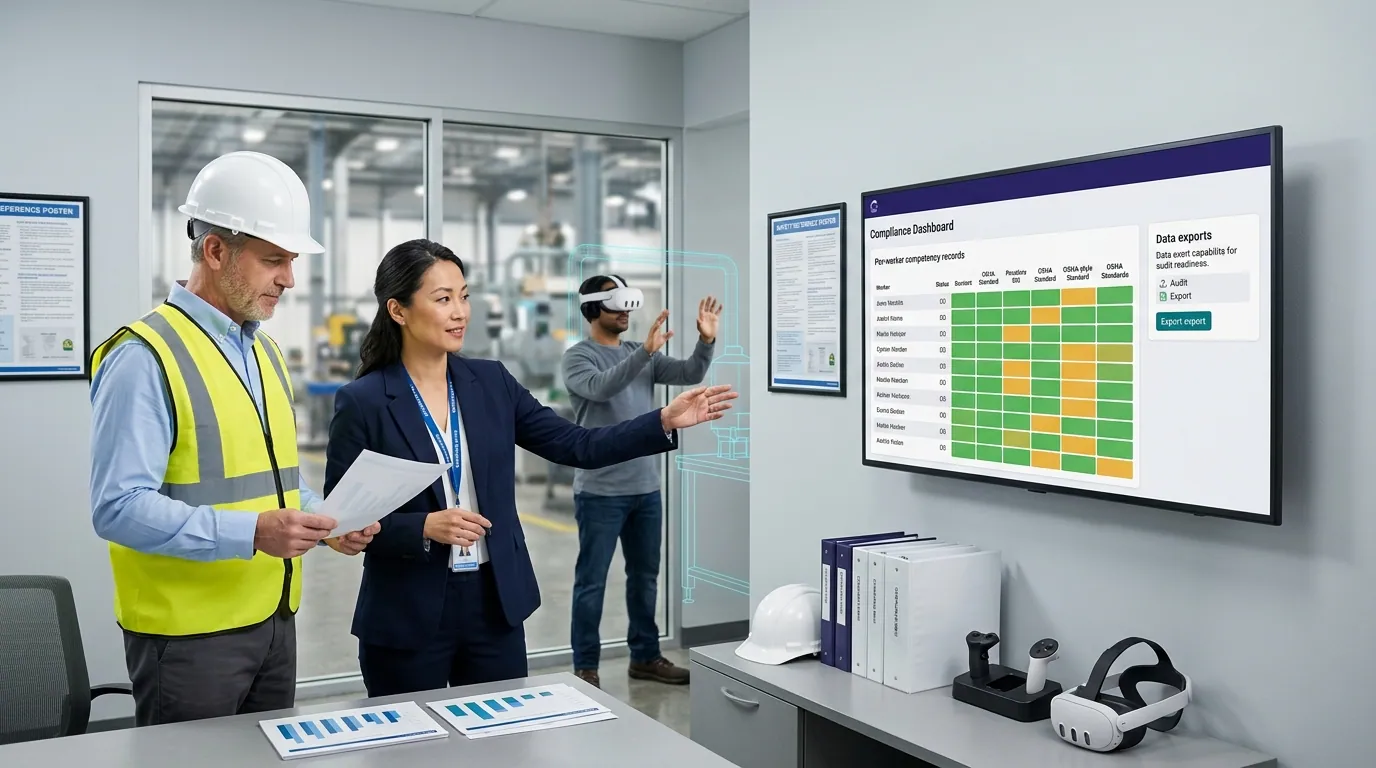
The companies above are strong for OSHA cards, content, and EHS tracking. The Prime VR represents the immersive frontier for the practical slice: custom VR scenarios for falls, forklift operation, lockout/tagout, confined space, hazmat, and arc flash, built on your real facility, where workers practice the dangerous task with a simulated consequence instead of a real one. It strengthens the practical-training and evaluation components that change behavior, not just the awareness layer.
Authorization and Credentials
Confirm the provider is authorized for OSHA outreach courses and trainers hold current credentials. Ask for proof.
Check the card issuance process.
Delivery and Scheduling
Compare in person, online and on site options. On site training can fit shift schedules.
Ask about group rates.
Reinforcement After Class
Toolbox talks, drills and refreshers keep lessons alive. Ask what follow up support exists.
Track completions.
Establishing the Requirement First
Occupational safety training obligations depend on the industry, the hazards present, the equipment used and the role, and they are set by regulation rather than by preference.
Buyers frequently approach this category by asking which provider is best before establishing which training their operations actually require.
Building the requirement list first, with the hazard and the source of the obligation recorded, makes the provider comparison straightforward rather than speculative.
What the Category Contains
Some providers deliver the standardized outreach courses, some deliver hazard specific competency training, some deliver site specific programs built around an employer own operations and some provide consulting alongside training.
Authorized providers for particular standardized programs are a defined set, and whether a course carries that authorization is verifiable rather than a matter of claim.
Employers should verify authorization and course recognition with the relevant authority rather than relying on marketing descriptions.
Awareness Against Competence
Awareness level training informs, while competency based training assesses whether the person can actually perform the task safely, and regulations frequently require the latter.
Programs that issue completion certificates without assessment satisfy an administrative box but do not establish competence if an incident occurs.
Where a standard specifies demonstrated ability, practical evaluation is part of the requirement rather than an optional enhancement.
Site Specificity
Much safety training only transfers when it reflects the actual hazards, equipment and procedures of the workplace, which generic catalog content cannot do.
Providers should be asked what site information they require and whether content will be adapted, since the answer determines transfer value.
Hazard assessments, procedures and equipment inventories are the inputs that make site specific content accurate, and supplying them is internal work.
Delivery and Refreshers
Delivery format has to fit shift patterns, literacy and language profiles and the practical reality of releasing crews from production.
Refresher intervals are set by regulation for some topics and by employer policy for others, and tracking both is part of the program rather than an afterthought.
Trigger based requirements, including new hire, role change, new equipment and procedure change, are where compliance gaps most commonly appear.
Questions Worth Asking
Useful questions include which obligations the course addresses, whether authorization applies, whether assessment is included, what site input is required and how records are provided.
Simulation and structured practice let workers rehearse hazardous procedures before performing them in the workplace.
Federal and state safety regulations differ and change, and applicable requirements and accepted training should be confirmed with the relevant authority.
Common Mistakes and How to Avoid Them
Recurring errors include selecting a provider before establishing the obligation list, accepting completion in place of assessed competence, using generic content where site hazards matter, failing to track trigger based requirements and not verifying course recognition.
Supervisors can help by making it acceptable to pause and ask. A culture where questions are treated as competence rather than weakness produces fewer errors in occupational safety training.
How Employers Evaluate Readiness
Employers assess programs through recordable incident and near miss rates, inspection and citation history, whether training records can be produced on request, assessment results and observed behavior in the workplace.
Keeping Skills Current
Regulations, standards, equipment and site hazards change. Reassigning ownership for monitoring regulatory change prevents delivering training against a superseded requirement.
Planning and Preparation
Preparation includes building the obligation register from hazard assessments with the source recorded, verifying course recognition with the authority, confirming where assessed competence is required, supplying site hazard information and setting both calendar and trigger based scheduling.
Documentation That Holds Up
Training records with dates, content, assessment outcomes and expiry, hazard assessments supporting the requirement list, and evidence retained for the required period are what an inspection examines first.
Related Guides
These cover adjacent ground with a different focus:
Frequently Asked Questions
What is the best OSHA training company?+
It depends on need. OSHA Education Center is a default for authorized OSHA 10/30 outreach cards, 360training and ClickSafety lead for broad low-cost online courses, the National Safety Council is the standards authority for foundational and on-site training, and HSI suits enterprises that want EHS software plus content. These cover the compliance and knowledge layer well. For high-risk physical work where a video does not build judgment, immersive VR adds safe hands-on practice of the dangerous scenarios, covered below.
Is online OSHA training enough?+
Online OSHA courses satisfy the formal-instruction and awareness requirements and are efficient at scale. But many OSHA standards also require practical training and an evaluation that show the worker can actually perform the task safely. For physical hazards, falls, forklift, confined space, employers pair the online course with hands-on or simulator practice and a final evaluation. Online alone covers knowledge, not demonstrated capability.
Where does VR fit in OSHA training?+
VR fits the practical-training slice of OSHA compliance, where the goal is judgment and behavior under real conditions: falls and fall protection, forklift and equipment operation, lockout/tagout, confined space, hazmat, arc flash. Workers practice the scenario in a realistic simulation and the system logs per-worker performance, producing documented practice that strengthens the overall OSHA program alongside the required course and evaluation.
How can I verify an OSHA outreach trainer?+
Ask for their trainer authorization and check with OSHA or the training organization.
Is on site OSHA training better?+
It can be, since content can match your hazards and schedules.
Make OSHA training stick where it matters most
We build custom VR practice for your highest-risk OSHA topics, on your real facility. Tell us the hazards and we will scope it.