
Best Industrial Training Companies (2026)
Industrial training has to build real, hands-on competence in equipment, safety, and quality, not just knowledge. The best providers combine curriculum with simulation, hardware, and recognized certification. These are the established industrial training companies.
QUICK ANSWER
The best industrial training companies include Tooling U-SME, Amatrol, MSSC, Interplay Learning, Vector Solutions, and DuPont Sustainable Solutions. They range from manufacturing curriculum and certification to hands-on simulation hardware and skilled-trades content, and the right pick depends on whether you need certification, hardware, or scalable online trades training.
How to read this list
Industrial training providers differ in whether they lead with certification, physical simulation hardware, or scalable online content. Match the pick to your trades mix, whether you need recognized certification, and how hands-on your training must be.
The Companies
Tooling U-SME
Best for: Manufacturing curriculum and certification
A widely used manufacturing training provider with a deep online curriculum and industry-recognized certifications.
Amatrol
Best for: Hands-on simulation hardware
Provides physical skills-training systems and eLearning for hands-on competence in industrial trades and technologies.
MSSC
Best for: Certified production and logistics
The Manufacturing Skill Standards Council offers nationally recognized production and logistics certifications.
Interplay Learning
Best for: Scalable online and VR trades training
Delivers online and immersive skilled-trades training for HVAC, electrical, and facilities maintenance at scale.
Vector Solutions
Best for: Industrial safety and compliance
Offers a large library of industrial safety, compliance, and operations training for manufacturing and distribution.
DuPont Sustainable Solutions
Best for: Operational safety and risk
Provides operational safety, risk, and workforce-capability training for heavy industry and manufacturing.
THE IMMERSIVE OPTION
Where custom VR fits industrial training
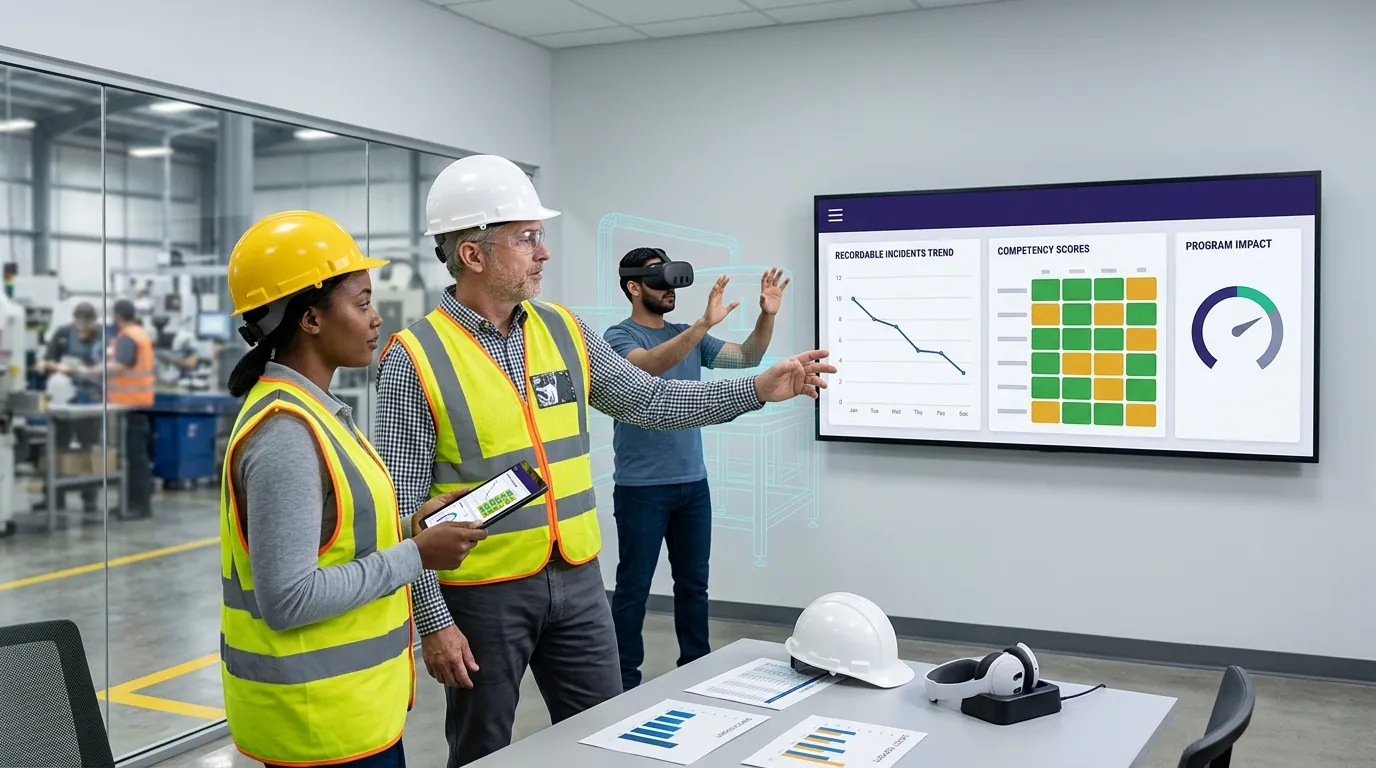
These companies deliver strong curriculum, certification, and even simulation hardware. What a custom VR program adds is practice on your exact equipment and procedures, not a generic module, with performance measured step by step. That specificity is where custom immersive training fits.
The Prime VR builds custom VR training modeled on your specific machines, safety procedures, and quality standards, delivered on standalone headsets with performance data that exports to your LMS. It complements curriculum providers with practice on your real operation.
Assessing Fit With Your Equipment
Generic modules may not match your machines and procedures. Look for customization and site specific content.
Ask for examples.
Compliance Coverage
Check that training covers OSHA and industry requirements relevant to your work. Documentation matters.
Confirm recordkeeping.
Delivery Methods
Blended formats with hands on practice usually outperform video alone. Consider shifts and schedules.
Pilot with a small group.
Questions to Ask Providers
Ask about instructor experience, hands-on access and how records support audits. Confirm coverage of the standards that apply to you.
Request sample materials.
Planning Across Sites
Multi-site companies should confirm consistent delivery and reporting.
Pilot at one plant.
How to Evaluate Providers
Industrial training providers differ enormously in depth, delivery capability and whether their programs produce measurable capability change.
The useful evaluation starts from the capability gap the organization actually has, because a strong provider in the wrong discipline solves nothing.
Reputation and client lists indicate scale rather than fit, and buyers who select on those alone frequently end up with generic content.
Scope and Specialization
Some providers cover a broad range at moderate depth while others specialize narrowly with substantial technical depth.
Breadth is useful where an organization needs consistent baseline training across many areas, and depth is what matters for specific technical competence.
Providers who can train on the organization actual equipment and processes deliver more transfer than those working from generic material.
Delivery Capability
Classroom, hands on laboratory, on site, online and simulation based delivery each have different costs and different effects on retention.
On site delivery reduces travel cost and time away, and it requires the provider to be capable of working around production constraints.
Where the work is hazardous or the equipment cannot be taken out of service, simulation is often the only way to provide realistic practice.
Assessment and Evidence
Programs that assess competence rather than attendance are the ones that produce evidence an employer can rely on.
Ask what the assessment consists of, who conducts it, and what happens when a participant does not meet the standard.
Providers unwilling to discuss failure rates are generally not assessing to a standard.
Questions Worth Asking
Useful questions include how content is kept current with codes and technology, what instructor qualifications and industry experience are, how programs are adapted to a site, and what records are provided.
Ask how the provider measures whether training changed performance, and what evidence exists from comparable clients.
Ask what is required from the organization, because programs fail as often from lack of internal support as from provider weakness.
Making the Investment Work
Training transfers when supervisors reinforce it, when people apply it soon after, and when the organization measures something that would change if it worked.
Simulation and structured practice let people build skill before performing tasks where errors are expensive or dangerous.
Applicable regulations, certification body requirements and employer obligations determine what training is mandatory, and those requirements should be confirmed with the relevant authorities.
Common Mistakes and How to Avoid Them
Common errors include selecting on reputation rather than fit, buying generic content for site specific equipment, accepting attendance records as evidence of competence, and providing no internal reinforcement after delivery.
Supervisors can help by making it acceptable to pause and ask. A culture where questions are treated as competence rather than weakness produces fewer errors in industrial training procurement.
How Employers Evaluate Readiness
Organizations assess training investment through competence assessment results, changes in defect and incident rates, time to productivity for new staff, equipment downtime and whether regulatory training obligations are met.
Keeping Skills Current
Equipment, codes and technology change. Confirming that program content matches current standards and the equipment actually in use prevents training people on configurations the site no longer runs.
Planning and Preparation
Preparation includes defining the capability gap in measurable terms, identifying which training is regulatory and which is developmental, agreeing how success will be measured and confirming what internal time and support the program requires.
Documentation That Holds Up
Training records with assessment results, competence matrices by role, regulatory training documentation and post training performance measures are what demonstrate the investment produced capability rather than attendance.
Frequently Asked Questions
What should industrial training deliver?+
Real hands-on competence in equipment, safety, and quality, backed by recognized certification where relevant. The best providers combine curriculum with simulation and measurable skill verification.
What is the difference between industrial training providers?+
Some lead with certification and curriculum, some with physical simulation hardware, and some with scalable online or immersive content. The right fit depends on your trades and how hands-on your training must be.
How does custom VR compare to off-the-shelf industrial training?+
Off-the-shelf training teaches general principles, while custom VR replicates your exact equipment and procedures so workers practice the real task and their competence is measured on it.
Why customize industrial training?+
Procedures and equipment differ, so tailored content is more effective.
Is online training enough for industrial safety?+
Often not alone, since practical evaluation is required for many tasks.
Train on your exact equipment, not a generic module.
We build custom VR training on your machines and procedures.