
Best Hospitality Training Programs (2026)
Hospitality runs on service, and service runs on trained people delivering it consistently across every property and shift. The best hospitality training builds guest-experience skills and holds the standard through high turnover. These are the leading programs and platforms.
QUICK ANSWER
The best hospitality training programs include Typsy and the American Hotel and Lodging Educational Institute (AHLEI) for hospitality-specific content, Trainual and Docebo for multi-property consistency, and eHotelier and TalentLMS for professional development and scale. The right pick depends on whether you need recognized hospitality credentials or consistent multi-property delivery.
How to read this list
Hospitality training ranges from recognized industry credentials to flexible LMS platforms for multi-property consistency. Match the pick to whether you need certification, a hospitality-specific course library, or scalable delivery across properties.
The Programs
Typsy
Best for: Hospitality-specific skills library
A hospitality platform with a large library of service, food, beverage, and management courses for hotels and restaurants.
AHLEI
Best for: Recognized hospitality certification
The American Hotel and Lodging Educational Institute offers widely recognized hospitality certifications and professional development.
Trainual
Best for: Multi-property process and onboarding
Turns operations into assignable training, useful for hospitality groups standardizing service across properties.
Docebo
Best for: Scalable enterprise LMS
A cloud LMS with AI authoring and a large course library, used by larger hospitality organizations for scale.
eHotelier
Best for: Hospitality professional development
Offers online hospitality courses and professional development for hotel and hospitality staff and managers.
TalentLMS
Best for: Flexible multi-location learning
A cloud learning platform supporting branch-based structure for hotel chains and multi-location hospitality groups.
THE IMMERSIVE OPTION
Where custom VR fits hospitality training
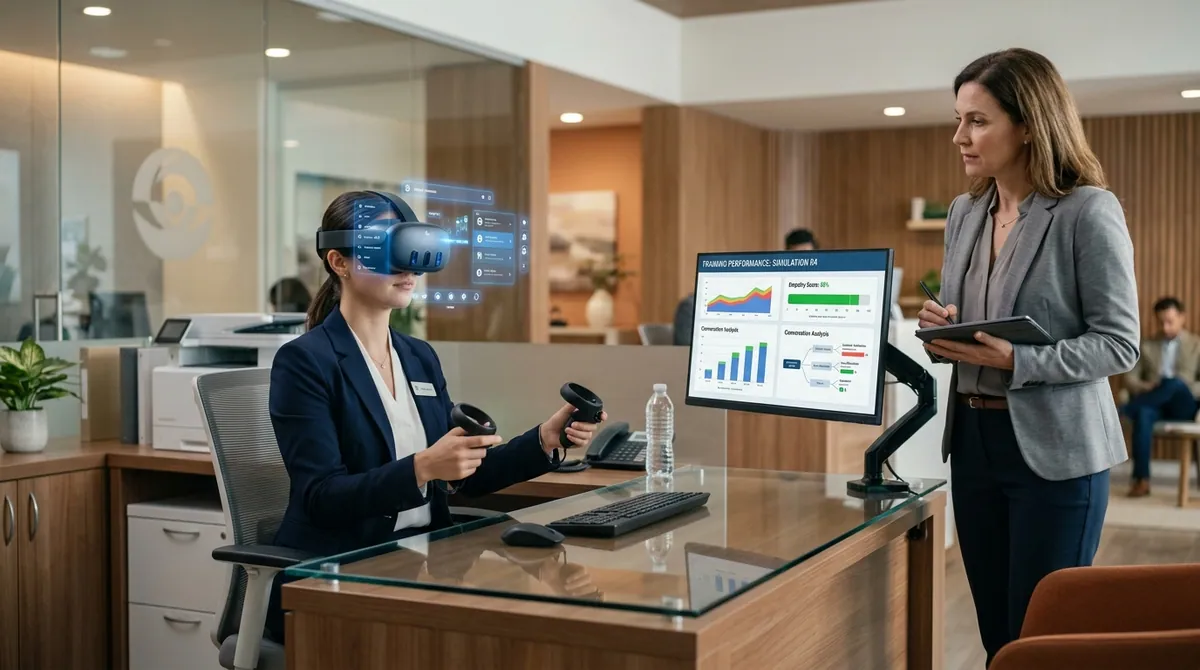
These programs teach service standards and deliver them consistently. What they cannot do is let staff physically rehearse the guest complaint, the VIP arrival, and the service-recovery moment until the response is natural. That rehearsal is where immersive practice fits.
The Prime VR builds custom VR scenarios for the guest moments that define hospitality, service recovery, difficult guests, and brand-standard interactions, so staff practice them in a realistic environment before the real guest, with performance measured.
Evaluation Criteria
Look at content depth, format, tracking and support for different roles. Fit your property type.
Ask for demos.
Blended Approaches
Combine online modules, on the job coaching and practice scenarios. Blended learning improves retention.
Reinforce with supervisors.
Measuring Impact
Track guest satisfaction, turnover and performance after training. Adjust content accordingly.
Set baselines before rollout.
Questions to Ask Vendors
Ask about content fit for your service standards, tracking, languages, and support. Request a pilot.
Talk to current customers.
Making Training Stick
Pair courses with shift huddles, coaching and recognition. Short refreshers keep standards visible.
Measure guest feedback.
What to Evaluate in a Hospitality Program
Hospitality training covers a wide range, from front desk and food service operations to revenue management and leadership, and programs differ substantially in which of those they actually address.
The first question is which roles the program is designed for. A program built for line level service staff answers different needs than one aimed at supervisors or property managers.
Program length, delivery format and whether the content is generic or adapted to a specific property type are the variables that most affect usefulness.
Criteria That Distinguish Programs
Useful evaluation criteria include curriculum depth, how skills are practiced rather than described, how progress is assessed and whether any recognized credential results.
Practice matters more than content coverage in service roles, because guest interaction, complaint handling and upselling are performance skills rather than knowledge.
Ask how a program handles the situations staff actually find difficult: an angry guest, an overbooked property, a service failure during a busy period.
Questions Worth Asking Providers
Ask what the program measures and what evidence exists that those measures improve. A provider who can describe their assessment method has thought about outcomes.
Ask how content is kept current, how it is adapted to a specific brand or property standard, and what is required from the property to deliver it.
Ask about the time commitment per employee, because programs that cannot be delivered around operating hours will not be completed regardless of quality.
Formats and Their Trade-offs
Classroom delivery suits discussion and group practice but removes staff from operations and is difficult to schedule across shifts.
Online and self paced delivery scales and fits around shifts, but completion rates depend heavily on whether managers make time for it.
Simulation and scenario based practice occupy a middle position, allowing repeated rehearsal of guest interactions without either scheduling everyone together or relying on reading alone.
Measuring Whether Training Worked
Guest satisfaction scores, complaint categories, upsell rates, service recovery outcomes and staff turnover are the measures most closely connected to training in hospitality.
A baseline before training is what makes any of those measures meaningful, and it is the step most often skipped.
Attribution is imperfect because many factors affect guest experience, and honest evaluation acknowledges that rather than claiming a single cause.
Making the Decision
The right program depends on the property type, the roles involved, the current performance gap and the operational constraints on delivery.
Piloting with one department before committing across a property reveals practical problems that no evaluation process surfaces in advance.
Requirements including food safety and alcohol service certification vary by jurisdiction, and operators should confirm what is mandatory in their location.
Common Mistakes and How to Avoid Them
Common errors include selecting a program without defining the performance gap, choosing based on content volume rather than practice opportunity, ignoring scheduling feasibility and failing to establish a baseline before starting.
Supervisors can help by making it acceptable to pause and ask. A culture where questions are treated as competence rather than weakness produces fewer errors in hospitality training.
How Employers Evaluate Readiness
Operators evaluate training decisions on guest satisfaction trends, service recovery outcomes, completion rates and whether behavior on the floor actually changes after the program ends.
Keeping Skills Current
Guest expectations, brand standards and regulatory certification requirements change. Reviewing whether a program still matches current standards prevents training staff to a superseded expectation.
Planning and Preparation
Preparation includes defining the specific behaviors that need to change, establishing baseline measures, confirming how delivery will fit around shifts and agreeing what managers must do to reinforce the training.
Documentation That Holds Up
Records of completion, assessment results and the measures tracked before and after are what allow an operator to judge whether a program earned its cost or simply occupied time.
Related Guides
These cover adjacent ground with a different focus:
- Best Restaurant Staff Training Programs in Las Vegas (2026)
- Best Restaurant Staff Training Programs in Los Angeles
- Best Restaurant Staff Training Programs in Miami (2026)
Best Hospitality Training Programs: what to know
This guide covers what it is, who is required to complete it, how it is usually delivered, and what The Prime VR changes when the same material is rebuilt as scored practice in a headset. Every attempt is logged, so competence is something you can see rather than assume.
Frequently Asked Questions
What should hospitality training cover?+
Guest-experience and service skills, brand and operational standards, food and beverage where relevant, and consistency across properties and shifts through high turnover.
What is AHLEI?+
The American Hotel and Lodging Educational Institute is the training and certification body of the American hotel and lodging industry, offering widely recognized hospitality credentials.
How does VR improve hospitality training?+
VR lets staff rehearse guest interactions and service-recovery moments in a realistic environment, building natural, confident responses that classroom training only describes.
How should hotels choose a training program?+
Match content to roles and brand standards, and look for tracking and practice.
What metrics show training success?+
Guest scores, turnover, error rates and manager observations.
Turn service standards into natural guest moments.
We build custom VR scenarios for the guest experiences that matter.
VR scenario designs related to hospitality industry training
Proposed practice scenarios and checklist guides built around specific tasks. Each one lists what VR does not replace.
- Hotel Cleaning Training: Custom VR Scenario Design
- Management and Hospitality Courses in VR: Scenario and Pilot
- Restaurant Hospitality Training in VR: Scenario and Pilot
- Hospitality Training Examples: A Practical Checklist
- Manager in Training Programs Hospitality: VR Scenarios