
The 4-Stroke Engine Cycle Explained
Intake, compression, power, exhaust: four strokes, two crankshaft revolutions, one cycle. Here is what actually happens inside the cylinder, why valve timing is not symmetric, and how the diesel (compression ignition) version differs from gasoline.
QUICK ANSWER
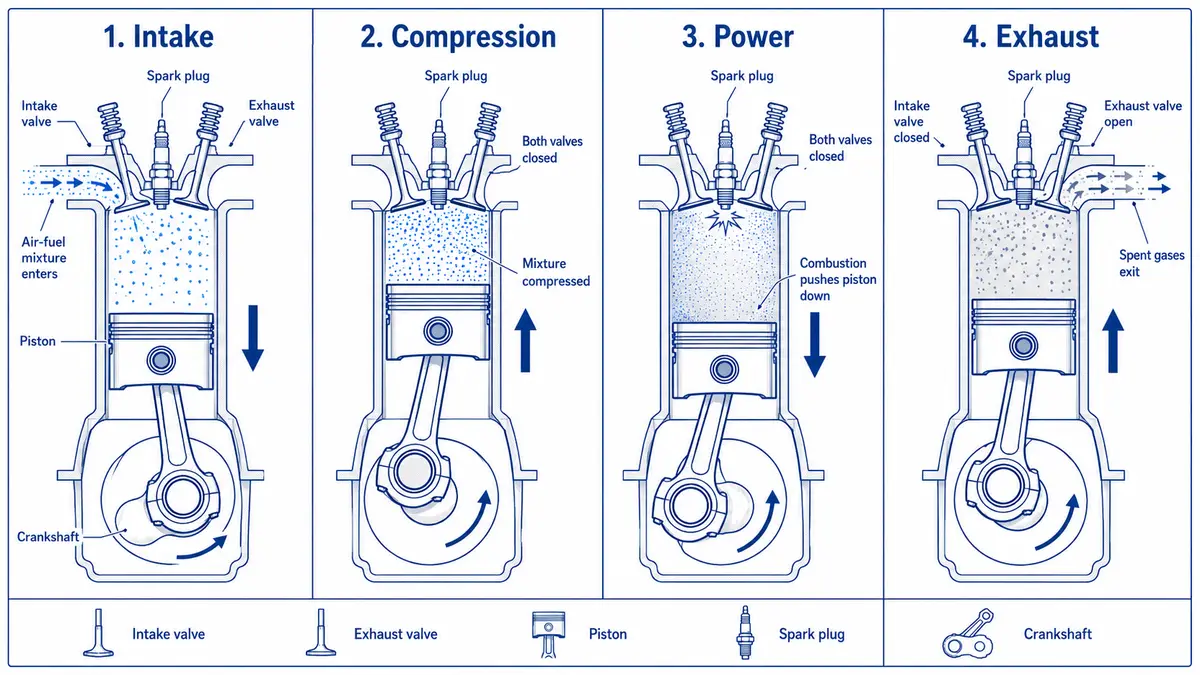
A 4-stroke engine completes one combustion cycle across four piston strokes: intake (air or air-fuel mixture enters), compression (the charge is squeezed into a smaller volume), power (ignition drives the piston down), and exhaust (spent gases are pushed out). That is two full crankshaft revolutions, 720 degrees, per cycle. Gasoline engines ignite the compressed charge with a spark; diesel (compression ignition) engines compress air alone until it is hot enough to ignite injected fuel on its own.
The Four Strokes, In Order
- Intake: the piston travels from top dead center (TDC) to bottom dead center (BDC). The intake valve is open, the exhaust valve is closed, and the drop in cylinder pressure pulls in air (diesel) or an air-fuel mixture (port-injected gasoline) as the piston descends.
- Compression: both valves close and the piston travels back up from BDC to TDC, compressing the intake charge into a fraction of its original volume. This is where the two ignition types start to diverge, covered below.
- Power: ignition occurs near TDC, the rapidly expanding combustion gases push the piston back down to BDC, and this is the only one of the four strokes that actually produces usable work, the other three all consume energy stored in the crankshaft's rotating momentum.
- Exhaust: the exhaust valve opens and the piston travels from BDC back to TDC, pushing the spent combustion gases out of the cylinder, after which the cycle restarts with intake.
Two Crankshaft Revolutions, One Power Stroke
Each stroke is one piston travel between TDC and BDC, which corresponds to half a crankshaft revolution (180 degrees). Four strokes add up to 720 degrees, two complete turns of the crankshaft, for a single power stroke. That ratio, one power event per two revolutions, is the mechanical reason 4-stroke engines run smoother and more efficiently than 2-stroke designs but produce less power for a given displacement and RPM: a 2-stroke fires once every single revolution instead of every other one.
Valve Timing Is Not Symmetric
Textbook diagrams show the intake stroke starting exactly at TDC and the exhaust stroke ending exactly at TDC, but real engines do not open and close valves at those precise points. Gas has mass and takes time to start and stop flowing, so the intake valve commonly opens somewhere around 10 to 20 crank degrees before TDC, while the exhaust valve from the previous cycle is still finishing its close, and stays open well past BDC into the start of the compression stroke to keep filling the cylinder while the piston is still moving slowly near the bottom. On the other end, the exhaust valve opens well before BDC on the power stroke, while there is still meaningful cylinder pressure left to push the spent gas out on its own, and stays open past TDC into the new intake stroke.
That brief window where both valves are open at once, intake already opening while exhaust is still closing, is called valve overlap, and it is a deliberate tuning choice rather than a flaw. More overlap lets high-RPM engines breathe better at the top end, at the cost of a rougher, lower-torque idle, which is why a stock economy engine and a performance camshaft for the same block specify very different overlap numbers even though both are still, mechanically, a 4-stroke cycle.
Gasoline (Spark Ignition) vs. Diesel (Compression Ignition)
Both engine types run the same four strokes, but the compression and power events work on different principles:
- Spark ignition (gasoline): air and fuel are mixed before or during intake, compressed to a moderate ratio, and ignited by a spark plug at a precisely timed moment. Compressing the mixture too far causes it to ignite on its own before the spark fires, engine knock, which limits how much a gasoline engine can be compressed.
- Compression ignition (diesel, a "four-stroke CI engine"): only air is drawn in and compressed, to a much higher ratio than a gasoline engine, which heats the air enough that fuel injected near the top of the compression stroke ignites on contact, with no spark plug at all. Higher compression is the point, not a limitation, which is why diesel engines run more efficiently but require heavier construction to survive the higher forces.
Named After the Engineers Who Invented Them
The spark-ignition version of this cycle is called the Otto cycle, after Nikolaus Otto, the German engineer who built the first practical 4-stroke internal combustion engine in 1876 and gave the industry its first real alternative to the steam engine. The compression-ignition version is the Diesel cycle, after Rudolf Diesel, who patented his high-compression, spark-free engine in 1892 and got a single-piston version running in 1894. Both men were solving the same problem, more usable work per unit of fuel, from two different directions: Otto's design ignited a controlled mixture with a spark, Diesel's design relied on compression alone.
That difference in approach shows up directly in the numbers. Typical spark-ignition (Otto cycle) engines run compression ratios in roughly the 8:1 to 12:1 range, limited on the high end by engine knock, the fuel-air mixture pre-igniting from heat and pressure before the spark fires. Compression-ignition (Diesel cycle) engines run in roughly the 14:1 to 22:1 range, since higher compression is exactly what makes ignition happen without a spark in the first place, and the heavier block, head, and rotating assembly needed to survive those forces is a large part of why diesel engines are built the way they are.
4-Stroke vs. 2-Stroke
A 2-stroke engine compresses all four events into a single crankshaft revolution by using the piston itself to uncover and cover intake and exhaust ports in the cylinder wall, instead of dedicating a full stroke and a camshaft-driven valve to each event. There is no separate oil sump or oiling system on the simplest 2-stroke designs: oil is mixed directly into the fuel, and lubricates the piston, rings, and bearings as that fuel-oil mixture passes through the crankcase on its way to the combustion chamber. That is mechanically simple and produces more power for a given displacement, since there is a power event every single revolution instead of every other one, but it also means a meaningful amount of unburned oil and fuel exits through the exhaust port, which is the source of the visible smoke and higher emissions that gave 2-strokes their reputation.
The 4-stroke's separate oil system keeps lubricant out of the combustion chamber entirely, its dedicated valve events give an engineer far more control over exactly when air, fuel, and exhaust move, and its cleaner combustion is why it now dominates everything except a shrinking set of small handheld equipment where the 2-stroke's power-to-weight ratio and mechanical simplicity still matter more than emissions or fuel economy.
Why Engines Have Multiple Cylinders
A single-cylinder 4-stroke fires once every two crankshaft revolutions and coasts on stored momentum the rest of the time, which is why a single-cylinder engine feels rougher the lower its RPM and its flywheel mass. Adding cylinders and staggering their firing order so that at any given moment one cylinder somewhere in the engine is on its power stroke smooths that delivery out, which is the entire mechanical reason four, six, and eight-cylinder layouts exist. A common inline-4 firing order, for example, is 1-3-4-2 rather than the physical order the cylinders sit in, specifically so that no two adjacent cylinders fire back to back, which would load one side of the crankshaft and main bearings harder than the other. The firing order is engineered for balance, not chosen arbitrarily, and a technician diagnosing a rough-running multi-cylinder engine needs to know it to correctly trace a misfire back to a single cylinder.
Where 4-Stroke Engines Actually Show Up
- Passenger vehicles and light trucks: spark ignition, the standard automotive configuration.
- Heavy trucks, buses, and industrial equipment: compression ignition (diesel), valued for durability and fuel efficiency under sustained load.
- Standby and prime power generators: both spark ignition (natural gas/propane) and compression ignition (diesel) 4-stroke units, sized to the load they back up.
- Motorcycles and marine outboards: largely converted to 4-stroke over the last two decades for emissions and fuel economy, with 2-stroke now limited mostly to small handheld tools and a subset of performance and racing applications where power-to-weight still outweighs the emissions and fuel-consumption tradeoff.
Every one of these applications is running the same four events described at the top of this guide, intake, compression, power, exhaust, just tuned differently: a diesel generator prioritizes efficiency and longevity under sustained load, a motorcycle engine prioritizes high-RPM breathing and lighter weight, and a passenger car engine splits the difference for everyday drivability. A technician who understands the cycle itself, not just the specific engine in front of them, can transfer that understanding across all of these applications instead of relearning diagnostics from scratch on every new platform.
This cycle is the mechanical foundation underneath automotive technician training, diesel mechanic training, and generator maintenance, three trades that all diagnose the same four events, just in different housings and displacements.
What Goes Wrong: The Diagnostics Version
Understanding the cycle matters most when something in it fails. The three problems technicians chase most often when a 4-stroke engine runs poorly with no obvious fuel or ignition fault:
- Timing chain or belt wear: the mechanism that keeps the camshaft (and therefore valve events) synchronized to the crankshaft. Enough stretch or slack throws valve timing off the intended window described above; a full failure on an interference engine lets the piston contact an open valve.
- Valve clearance out of spec: too tight and a valve may not fully seat, bleeding compression on that cylinder; too loose and valve events open late and close early, quietly losing power and efficiency without a fault code.
- Low compression: worn piston rings or a burnt valve let pressure leak past during the compression stroke, which is why a compression test across every cylinder, not just the one acting up, is the standard first step before chasing a fuel or ignition system that may be working fine.
What a Compression Test Actually Measures
A compression test cranks the engine with the spark or fuel disabled and a gauge threaded into the spark plug or injector hole, reading the peak pressure the compression stroke builds in each cylinder. Healthy gasoline engines typically read somewhere in the 125 to 200 psi range per cylinder; healthy diesel engines, because of their much higher compression ratio, typically read 275 to 400 psi or more, which is why diesel compression gauges are built to read up to roughly 1,000 psi instead of the 300 psi gauges used on gasoline engines. The absolute number matters less than the spread between cylinders: a cylinder reading more than about 10% below the others points to a specific mechanical problem on that cylinder, a ring, a valve, or a head gasket, rather than a general engine issue.
All three point back to the same four events described above: a timing fault desynchronizes when the valves open relative to the piston, a clearance fault changes how completely they seal, and a compression fault means the compression stroke is not actually building the pressure the power stroke depends on. Technicians who can trace a symptom back to which of the four strokes is actually failing diagnose faster than technicians who jump straight to swapping the most commonly failing part.
Why This Cycle Is Hard to Teach From a Static Diagram
A textbook diagram of the 4-stroke cycle shows four frozen snapshots, but the actual cycle is a continuous, timed sequence: valves opening early, staying open past the point you would expect, overlapping with each other, all synchronized to a spinning crankshaft happening dozens of times per second at idle and hundreds of times per second at redline. Trainees who can label a diagram often still struggle to reason about a real symptom, a rough idle, a specific misfire code, an intermittent no-start, because the diagram never showed them the cycle in motion, at the wrong timing, failing in the specific way their real engine is failing.
WE BUILD THIS IN VR — THE PRIME VR
We build the 4-stroke cycle into VR so trainees can see valve timing, compression, and combustion happening inside a transparent cylinder, then practice the diagnostic sequence (compression test, timing check, valve clearance) on a simulated engine that scores each step, before they touch a real one.
Book a discovery callFrequently Asked Questions
What are the 4 strokes in a 4-stroke engine? +
Intake (piston moves down, intake valve open, air-fuel mixture or air enters), compression (piston moves up, both valves closed, the charge is compressed), power (ignition drives the piston down), and exhaust (piston moves up, exhaust valve open, spent gases are pushed out). One full cycle is these four strokes in that order, repeating.
What is a four stroke engine? +
An internal combustion engine that completes its intake, compression, power, and exhaust events across four separate piston strokes, which equals two full crankshaft revolutions per cycle. It is the dominant design in cars, trucks, motorcycles, generators, and most modern small engines.
How many crankshaft revolutions does one 4-stroke cycle take? +
Two. Each stroke is one piston travel from top dead center to bottom dead center or back, which is half a crankshaft revolution, so four strokes add up to 720 degrees, two full turns, per complete cycle.
Do the valves open exactly at top and bottom dead center? +
No. Real valve timing is offset from TDC and BDC to account for the time it takes gas to actually start and stop moving. The intake valve typically opens before TDC and the exhaust valve stays open past TDC, creating a brief window called valve overlap where both are open at once.
What is a four stroke CI engine? +
CI stands for compression ignition, the diesel version of the 4-stroke cycle. Instead of a spark plug igniting a pre-mixed air-fuel charge (spark ignition, gasoline), a CI engine compresses air alone to a high enough ratio that injected fuel ignites from heat and pressure. The four strokes are the same, but the compression stroke and the ignition event are fundamentally different.
What is the difference between a 2-stroke and a 4-stroke engine? +
A 2-stroke engine completes intake, compression, power, and exhaust in a single crankshaft revolution by combining events (the piston itself uncovers ports instead of using dedicated valve strokes), which produces more power for its size but burns oil with the fuel and pollutes more. A 4-stroke dedicates one full stroke to each event, runs cleaner, and separates the oil supply from the combustion chamber.
Where are 4-stroke engines used? +
Nearly everywhere in modern transportation and equipment: passenger cars and light trucks (spark ignition), heavy trucks and diesel generators (compression ignition), most current motorcycles, marine outboards above the smallest sizes, and virtually all current small engines sold for lawn and garden equipment due to emissions rules that pushed the market away from 2-stroke designs.
What are the most common 4-stroke engine problems technicians diagnose? +
Timing chain or belt wear (which throws valve timing off and can cause a no-start or piston-to-valve contact if it fails), valve clearance drifting out of spec, and low compression from worn rings or a burnt valve. A compression test across all cylinders is the standard first diagnostic step when a technician suspects an internal mechanical problem rather than a fuel or ignition fault.
What is a good compression test reading? +
For most gasoline engines, 125 to 200 psi per cylinder is a healthy range; diesel engines, because of their much higher compression ratio, typically read 275 to 400 psi or more. The absolute number matters less than consistency: any single cylinder reading more than about 10% below the rest points to a specific mechanical fault on that cylinder rather than a general engine problem.
What is TDC and BDC? +
Top dead center (TDC) and bottom dead center (BDC) are the two extreme points of piston travel inside the cylinder, TDC at the very top of the stroke and BDC at the very bottom. Every stroke in the 4-stroke cycle is one piston trip between these two points, and both valve timing and ignition timing are measured in crank degrees relative to them.
Train engine diagnostics before the shop floor
We build the cycle, the failure modes, and the fix into scored VR practice.