
Work at Height VR Training for Dubai High-Rise Construction (Decree No. 19 of 2025)
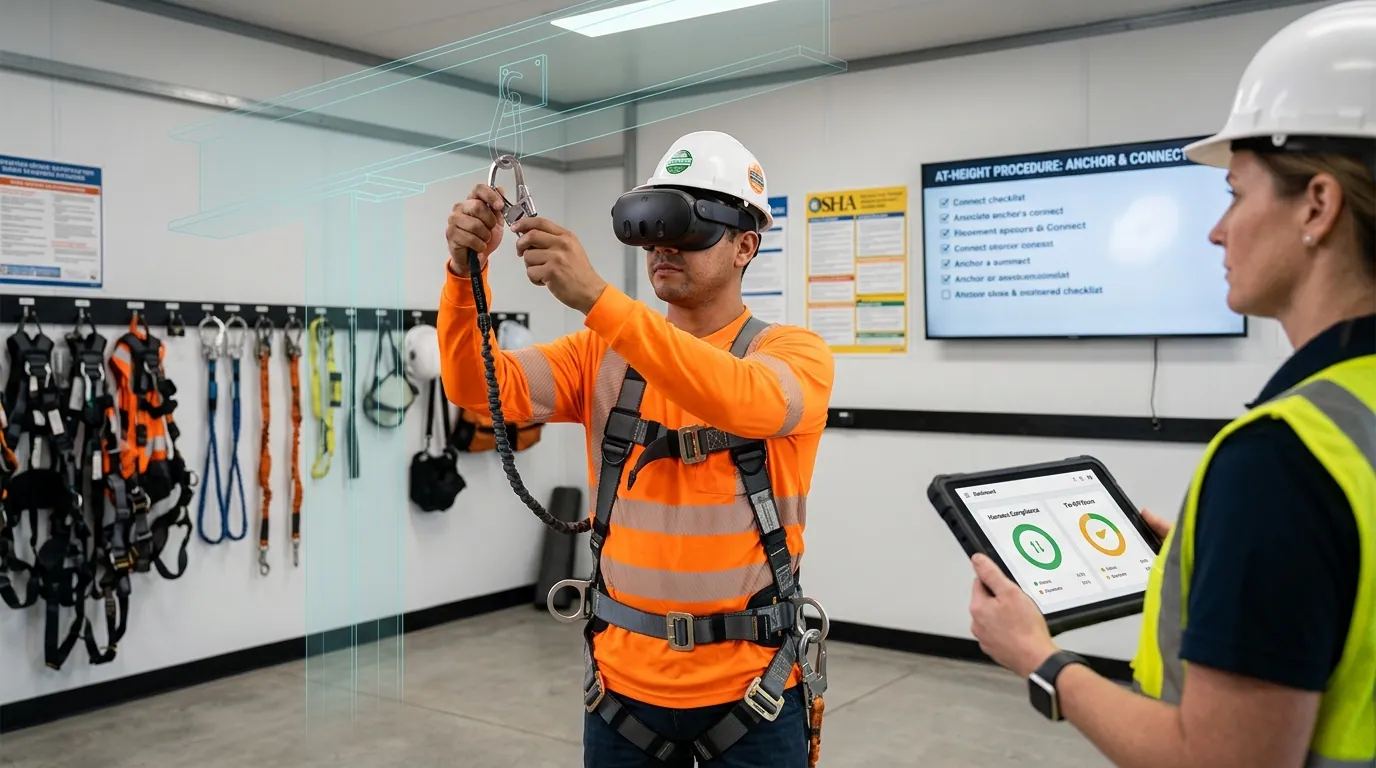
VR work at height scenario for Dubai high-rise sites: slab edges, open shafts, anchor points and the checks before clipping on, under Dubai safety rules.
QUICK ANSWER
Dubai issued Decree No. (19) of 2025 Concerning Safety in Construction Works to set the legal frame for construction site safety in the emirate. On a high-rise frame, the most serious exposure is still the open edge and the open shaft. A VR scenario puts the worker on a virtual slab edge so they can practise the checks without real height.
What the Rule Requires
Dubai Decree No. (19) of 2025 Concerning Safety in Construction Works: the decree sets the legal framework for safety in construction works in the Emirate of Dubai, and the Dubai Municipality safety guide sets out how sites put it into practice. Contractors should map each check point in this scenario to the current text of both before rollout.
The scenario is level 23 of a residential tower frame. The edge barrier on one side was removed to land a bundle of rebar and not refitted, a lift shaft has a loose plywood cover, and the anchor point marked on the method statement is on a column that has not been cast yet.
Hazards in This Scenario
- Falls from slab edges with barriers removed
- Falls through loose shaft covers
- Anchoring to a point not designed for fall arrest
- Dropped objects onto lower floors
The Procedure the Scenario Rehearses
- Walk the floor and check every edge barrier before work
- Report and secure any barrier removed for a delivery
- Treat any cover over a shaft as a hazard until it is fixed and marked
- Use only the anchor points named in the method statement
- Inspect the harness and lanyard before clipping on
- Keep tools tethered near the edge
Mistakes the Scenario Is Built to Catch
- Working next to a gap left after a delivery
- Standing on a shaft cover
- Clipping to a rebar starter bar
- Skipping the harness inspection
Competence Assessment Matrix
| Decision point | What the assessor sees | Pass standard |
|---|---|---|
| Edge | Barrier gap after delivery | Reported and closed before work |
| Shaft | Loose cover | Not stepped on, reported, fixed and marked |
| Anchor | Choice of anchor point | Only the rated point in the method statement |
| Harness | Pre-use check | Webbing, buckles and lanyard checked first |
What VR Covers
- Real height cues without fall risk
- Hidden defects placed on the floor
- Anchor point choices with consequences
- A record of what each worker spotted
What VR Does Not Replace
- Practical harness fitting and rescue drills
- Site supervision and permits
- Engineering of edge protection
Scope of a One-Scenario Pilot
A pilot builds this scenario as a single module, in Unity or Unreal Engine depending on the visual fidelity the task needs and the headsets on site. It runs on standalone headsets, logs every learner decision, and exports a per-person record for your training file. It is measured against your current method with a test cohort before anything is scaled.
Frequently Asked Questions
What is Decree No. 19 of 2025?
It is the Dubai decree concerning safety in construction works in the emirate. It applies to construction work in Dubai alongside the municipality guidance.
Can VR count as work at height training in Dubai?
It supports the training. Practical harness use, rescue drills and site rules still have to be delivered and recorded.
Why put hidden defects in the scenario?
Because on a real floor the hazard is often a small change, like a missing barrier after a delivery, not an obvious gap.
Running this scenario across several sites or contractors?
We review your current procedure and tell you which parts can be rehearsed in VR and which still need hands-on practice.
Plan a Multi-Site PilotFurther reading
- Heat Stress VR Training for UAE Construction Sites: Midday Break, Hydration and Early Signs
- Scaffold Inspection VR Training for UAE Contractors: Tags, Ties and Daily Checks
- Tower Crane Lifting VR Training for Dubai Sites: Rigging, Wind Limits and Exclusion Zones
- Multilingual Site Induction in VR for UAE Contractors: One Standard Across Every Crew
- Fall protection VR training
- Fall protection requirements
- All VR training scenarios: United Arab Emirates
- VR pilot readiness checklist
- How VR training programs are priced