
Rooftop Unit Maintenance: Keeping Commercial HVAC Running
A commercial rooftop unit that fails in July shuts down a store or an office. Planned maintenance is what keeps it running when it matters most.
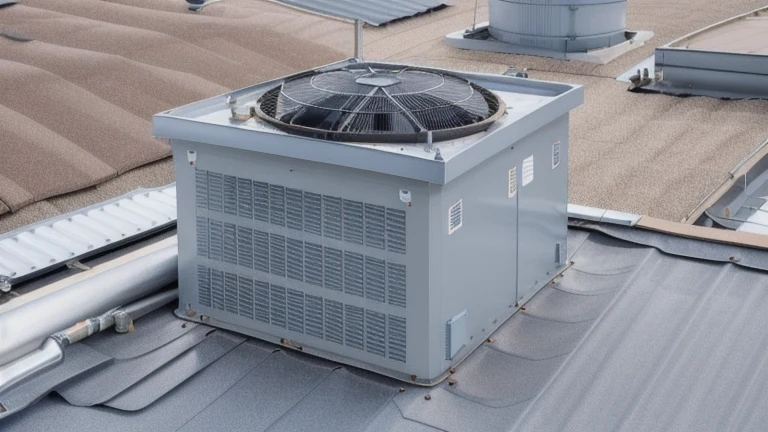
QUICK ANSWER
Rooftop unit maintenance covers filter and belt changes, coil cleaning, economizer and damper checks, electrical connection inspection, and refrigerant and airflow verification. Neglected coils and clogged filters are the most common causes of high energy bills and premature compressor failure in commercial HVAC.
The Airflow and Coil Basics
Most rooftop unit failures trace back to airflow. A clogged filter or a dirty coil forces the system to work harder, drives up energy cost, and eventually overheats the compressor. Filters, belts, and coil cleaning are the highest-return tasks.
The Full Service Round
- Economizer and dampers: a stuck economizer wastes energy year round.
- Electrical connections: checked and torqued to prevent hot spots.
- Refrigerant and airflow: verified so the unit delivers rated capacity.
Safe Access on a Roof
Rooftop work adds fall exposure, so it connects to fall protection, and the refrigerant work follows charging and recovery.
WE BUILD THIS IN VR — THE PRIME VR
We build rooftop unit service into VR so technicians practice the full maintenance round, from economizer checks to electrical inspection, plus rooftop fall-protection setup. The scoring layer catches skipped steps that turn into summer no-cool calls.
Book a discovery callSeasonal Startup Checks
At the start of cooling and heating seasons, technicians check belts, filters, coils, drain pans, electrical connections and controls. Changing filters and cleaning coils restores airflow and efficiency. Verifying operation in each mode catches failures before hot or cold days.
Keep a maintenance log for each unit so patterns of failure are visible.
Diagnosing Common Problems
Common issues include low airflow, dirty condenser coils, failed capacitors and contactors, and refrigerant leaks. Measuring temperature split, amp draw and pressures helps isolate the cause. Compare readings to the unit's nameplate and manufacturer data.
Do not add refrigerant without finding and repairing the leak.
Roof Safety and Access
Working on a roof involves fall hazards, weather exposure and electrical risk. Use approved ladders or fixed access, guard edges and skylights as required, and follow lockout and tagout before opening panels. Plan tools and parts so trips up and down are limited.
Rooftop work in extreme heat or ice should be paused or modified for safety.
Record Keeping and Trends
Log readings at every visit: pressures, temperatures and amp draw. Comparing them over time reveals slow problems before a breakdown.
Note filter sizes and belt types to speed future visits.
Customer Communication
Explain findings in plain language and document recommendations. Clear reports help customers approve repairs.
Photograph problems when possible.
What the Equipment Does
A rooftop unit packages heating, cooling, filtration and air movement into a single assembly serving a defined zone, which makes it convenient to install and exposed to weather for its entire life.
That exposure is the central maintenance fact, because every failure mode is accelerated by sun, rain, wind driven debris and temperature cycling.
Units vary widely in capability, from single stage constant volume packages to units with economizers, variable speed fans and integrated controls, and the maintenance scope follows that capability.
Airflow and Filtration
Airflow is the most common cause of poor performance, and it is usually restricted by loaded filters, dirty coils or duct problems rather than by a failed component.
Filter selection involves a tradeoff between filtration efficiency and pressure drop, and installing a higher efficiency filter than the unit was designed for reduces airflow measurably.
Belt condition, tension and sheave alignment on belt driven units determine whether the fan delivers design airflow, and slipping belts produce symptoms that resemble refrigeration faults.
Coils and Refrigeration
Condenser coils collect debris from the roof surface and from the surrounding environment, and a fouled condenser raises head pressure, reduces capacity and shortens compressor life.
Evaporator coil condition affects both capacity and indoor air quality, and a coil that is wet and dirty becomes a biological problem rather than only a performance one.
Refrigerant charge should be evaluated by measured superheat or subcooling rather than by pressure alone, and adding refrigerant without finding a leak addresses a symptom while the cause continues.
Economizers and Controls
Economizer operation saves significant energy when outdoor conditions allow, and economizers fail frequently and silently because nothing obvious happens when they stop working.
Damper linkage, actuator function and the outdoor air sensor should each be verified rather than assumed from a control signal.
Control settings including setpoints, schedules and staging are frequently left at values that no longer match how the space is used, which wastes energy without producing a complaint.
Structural and Electrical Condition
Curb condition, flashing and cabinet integrity determine whether water enters the unit and the building, and roof leaks attributed to the roof frequently originate at the unit.
Electrical inspection covering connection tightness, contactor condition, capacitor values and motor current identifies failures before they strand the equipment.
Condensate drainage, including trap configuration and pan condition, is a small item that causes disproportionate damage when it is neglected.
Program and Skill
Scheduled maintenance at intervals matched to the environment produces better results than reactive service, and units on dirty or coastal sites need more frequent attention than a standard interval assumes.
Simulation and structured practice let technicians build diagnostic sequence and measurement technique without occupying equipment that is in service.
Manufacturer instructions, applicable mechanical and electrical codes, refrigerant handling regulations and employer safety procedures including roof access and fall protection govern this work and should be confirmed for the specific site.
Common Mistakes and How to Avoid Them
Recurring errors include adding refrigerant without locating a leak, judging charge from pressure alone, installing filters that restrict design airflow, ignoring economizer function because nothing alarms, and leaving condensate drainage unverified.
Supervisors can help by making it acceptable to pause and ask. A culture where questions are treated as competence rather than weakness produces fewer errors in rooftop unit service.
How Employers Evaluate Readiness
Employers and building owners assess technicians on callback rates, energy performance after service, equipment life, comfort complaints resolved on the first visit and the quality of service documentation.
Keeping Skills Current
Refrigerants, controls, efficiency requirements and handling regulations change. Confirming current manufacturer information and refrigerant handling requirements prevents servicing equipment with a superseded procedure.
Planning and Preparation
Preparation includes confirming safe roof access and fall protection, reviewing equipment history and prior service records, verifying the unit configuration and control sequence, and having correct filters and belts on hand before the visit.
Documentation That Holds Up
Service records with measured readings, refrigerant handling documentation, filter and belt changes with dates, economizer verification and identified deficiencies with recommendations are what support warranty claims and capital planning.
Frequently Asked Questions
What causes most rooftop unit failures? +
Airflow restriction from clogged filters and dirty coils. It forces the system to work harder, raises energy use, and overheats the compressor, so filter and coil maintenance is the highest priority.
How often should a commercial RTU be serviced? +
Most commercial rooftop units need service at least twice a year, before cooling and heating seasons, with filter checks more often depending on the environment.
Why check the economizer? +
A stuck or failed economizer either wastes energy by bringing in unconditioned air or fails to use free cooling when it should. It is a common and costly overlooked fault.
How often should rooftop units be serviced? +
Many commercial units are serviced at least twice a year, and more often in harsh environments or critical facilities.
What is a typical sign a rooftop unit needs attention? +
Uneven temperatures, unusual noises, frequent cycling, higher energy bills or visible ice on coils.
Keep commercial HVAC running
We build your RTU maintenance round into scored VR practice.