
Best Multi-Location Training Programs (2026)
When the same operation runs in ten, fifty, or five hundred locations, the hardest problem is consistency. These platforms are built to deliver one training standard everywhere and give headquarters visibility into who is trained and who is not.
QUICK ANSWER
The best multi-location training programs include Trainual, WorkRamp, 360Learning, Wisetail, Schoox, and Continu. They all solve the core multi-site problem, delivering one consistent standard across every location with central reporting, and differ mainly in how they balance process documentation, engagement, and enterprise scale.
How to read this list
Each platform is strong for a different flavor of multi-site training, from process documentation to collaborative learning. Match the pick to your number of locations, workforce type, and how much central control you need.
The Platforms
Trainual
Best for: Process documentation and onboarding
Turns the way you operate into assignable training, ideal for growing multi-location businesses standardizing how every site works.
WorkRamp
Best for: Employee and customer enablement
A learning platform used to onboard and upskill teams at scale, with strong reporting for distributed workforces.
360Learning
Best for: Collaborative, peer-driven learning
Lets internal experts build and share courses, useful when best practices need to spread across locations quickly.
Wisetail
Best for: Frontline engagement and culture
Known for engaging, on-brand learning, often chosen by multi-site retail, restaurant, and hospitality operators.
Schoox
Best for: Learning plus talent development
Combines training with skills and career growth for large, distributed workforces.
Continu
Best for: Modern enterprise LMS
A clean, integrated learning platform for mid-market and enterprise businesses managing training across many teams and sites.
THE IMMERSIVE OPTION
Where custom VR fits multi-location training
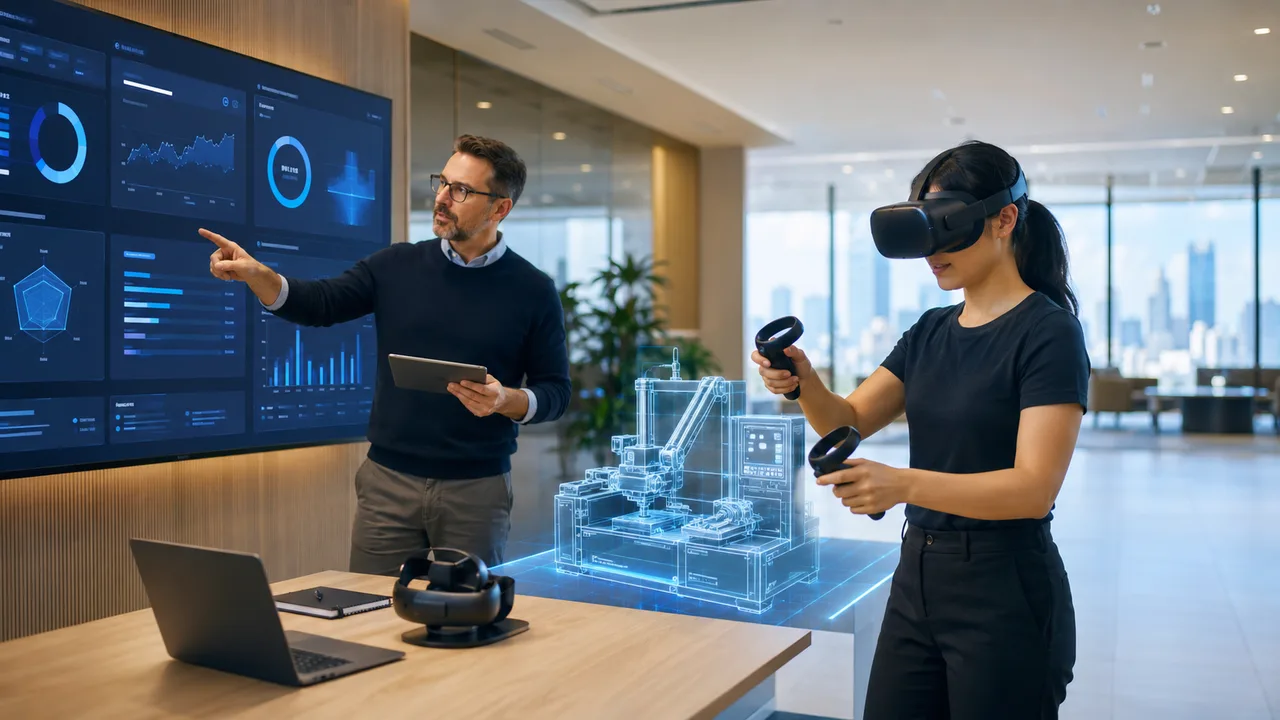
These platforms make training consistent and measurable. What they cannot do is make a frontline worker at every location physically practice the high-stakes procedure until it is automatic. That practice layer is where immersive simulation adds value.
The Prime VR builds custom VR training on your exact operations and delivers the identical scenario to every location, with performance data that exports to whichever platform you run. One standard, practiced, everywhere.
Consistency Across Locations
Standard content and tracking ensure each site meets the same expectations. Central visibility helps leaders.
Use common reporting.
Local Adaptation
Allow room for local regulations and needs while keeping core standards. Balance control and flexibility.
Involve site managers.
Rollout and Adoption
Plan launches, provide support and gather feedback. Adoption depends on managers.
Start with a pilot.
Choosing Reporting Tools
Look for dashboards by location and role. Managers need visibility into completion and gaps.
Export data easily.
Change Management
Introduce new training gradually and gather feedback. Communicate the purpose.
Support local leaders.
The Problem Multi Location Training Solves
Organizations operating across many sites face a consistent difficulty: delivering the same standard of training everywhere without the cost of moving instructors or staff.
Variation between locations is the usual symptom. The same role is performed differently at each site because training was delivered locally and drifted.
A program suitable for this context must be evaluated on consistency and reach, not only on content quality.
Criteria That Matter Across Sites
Useful criteria include whether content can be delivered identically everywhere, how completion is tracked centrally, how updates propagate and what each location must provide to deliver it.
Programs requiring an instructor at each site introduce the variation they were meant to eliminate unless instructor certification is itself standardized.
Language, regional regulatory differences and local operating practices determine how much of a program can be common and how much must be adapted.
Questions Worth Asking Providers
Ask how a program handles a content update: whether every location receives it automatically or whether each must implement it.
Ask what reporting exists at the location, region and organization level, because the ability to see who has completed what is the main administrative value.
Ask what happens when a location has limited connectivity, equipment or dedicated training space, since those constraints are common and frequently ignored.
Delivery Formats
Centralized classroom delivery achieves consistency and costs travel and time away from operations, which limits how often it can happen.
Digital delivery scales to any number of locations and depends on local management to create the time for completion.
Simulation and scenario based practice can be distributed to locations, allowing hands on rehearsal without requiring a central facility or an instructor at each site.
Measuring Consistency
The measure that matters is whether performance converges across locations, not whether completion rates are high.
Comparing operational measures between sites before and after a program reveals whether training changed behavior or only records.
Baselines by location, captured before a program starts, are what make that comparison possible, and they are commonly skipped.
Deciding and Rolling Out
Piloting at a small number of representative locations, including a difficult one, surfaces practical problems before an organization wide commitment.
Local management engagement determines completion more than any program characteristic, and a rollout plan should address it explicitly.
Regulatory requirements differ by jurisdiction, and organizations operating across regions should confirm what training is mandatory in each location.
Common Mistakes and How to Avoid Them
Common errors include selecting a program that requires resources some locations do not have, assuming completion equals capability, omitting local management from the rollout and failing to baseline performance by site.
Supervisors can help by making it acceptable to pause and ask. A culture where questions are treated as competence rather than weakness produces fewer errors in multi location training.
How Employers Evaluate Readiness
Organizations evaluate these programs on whether performance variation between locations narrows, completion and retention rates, administrative effort and whether updates actually reach every site.
Keeping Skills Current
Locations, staffing and regulatory requirements change. Reviewing whether content still matches current operating practice at each site prevents standardizing on a procedure that has moved on.
Planning and Preparation
Preparation includes mapping what varies between locations, defining what must be common, establishing baselines by site, confirming technical and space constraints and assigning ownership at each location.
Documentation That Holds Up
Central completion records, assessment results and location level performance data are what allow an organization to demonstrate coverage and to identify which sites need attention.
Frequently Asked Questions
What is the biggest challenge in multi-location training?+
Consistency. The same operation interpreted differently at each site creates uneven quality and compliance. Multi-location platforms solve this by delivering one standard everywhere with central visibility.
How is multi-location training different from a single-site LMS?+
Multi-location platforms add central reporting across sites, location-level administration, and tools to roll out and enforce one standard, rather than managing a single team.
Can VR training deploy across many locations?+
Yes. A VR scenario built once deploys identically to every location on standalone headsets, so the same procedure is practiced and measured the same way everywhere.
How can multi location companies keep training consistent?+
Use shared platforms, standard content, certifications and reporting.
Why start with a pilot?+
It shows what works and reveals problems before a full rollout.
One training standard, practiced at every location.
We build custom VR training that deploys identically across all your sites.