
Best Leadership Training Companies (2026)
The leading leadership development companies range from classic methodology to assessment-driven programs. This guide compares the top providers by what each is best for, then covers immersive VR for practicing the manager conversations that decide whether training sticks.
QUICK ANSWER
The best leadership training companies in 2026 are Dale Carnegie and Blanchard for frontline and new-manager skills, FranklinCovey for principle-based programs at scale, the Center for Creative Leadership for research-based executive development, and DDI for assessment-driven leadership and succession. These provide frameworks and assessments. For the difficult conversations and decisions leaders most need to practice, immersive VR (such as custom programs from The Prime VR) adds realistic, measured rehearsal.
The companies, and what each is best for
Dale Carnegie
Best for: Foundational leadership and communication
A long-established provider of leadership, communication, and influence training, strong for first-time and frontline managers.
FranklinCovey
Best for: Principle-based leadership at scale
Known for frameworks like the 7 Habits and 4 Disciplines of Execution, with broad enterprise leadership programs.
Center for Creative Leadership (CCL)
Best for: Research-based executive development
A research institution focused on leadership development, assessments, and programs for mid- to senior-level leaders.
DDI
Best for: Assessment-driven leadership and succession
Development Dimensions International specializes in leadership assessment, selection, and development tied to succession planning.
Blanchard
Best for: Situational leadership and manager skills
Known for Situational Leadership and practical manager skill-building across organizations of all sizes.
SPECIAL MENTION: IMMERSIVE TECHNOLOGY
The Prime VR, for VR leadership practice
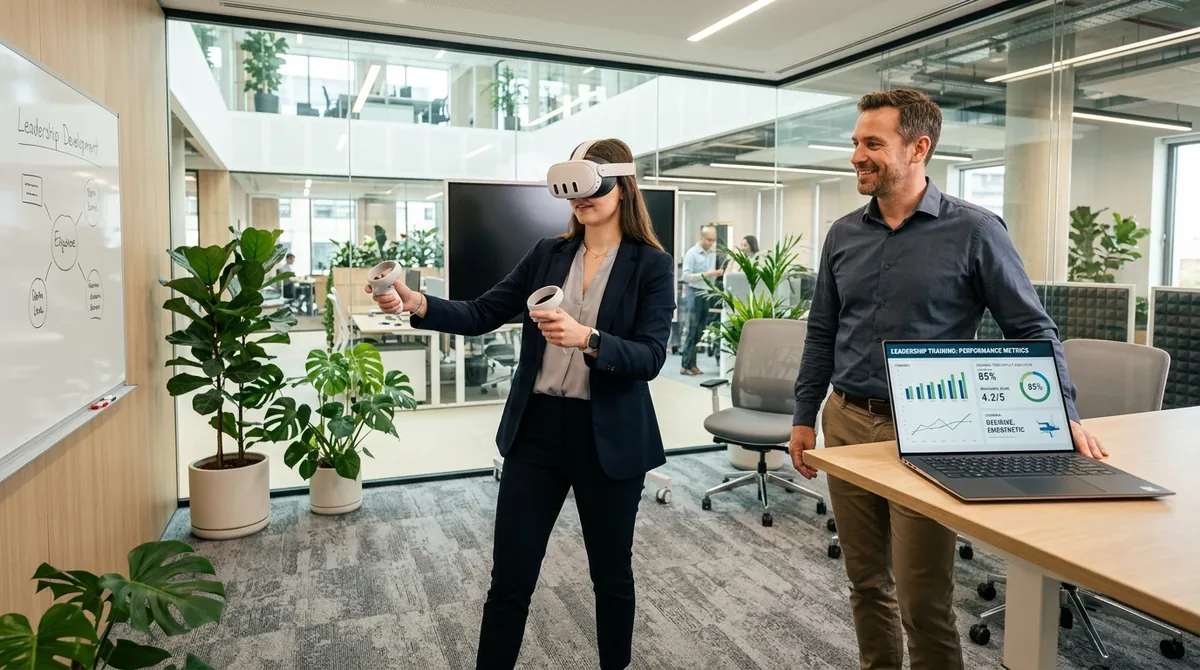
The companies above deliver frameworks and assessments. The Prime VR represents the immersive frontier: custom VR programs where managers rehearse feedback, coaching, conflict, and difficult conversations with virtual team members, and the system measures how they respond. Built around your real scenarios and values, it turns a one-time workshop into repeatable practice that holds up in the actual moment.
Explore enterprise VR training.
Matching Program to Level
Front line supervisors, mid level managers and executives have different needs. Choose accordingly.
Define target outcomes.
Application on the Job
Transfer improves with practice, coaching and manager support. Ask how the provider reinforces learning.
Plan follow up.
Measuring Results
Use 360 feedback, engagement and retention data. Set baselines.
Be cautious of unsupported claims.
Questions to Ask Providers
Ask about program design, facilitator experience and how behavior change is reinforced. Request references.
Pilot with a cohort.
Making Programs Stick
Pair workshops with coaching and on-the-job projects. Involve senior leaders.
Follow up.
Defining the Problem First
Leadership development is commissioned more often than it is specified, and programs bought without a defined problem produce satisfaction scores and no change.
The useful starting point is what leaders in this organization are failing to do, which is usually visible in retention, decision speed or execution quality.
First line manager capability, senior leadership alignment and executive development are distinct problems requiring distinct programs.
Content and Approach
Approaches range from competency frameworks and structured curricula to action learning, coaching and experiential formats, and they suit different problems.
Content built for large hierarchical organizations frequently does not transfer to smaller or flatter ones, and the reverse is equally true.
Programs should state what they assume about the operating environment, because that assumption determines whether the content is usable.
Transfer to the Job
Development that ends when the program ends produces no durable change, and transfer mechanisms are what separate programs that work from those that do not.
Manager involvement, structured application between sessions, peer groups and coaching are the mechanisms that produce transfer, and their absence should be treated as a warning.
The participant own manager is the strongest influence on whether new behavior survives, and programs that ignore that relationship rely on individual determination.
Assessment and Feedback
Multi rater feedback, behavioral assessment and structured observation each provide different information, and their quality and validity vary considerably between providers.
Assessment without a plan for how results will be used generates data that participants find intrusive and that changes nothing.
Confidentiality arrangements around assessment results should be agreed in advance, because participants who doubt them will not answer honestly.
Measurement
Programs should be measured on behavior and on organizational outcomes rather than on participant satisfaction, which correlates poorly with change.
Retention within participant teams, internal promotion readiness, engagement scores and execution measures are the indicators most organizations can actually obtain.
A baseline before the program is required for any of that to be meaningful, and it is the step most commonly omitted.
Questions Worth Asking
Useful questions include what problem the program is designed for, what transfer mechanisms are included, what the organization must supply and how outcomes will be evidenced.
Simulation and structured practice let leaders rehearse difficult conversations and decisions before facing them with their own teams.
Employment law, data protection and assessment related obligations govern parts of this, and applicable requirements should be confirmed with qualified advisors.
Common Mistakes and How to Avoid Them
Common errors include commissioning development without defining the problem, ignoring the participant own manager, running assessment without a plan for the results, measuring satisfaction rather than behavior and omitting a baseline.
Supervisors can help by making it acceptable to pause and ask. A culture where questions are treated as competence rather than weakness produces fewer errors in leadership development.
How Employers Evaluate Readiness
Organizations assess programs through retention in participant teams, internal promotion readiness, engagement and execution measures, and whether observable behavior has changed several months after delivery.
Keeping Skills Current
Organizational structure, strategy and leadership demands change. Reassessing what leaders actually need before renewing a program prevents developing capability the organization has moved past requiring.
Planning and Preparation
Preparation includes defining the capability gap with evidence, identifying the population precisely, securing the involvement of participants managers, baselining the measures that will be tracked and agreeing confidentiality around any assessment.
Documentation That Holds Up
Baseline and follow up measures, assessment records with agreed confidentiality terms, coaching and application records and documented behavior change observations are what demonstrate whether the investment produced anything.
Frequently Asked Questions
What is the best leadership training company?+
It depends on level and goal. Dale Carnegie and Blanchard are strong for frontline and new-manager skills, FranklinCovey for principle-based programs at scale, CCL for research-based executive development, and DDI for assessment-driven leadership and succession. These provide the frameworks and assessments. For the part leaders most need to practice, difficult conversations, feedback, and decisions under pressure, immersive VR adds realistic rehearsal, covered below.
Does leadership training actually change behavior?+
Leadership training changes behavior most when managers practice the hard moments and get feedback, not just learn models. The frameworks above set the foundation; the differentiator is rehearsal of real situations, a tough feedback conversation, a conflict, a layoff. That is why role-play and immersive simulation matter: managers build the composure and habits that hold up in the actual moment.
How does VR leadership training work?+
VR leadership training puts managers in realistic simulations with virtual team members where they practice feedback, coaching, conflict, and difficult conversations, and the system measures how they respond. Custom programs are built around your real scenarios and values, then owned and reused, turning a one-time workshop into repeatable, measured practice.
How can companies measure leadership training?+
Through feedback, engagement, retention and performance metrics over time.
Is online leadership training effective?+
It can be when paired with practice, coaching and application.
Let managers practice the conversation, not just read about it
We build custom VR leadership scenarios on your real situations and values. Tell us the moments that matter and we will scope it.
VR scenario designs related to leadership training
Proposed practice scenarios and checklist guides built around specific tasks. Each one lists what VR does not replace.
- Fire Service Leadership Training in VR: Scenario and Pilot
- Emotional Intelligence Leadership Training: VR Scenarios
- Police Executive Leadership Training: VR Scenarios
- Strategic Leadership Program in VR: Scenario and Pilot
- Health Care Leadership Training in VR: Scenario and Pilot
- Government Leadership Training: VR Scenarios for Teams