
Best Customer Service Training Companies (2026)
The leading customer service training companies range from classic methodology to online microlearning. This guide compares the top providers by what each is best for, then covers immersive VR for practicing the difficult interactions content alone cannot rehearse.
QUICK ANSWER
The best customer service training companies in 2026 are Dale Carnegie for interpersonal methodology, Service Quality Institute for structured service-culture programs, Bonfire Training for contact-center skills, Canity for online microlearning, and HSI for service content inside a broader platform. These deliver framework and content. For teams that must practice de-escalation and empathy under pressure with difficult customers, immersive VR (such as custom programs from The Prime VR) adds realistic, measured rehearsal.
The companies, and what each is best for
Dale Carnegie
Best for: Interpersonal and service-skills methodology
A long-established name in interpersonal skills, with strong programs for empathy, communication, and handling difficult customers.
Service Quality Institute
Best for: Structured customer-service programs
Dedicated customer-service training programs and materials used by service organizations to build a consistent service culture.
Bonfire Training
Best for: Call center and contact center skills
Focused on contact-center customer service and leadership, a fit for support and call-center teams.
Canity
Best for: Online microlearning for service teams
Bite-sized online customer-service courses, convenient for distributed or high-turnover frontline teams.
HSI
Best for: Service training inside a broader L&D platform
Customer-service and soft-skills content within a larger training and EHS platform for organizations standardizing at scale.
SPECIAL MENTION: IMMERSIVE TECHNOLOGY
The Prime VR, for VR customer service practice
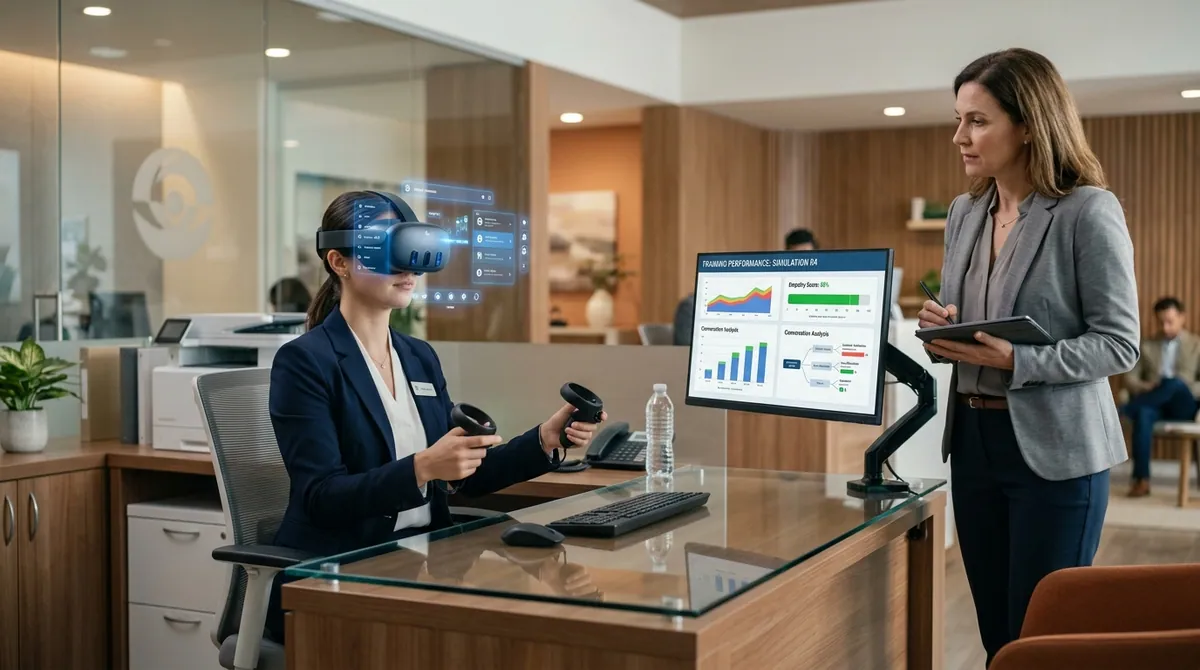
The companies above deliver methodology and content. The Prime VR represents the immersive frontier: custom VR programs where reps practice real interactions with virtual customers, de-escalation, empathy under pressure, complex requests, and the system measures how they respond. Built around your actual scenarios and policies, it turns the framework into repeatable practice that holds up with a frustrated real customer.
Skills That Matter
Empathy, communication, de-escalation and problem solving underpin great service. Programs should include practice.
Use call and chat examples.
Channel Coverage
Service happens in person, by phone, chat and email. Ensure training fits your channels.
Update for new tools.
Quality Assurance Links
Connect training with QA scoring and coaching. Consistent feedback improves results.
Track CSAT.
Questions to Ask Providers
Ask about role-play, customization and measurement. Check how the program supports your channels.
Talk to customers.
Reinforcement
Combine training with call reviews and coaching. Recognize great service.
Repeat refreshers.
Starting From the Service Failure
Service training is most often bought after complaint volume rises, and programs commissioned in that state tend to address tone while the cause sits in process.
The useful first step is analyzing where contacts fail, since the answer is frequently that staff lack authority or information rather than manner.
Training cannot resolve a structural failure, and spending on it in that situation produces politer delivery of the same unsatisfactory outcome.
Channel and Context
Service delivered by phone, chat, email, social and in person requires different skills, and programs built for one channel transfer poorly to another.
Contact center work, field service and retail counter service have different pressures, and generic content rarely reflects any of them accurately.
Evaluation should establish which channels and contexts a program was designed for rather than accepting that it covers service generally.
Content Worth Paying For
The content that changes outcomes covers establishing the facts, handling refusal, de escalation, recovery after failure and the judgment about when to escalate.
Scripted approaches produce consistency at the cost of the adaptability that difficult contacts require, and the balance should be a deliberate choice.
Programs should state what decision authority they assume staff have, because content that assumes latitude the organization does not grant will not be usable.
Reinforcement and Coaching
Service behavior decays quickly without reinforcement, and the team leader coaching capability is the strongest predictor of whether training survives.
Quality monitoring frameworks should reward resolution and customer outcome rather than adherence to a checklist, which otherwise drives behavior nobody intended.
Programs that leave coaching entirely to the buyer should be priced with the internal effort that implies rather than on the license fee alone.
Measurement
Service programs should be evaluated on resolution rates, repeat contact volume, escalation rates, customer satisfaction after contact and staff retention.
Baselines before delivery are required for any of those to mean anything, and in this category they are usually available because the measures already exist.
Staff turnover is both an outcome and a constraint, since a program with a long ramp is poorly suited to a high turnover environment.
Questions Worth Asking
Useful questions include which channels the content was built for, what decision authority it assumes, what reinforcement is included and what the buyer must supply.
Simulation and structured role practice let staff rehearse complaints, refusals and de escalation before handling live customers.
Consumer protection rules, data protection and sector specific regulation govern parts of service delivery, and applicable requirements should be confirmed with qualified advisors and the relevant authorities.
Common Mistakes and How to Avoid Them
Common errors include buying training to solve a process problem, using content built for a different channel, assuming decision authority staff do not have, omitting team leader coaching capability and measuring satisfaction with the course rather than with the service.
Supervisors can help by making it acceptable to pause and ask. A culture where questions are treated as competence rather than weakness produces fewer errors in customer service training.
How Employers Evaluate Readiness
Organizations assess programs through resolution and repeat contact rates, escalation volume, customer satisfaction after contact, quality monitoring results and whether staff retention improves in the trained population.
Keeping Skills Current
Products, policies, channels and customer expectations change. Reviewing whether content still matches what staff are permitted and equipped to do prevents training against a service model that has moved on.
Planning and Preparation
Preparation includes analyzing where contacts currently fail, confirming what decision authority staff hold, baselining resolution and repeat contact measures, identifying the channels in scope and securing team leader involvement in reinforcement.
Documentation That Holds Up
Baseline and post program service measures, quality monitoring records, coaching records and completion and assessment data are what demonstrate whether the program changed service rather than only satisfied participants.
Frequently Asked Questions
What is the best customer service training company?+
It depends on need. Dale Carnegie leads for interpersonal methodology, Service Quality Institute for structured service-culture programs, Bonfire Training for contact-center skills, Canity for online microlearning, and HSI for service content inside a broader platform. These deliver the framework and content. For teams that need to practice real interactions, de-escalation, empathy under pressure, difficult customers, immersive VR adds realistic, measured practice, covered below.
Does customer service training improve outcomes?+
Customer service training improves outcomes most when reps practice the interaction and get feedback, not just learn principles. Methodology and content set the foundation; the differentiator is realistic rehearsal of tough moments. That is why role-play and, increasingly, immersive simulation matter: reps build the composure and reflexes that hold up with a frustrated real customer.
How does VR customer service training work?+
VR customer service training puts reps in realistic, interactive simulations with virtual customers where they practice de-escalation, empathy, and complex requests, and the system measures how they respond. Custom programs are built around your actual scenarios, products, and policies, then owned and reused with every new hire, turning the methodology into repeatable practice rather than a one-time workshop.
What skills should customer service training teach?+
Active listening, empathy, clear communication and problem resolution.
How can training improve CSAT?+
By building consistent skills and giving reps practice with real scenarios.
RELATED ARTICLES
Let reps practice the hard conversation safely
We build custom VR customer-service scenarios on your real situations and policies. Tell us the moments that matter and we will scope it.
VR scenario designs related to customer service training
Proposed practice scenarios and checklist guides built around specific tasks. Each one lists what VR does not replace.
- Courses on Customer Service Management: VR Scenarios
- Customer Service Communication Training: VR Scenarios
- First Class Customer Service with VR Practice Scenarios
- Customer Service Manager Training in VR: Scenario and Pilot
- Customer Service Training Material in VR: Scenario and Pilot
- Customer Service Training Activities: VR Scenarios
- Customer Service Sales Training: VR Scenarios for Teams